


VegNET NSW: From lab to land – researcher connections
8 September 2025
VegNET Vic: Vegetable farmers invest in the next generation with Lean Leaders
8 September 2025
Reading Time: 5 minutes
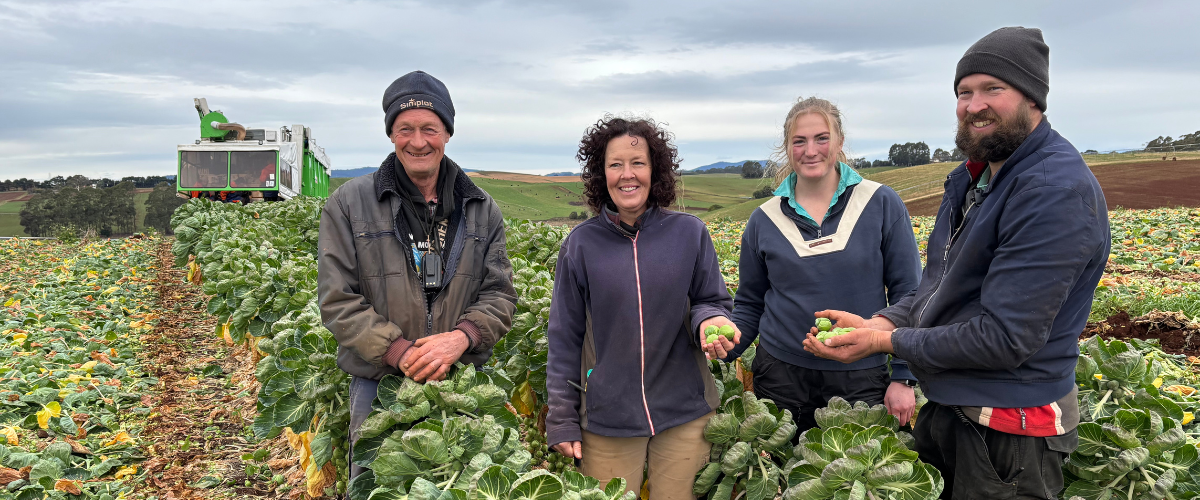
 In 2000, Johan and Nathalie Wolfert made a big decision to sell their farm in the Netherlands and move to Tasmania. After initially looking at Canada as an option and realising the short growing season would be too challenging, Tasmania was recommended for its fertile red soils.
Within two days of selling their property in the Netherlands, the Wolferts had secured their first block of land in Kindred, North West Tasmania – a 90ha farm, Kindred Downs, with a secure water supply.
Johan explains that Tasmania was chosen because of climate and opportunities to grow vegetables and other crops like poppies, pyrethrum and cereals. The rules in the Netherlands were increasingly pushing strongly towards organic farming, and finding labour was extremely hard.
Laying roots in Tasmania
Not long after settling in Kindred, they found that making a profit through vegetable production on the land they had was becoming an increasing challenge and an opportunity arose to expand, purchasing the neighbouring property which had significant water access. Since 2001, they have been growing Brussels sprouts, holding contracts with Simplot Australia and McCain Foods.
Brussels sprouts are known to be a challenging crop due to their long growing season (6-9 months depending on the variety) and high desirability to bugs including aphids, grubs, slugs and snails – which in turn makes the plant susceptible to fungal disease. Given their background as orchardists in the Netherlands, the Wolfert’s were up for the challenge.
In their first couple of seasons of growing sprouts, Johan admits that “returns were not good enough to be viable, so things had to change.” Twenty-five years on, the Wolferts have become true specialists in Brussels sprouts, which is their main crop by value. They are one of three commercial growers left in Tasmania, producing over 400 tonnes (give or take) across 14 hectares and continue to sell to processor, Simplot Australia, for the frozen vegetable processing market.
Their sprout specialisation is an ongoing learning journey and with the right crop management and varieties, the crop provides the Wolfert’s business with sufficient balance of risk and return.
Key crop management practices:
- Careful and consistent crop monitoring throughout the growing season, working closely with their agronomist, Emily Nellis of Merry Ag
- Timely spraying to keep on top of pest and fungal pressure
- Consistent watering and nutrition to maintain healthy plants
- Avoiding early planting to avoid excessive insect pressures
- Managing crop rotations to ensure sprouts are never planted following a potato crop to help manage volunteer potatoes and soil health, avoiding two heavy crops in a row
Choosing the right varieties
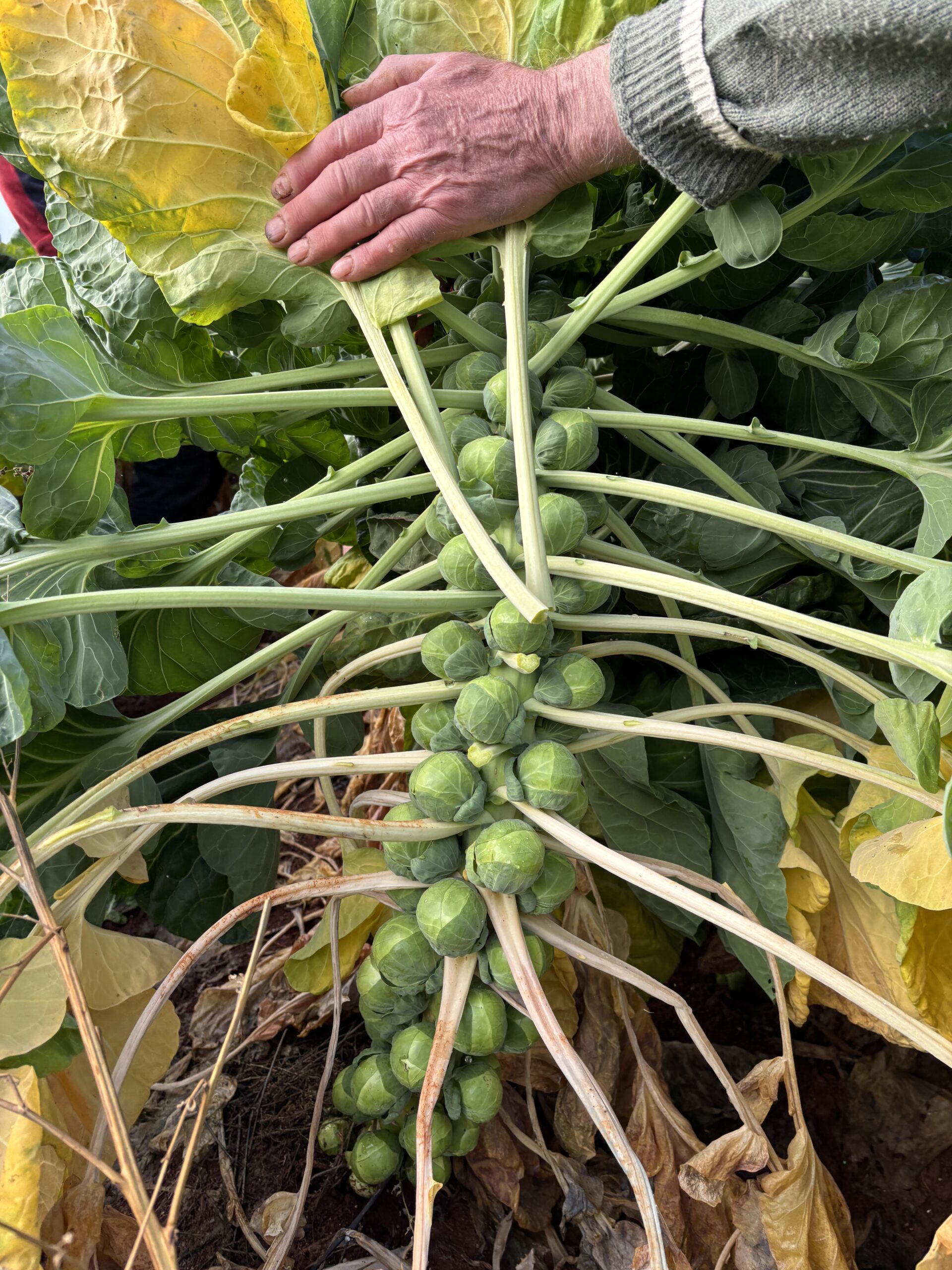 A key milestone for the Wolferts has been gaining the ability to choose their own varieties — a decision usually made by the processor. This reflects the trust they’ve earned and their ongoing commitment to improving quality and yield. Much of their learning has come from grower and factory tours in the Netherlands, Belgium, Canada and Australia, which they’ve then adapted for Tasmania’s soils, landscape, and climate.
This personal investment in R&D has paid off. In 2005, their yield jumped from 17 to 28 tonnes per hectare, and consistently thereafter, mainly due to new varieties.
Twenty-five years on, we’ve become true specialists in Brussels sprouts — proof that with persistence and the right mindset, even the toughest crops can turn into success.
The Wolferts have trialled a range of Brussels sprouts varieties to find what performs best in their growing conditions and suits the frozen vegetable processing market. They start small, planting a tray of around 250 plants to see how the new variety handles their soils, climate, and harvest timing. If it looks promising, they’ll ramp up to around 1,000 plants the following season, building from there based on further results.
For the 2024/25 season just harvested, they grew varieties from seed companies Bejo, Syngenta and Claus. The mix of varieties, grown by transplants from Hills Transplants, allows for staggered planting and harvesting — enabling their small team to harvest each variety at its optimum.
Investment and diversification for the future
Johan and Nathalie’s son, Yuri, has long been an integral part of the family business and has now taken on the management of Kindred Downs. While his parents remain actively involved, they are gradually stepping back from daily operations. Yuri brings valuable experience from years farming in the North West, time spent in the Netherlands working with leading harvester manufacturer Tumoba, and participation in several study tours and trips abroad.
This season, the Wolferts invested in a reconditioned Tumoba three-row harvester from the Netherlands, now affectionately known as ‘Sprout’. It’s the largest Brussels sprout harvester in the Southern Hemisphere, with a 10-tonne (26-boxes at 400kg) bunker capacity. This is a big leap from their older machines, which held just 4.5 and 4 tonnes respectively, and one of which is co-owned between Yuri and another grower also growing for Simplot Australia.
Despite Kindred’s hilly terrain compared to the flat fields of the Netherlands, ‘Sprout’ has been handling the slopes well with only minor adjustments needed. They consider this an important long term investment for their business, with significant gains to labour and harvesting efficiencies. However, one challenge anticipated is the expected drop in volume for the coming season due to a major Australian retailer importing sprouts from overseas.
In addition to sprouts and other vegetables, Yuri and his partner Sarah have recently diversified the business by establishing a seed cleaning operation. This move came after the closure of a local contractor in Ulverstone, which forced the Wolferts to haul seed over an hour from the farm to Carrick — but transport costs soon made this impractical. When the Ulverstone contractor’s equipment came up for sale, they took the opportunity and began cleaning their own seed, including lupins, wheat, and cover crop seeds — all grown on the farm, much of which they sell locally.
Word soon got around, and neighbouring farmers started bringing their seed for cleaning. With many Tasmanian growers currently shipping seed to the mainland due to limited local options, Yuri sees potential to expand their service, particularly in the North West.
“It’s not just about cleaning seed,” he says. “It’s about solving problems.” They now operate two machines and are planning to scale up for the coming season.
The Wolferts have been actively involved in levy-funded projects, including VegNET Tasmania, PotatoLink, and Soil Wealth and Integrated Crop Protection, and have also taken part in the Resilient Farming Tas program—led by RMCG and Optimum Standard—which helps farmers build resilience in their businesses.
FIND OUT MORE
Contact Prudence Rothwell, Regional Support Officer, RMCG, 0477 182 408 prudencer@rmcg.com.au
Tayla Field, Regional Development Officer, RMCG, 0429 391 538 taylaf@rmcg.com.au