


Smarter water and nutrient use in capsicum: Bundaberg trial moves into second season
9 December 2025Securing the future of crop protection
9 December 2025
Reading Time: 4 minutes
The project was born out of necessity with tightening margins and businesses seeking greater support on cost control and analysis to position vegetable and onion businesses to remain competitive.
The project is led by Planfarm and supported by RMCG and was introduced in 2023. For participating growers, it provides $10,000 in consulting services annually over five years to participating vegetable and onion growers for targeted business consultancy advice aimed at improving the income earned by those farming enterprises.
The value that individual businesses gain from being in the program is a deeper understanding of their business cost structure and where to better allocate resources to strengthen margins and set their business up for success.
In its second year the project has seen a substantial rise in grower involvement with participants farming over 5,500 hectares of vegetables and onions nationally as growers realised the benefits of business benchmarking.
Getting on board with Level Up Hort
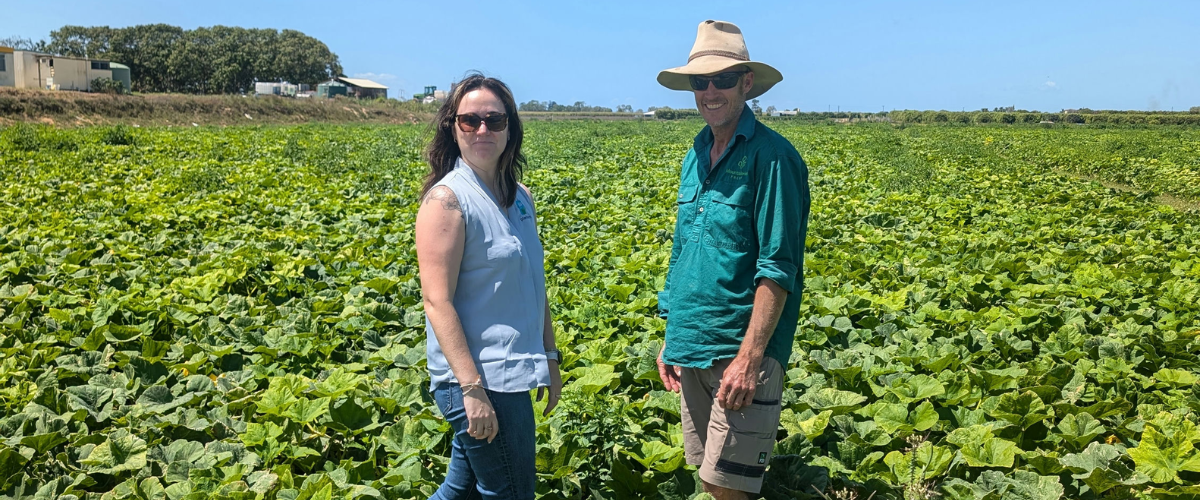
One of them is Burdekin vegetable and melon grower Chris Lyne from Mountainview Fresh Farms, who has been working with Planfarm horticultural business consultant Maria Fathollahi, based in Bundaberg.
Mountainview Fresh is a small to medium business. It has three equal shareholders, two based in Brisbane, and Chris managing the day-to-day operations. They started the operation five years ago, when none of them had been involved in horticulture, although Chris had worked in farming prior to this, mostly in cotton production.
“I’ve done probably 25 years in the ag sector, I went to an agriculture school and university, but never actually anything in horticulture,” said Chris.
The business has about 70 hectares under horticulture production, growing around 700 tonnes of pumpkins, as well as watermelons, and some sugarcane production.
After five years of doing, as Chris described it “not too bad”, Chris and his partners decided to take advantage of what the Level Up Hort project was offering, a decision based on Chris’ experience working in cotton production.
Benchmarking the key
“I suppose from a cotton background we’d gotten quite good in the benchmarking. Everything is shared in the cotton industry and there’s big meetings where the benchmarking groups all get together and share the numbers.
“So when I moved up here, we were searching for some benchmarking that was at the same level as the cotton industry. We tried quite a few different benchmarking groups and organisations, but whilst you had to crunch numbers you just didn’t actually understand what those numbers meant, and it didn’t tie it all together and help make good decisions.”
Based on that experience Chris was not so sure Level Up Hort would offer anything more. He was pleasantly surprised.
“I think it was evident from the first half hour of working with Maria that she actually understood, what the numbers meant, and some of the decisions that you can make based off those numbers.”
Mountainview Fresh Farms may not be as large-scale as some, including some who are part of Level Up Hort, but Maria said there is room within the project’s scope for farms of all sizes.
Providing business clarity
The Maria referred to here is Maria Fathollahi, who is a Horticulture Business Consultant with Planfarm, based in Bundaberg. “I think he wanted clarity,” said Maria.
“Like for many other growers, labour, I would say, was probably at the forefront of his mind. He would keep talking about understanding how his efficiency stacked up not only against others in the industry that grow similar crops, but how it impacts his own business.”
So when a farm decides to be part of Level Up Hort, and that initial meeting is held, what information are Planfarm’s consultants looking for?
“We always begin with the numbers,” said Maria.
“Production, what sort of income has come in and out of the bank and labour costs, and that sort of forms the baseline for what we try and build up. Real value then comes from when you sit down with the grower and turn those numbers into something more meaningful.
“I always like to say we don’t like to drown in spreadsheets; that’s my job. But it’s about defining clarity. I always like to focus on things like, what are the pressure points in the business, and what sort of practical steps can they take? So shifting the conversation from analysis paralysis to a bit more action on farm and what can we do at the same level to shift the needle?”
Embracing increased efficiency
For Chris being part of Level Up Hort has provided a clear path to becoming more efficient as a business.
“We had this massive to do list. The three of us would get together once a year. But it was mainly just filling them in on how the year went, more than actually deciding where the business went. Nothing really got decided, and you weren’t being held accountable. We actually thought we needed a CEO to start to chip away at that list.
“Now we meet face to face quarterly and catch up once a month. So we started making decisions and being held accountable for those decisions. Our to-do list diminished quite quickly. So just being able to make decisions and then if you’ve got an idea, as Maria says just run the numbers on it so you can decide if it’s actually worth doing or not.”
Already being used in on farm decision making
That approach has paid off on the farm.
“We’ve made the decision to not do winter watermelons this year because of some disease pressure. I think, previously, we probably would have just said, yeah, we know the disease pressure was going to be there, but we probably would have said let’s just scramble, and hopefully the market will respond. But after crunching those numbers it was a waste of time.
Maria said one of the biggest revelations for her and Chris and his partners, was the realisation that profitability is not always about spending less.
She comes back to clarity saying, “I think in Chris’s instance, it was a very powerful mindset change, and the way they approached things, not only at the board level but operationally on the farm.
“They have come miles in their progression from when we first started. Like Chris mentioned, the planting of watermelons in winter. All those decisions have been made with that powerful mindset change. But they’ve allowed them to happen.”
“Whether you’re farming 20 hectares or 200 hectares, I think every grower can benefit from actually understanding what’s happening on their own farm. We certainly, are starting to see some trends coming through. What the data has shown us is that those within the top performers, they know the numbers inside out. They’re intentional with how they spend, know the costs on their farms, and try and squeeze the most value out of every impact.
“It’s not about, the size of the farm or the type of crop or even the location that it’s grown in. We see profitable, resilient businesses across the board.”