


Video: 2025 Onion Study Tour to the United Kingdom and The Netherlands
9 December 2025VegNET Tas: From root causes to rotations – Practical approaches to integrated weed control in Tasmania
9 December 2025
Reading Time: 3 minutes
In vegetable production areas where soil is of poor quality or if properties are rented, growers tend to invest in relocatable infrastructure like hydroponic benches and basic pump systems. Kim Ngov’s new hydroponic system has attracted interest from other members of the Australian Cambodian Growers Association. VegNET NSW Regional Development Officer Sylvia Jelinek organised a study tour to visit a hydroponic lettuce farm and a vegetable production nursery, to offer growers the opportunity to learn about growing vegetables in Nutrient Film Technique (NFT) systems.
The journey from soil to solution
VegNET NSW Regional Development Officer (RDO), Sylvia Jelinek, and the team at Greater Sydney Local Land Services (LLS) have engaged with the growers from the Australian Cambodian Growers Association of NSW since the inception of VegNET in 2016. The growers are on a long-term soil improvement journey with activities like soil testing, adding soil amendments and compost, trialling cover crops, and other topics like plant health and pest and disease identification and management. Recently the focus has been shifting due to changing land use and finding rental properties suitable for longer term farming. The new Western Sydney International Airport is affecting land availability, so growers have less incentive to improve soil structure and health. The land that is available has poor quality soil not suitable for vegetable production. However, it can still be used for hydroponic production, is still close to markets and to the growers’ homes. Another advantage is a hydroponic system is modular, portable and relocatable, should the grower need to move farms again.
One grower, Kim Ngov, has taken a particular interest in soil health improvements on his farm in Wedderburn, NSW. Kim was seeing the benefits of using cover crops and compost with improved soil structure and weed suppression resulting in better crops of snake beans, chillis and snow peas. He also worked closely with the team from the Soil Wealth Integrated Crop Protection project (Hort Innovation project MT22004). As a respected member and influencer within the Australian Cambodian Growers Association of NSW, Kim’s farm was well-positioned to serve as a demonstration site for the group. In addition to his work with soil health, Kim also had a strong interest in protected cropping. He regularly attended Protected Cropping Australia events and was passionate about growing basil hydroponically in a greenhouse environment.
Rooted in resilience
A grower’s transition to NFT hydroponics
In 2023, Kim vacated his rental property in Wedderburn and returned to his family’s property in Kemps Creek, NSW. Unfortunately, much of the property was not suit- able for field grown vegetables due to poor drainage, subject to flooding and high salinity levels. Given these challenges, Kim opted to transition from traditional soil-based farming to hydroponics, drawing on his previous success growing basil in protected cropping systems.
At the new farm, weed matting was laid under the benches for weed suppression and still maintaining soil aeration. Nutrient Film Technique (NFT) benches were installed to support the new hydroponic systems. The space was organised into bays, each equipped with a 1000L tank to capture runoff from the crop. Each tank has a small submersible pond pump, used to recirculate the solution. This modular setup helped reduce installation costs and minimised crop loss in the event of a pump failure and are relatively inexpensive and widely available at major hardware stores.
Moving forward
Strengthening grower networks through regional study tours
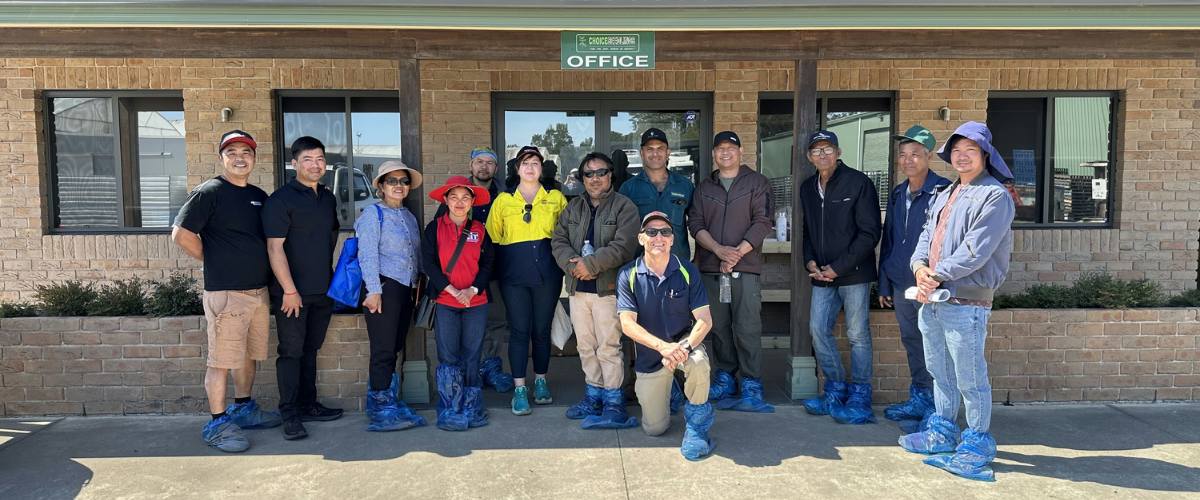
In a venture to inspire the rest of the growers, VegNET NSW organised a bus tour of NFT hydroponic enterprises in Southwest Sydney in September 2025 to show other NFT systems, good growing practices and motivate those still growing in the ground to convert to protected cropping. This bus trip was also supported by Greater Sydney LLS’ WaterWise project, funded by the Australian Government’s National Heritage Trust Capacity Building Grants being led by Matthew Plunkett from Greater Sydney LLS and a veteran of the VegNET NSW team. Twelve growers visited Choice Seedlings nursery and were kindly welcomed by owner Jeff Borg, who showed them around and openly chatted about systems, growing, infrastructure and irrigation. The day continued with lunch and a visit to a hydroponic lettuce farm in Pheasants Nest, where the growers could piece together the intricacies of a completely different growing system that they are used to.
Following the Southwest Sydney NFT study tour, two participating growers also joined WaterWise a study tour for North Coast and Greater Sydney growers and irrigators to Northern NSW and Queensland. Sponsored by VegNET NSW, the tour took place in October and attracted 20 growers and agronomists.
Key highlights included visits to the NSW DPIRD Wollongbar Primary Industries Institute and Queensland DPI Gatton AgTech Showcase and several impressive farms along the way. The tour was organised and led by Ewan Leighton, Senior Land Services Officer, from North Coast Local Land Services and Matthew Plunkett.