


VegNET SA: South Australian growers connecting, learning, and bringing new ideas home
9 December 2025
VegNET VIC joins the Winter Warmers program
9 December 2025
Reading Time: 3 minutes
VegNET Western Australia recently hosted an information session to consider practical assistive AI applications for vegetable growers.
Presentations on artificial intelligence (AI) in accessible technology for horticultural production were a highlight of the evening, starting with an introduction to how AI is being used in vegetable production and how growers can be part of new opportunities for investment and development, with live demonstrations of hort business scenarios.
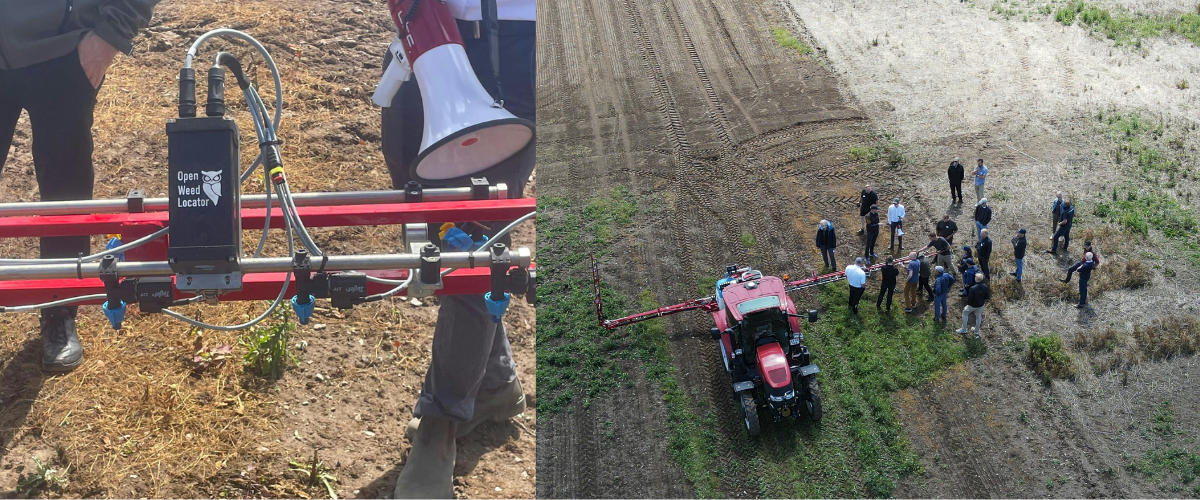
Jake and Mitch from the Warren Cauliflower Growers Group then shared their work with the Open Weed Locator (OWL) — an open-source, AI-powered camera system that detects and sprays weeds.
When one of their main herbicides was taken off the market, Jake began looking into robotic weeders but found commercial options too expensive. “Most of them were over $250,000, plus you had to pay ongoing subscription fees,” he said. “So, we started looking for something more practical.”
They came across OWL, developed by Dr. Guy Coleman from the University of Copenhagen, which uses freely available open-source software. The group decided to build their own version based on the same model. The OWL system uses a small camera and computer — costing about $1,200 — to detect weeds in the paddock and trigger a spray nozzle only when needed.
“It’s basically a smart spot sprayer you can build yourself,” Jake explained. “It’s simple, affordable, and you own it — no subscriptions and no lock-ins.”
Jake, Mitch, and 10 other growers from the Southwest built their first cameras during their visit to Copenhagen, learning how to assemble and calibrate them with guidance from Dr Coleman. “You don’t need to be a tech expert,” Mitch said. “If you can fix a pump, you can build one.”
The group is now working on ‘green-on-green’ weed detection, which allows the AI to recognise weeds growing among crops. This work depends on creating a large photo library of labelled weed images, which will be developed and shared through a public weed library seed-funded by VegNET. The aim is to make it accessible nationally with further investment.
Their goal is to create an affordable system that costs under $50,000, built entirely on open-source software that growers can adapt for their own farms. “It might not be perfect,” Jake said, “but it’ll do the job — and we’ll be the ones in control.”
Local innovation and shared learning
The OWL presentation sparked plenty of conversation about local innovation and how Western Australian growers are finding ways to lead the charge. The presenters were open about what had and hadn’t worked — from testing different camera angles and lighting conditions to experimenting with spray nozzles.
Growers appreciated seeing something that was achievable and practical. “It’s great to see technology that actually fits the scale of our farms,” one attendee said.
The group also reflected on what they had seen during their study tour of Denmark. A photo of a deep, dark soil profile sparked discussion about how local growers have learned to manage shallower, sandier soils differently. “We’ve had to learn biology instead of relying on fertiliser,” one grower said. “That’s something we’re already good at.”
The evening showed that while conditions vary from country to country, the willingness to share and adapt ideas is what drives progress.
Keeping AI practical
A panel session at the end of the evening brought together growers to discuss how AI fits into modern horticulture.
The message was consistent — technology needs to make life easier, not harder. “If it doesn’t save time or fit in with how we already do things, it’s not much help,” one grower commented.
There was strong support for keeping AI practical and grounded. Growers agreed that systems should work with what’s already on-farm, not require major changes. Data ownership was another key point, with participants saying that growers should have full control over their own information.
The discussion also highlighted the potential of open-source projects, where ideas and tools can be shared freely to reduce costs and duplication. Many agreed that the same AI tools could benefit other crops beyond vegetables, with applications across fruit and broadacre farming as well.
As one attendee summed up, “You can’t outsource common sense. AI can do the maths, but it doesn’t know what your paddock looks like after rain.”