


A levelling consideration: Stay the course or transition your business
2 March 2026Australian onions: From pantry staple to flavour obsessions
2 March 2026
Reading Time: 4 minutes
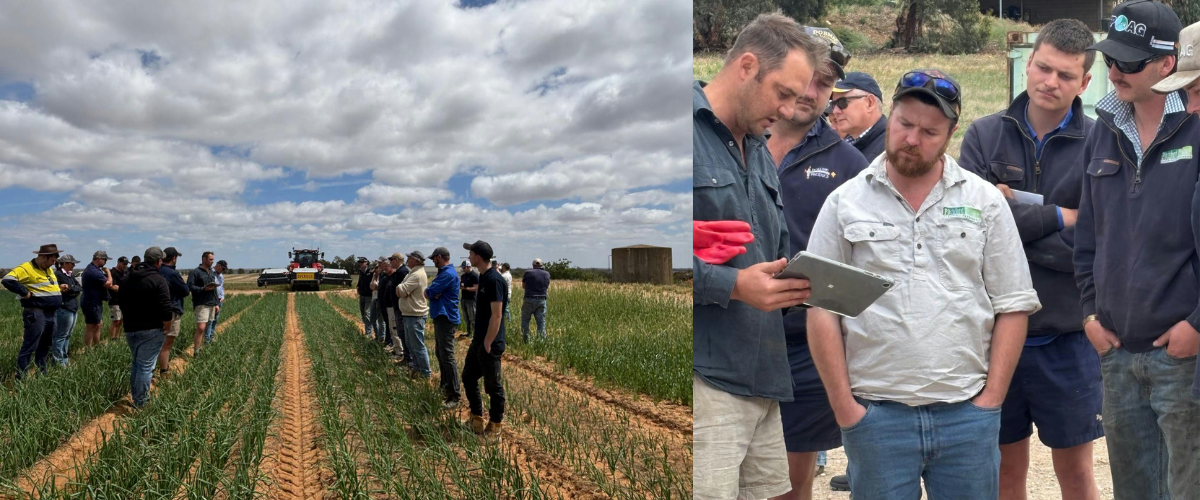
In October last year, James Smith from Bowhill Produce in South Australia began trialling an Ecorobotix ARA 620 UHP Sprayer equipped with Plant-by-Plant™ Artificial Intelligence on his onion crop, through the VegMech project. He shared his experience with the ultra-high precision sprayer at a field day organised by VegNET and the Queensland Department of Primary Industries, with local growers able to see the machine in action.
Where are you based and what do you grow?
“We’re at Bowhill on the Murray River, near Murray Bridge, so about an hour east of Adelaide.
“My grandfather bought the farm in the mid-1960s, and we’ve grown onions since then, and in the last decade we’ve also grown carrots. We also do some broadacre cropping. It’s a family run operation. My father took over from grandpa back in the 90s. I’ve been back on the farm for 12 years or so now, and work with dad.”
Can you tell us about the machine you are running trials with and how it works?
“It’s an Ecorobotix ARA Sprayer.”
“There’re cameras which identify what is a crop and what is a weed. Then, depending on what you tell it to do, it will target that specific plant. So, if you’re wanting to target grass in a crop, you set it with the algorithm to target specifically grass in an onion crop, or cabbage or whatever you’re growing. If you want broadleafs targeted, you can do that.
“If you want to target just the crop with a fungus or nutrient, or something like that, it has the ability to do that too.”
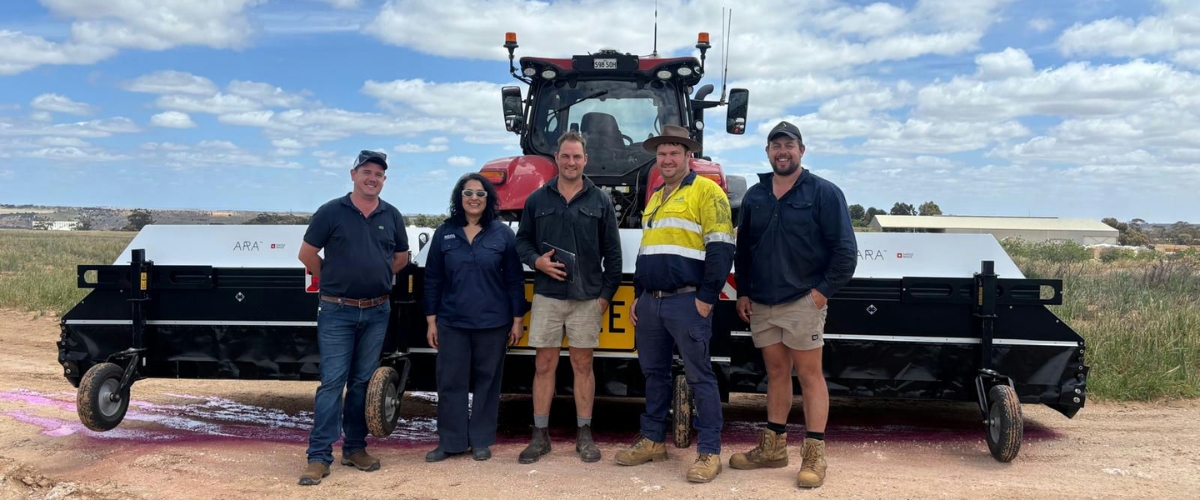
Ecorobotix Sprayer demonstration at Bowhill Produce.
How easy is it to set that programming?
“That’s the benefit of it. I think it’s very user friendly. You don’t need to be that tech savvy. Most farmers now have some technology skill because there’s a lot more creeping into our industry, but it’s very user friendly. So, all of the high-end technical stuff you don’t really need to know.”
How did you become part of the trial of this program?
“I got a text from AUSVEG, as did other growers in my area, calling for expressions of interest to trial it. I responded expressing interest as I’ve been looking at this sort of technology for a while.”
What has your experience with it been like?
“So along with AUSVEG and the Queensland DPI as part of this I’m obligated to perform a trial as a comparison against conventional methods. So, I selected a one-hectare block for conventional spraying methods, next to a one-hectare block for the spot sprayer.
“The area I did with the conventional sprayer with conventional chemical rates and everything I would do normally before this technology, I didn’t actually get weed control for a start. There were a lot of weeds that escaped, which means you’re going to lose yield for a start, and lose quality. And the rates you’re actually using in carpet spraying will probably reduce yield and quality as well. The crop’s still growing so we’re still to finally analyse that.
“Where I used the spot sprayer, it was clean as you’re not spraying the crop itself, you’re just targeting the weeds, and the chemical savings are huge. Initially you’ll get savings in your first application or two, but if you’re having to go in again, your savings are more. The results were chalk and cheese.”
So, it works best when the crop is relatively new?
“It can identify weeds from 2mm I’m told, so you can go in earlier. Because if you’re trying to go in with a conventional sprayer you have to wait for the crop to get to a certain stage so that it can survive the herbicide you put on, so it doesn’t stunt it too much.
“But with this you can go in earlier and you can go with much higher rates because you’re just targeting the weed. The downside is that when the crop’s a bit older, if you’ve got anything that has escaped, you can’t really use it for that.
But you’re probably not going to have that weed burden late in a crop, because if you’ve used it properly, you’re going to be on top of it all the time.”
You hosted a field day last year for local growers. What was the response from them?
“All positive from what I’ve heard. The retailer who we got it through, the Queensland DPI and AUSVEG all came back to me with very positive feedback. The growers who were there asked a lot of questions and are all very interested from what I gathered. I just think it was an overall good day.”
“The retailer was just excited that we could get a commercial size trial for growers to see it firsthand. People will see this machinery at other field days, but to see it on a farm working, where the growers were looking to buy it, were going to use it, it’s just a really good opportunity for them.”
This seems to be a growing area of technology. As a grower, can you see machines like this becoming more commonplace in the years ahead?
“Absolutely I think it will be. From what I hear from other growers who have been lucky enough to travel to Europe and America, this sort of technology seems to be already there. They might be a bit ahead of us, so I don’t see why we wouldn’t follow suit. The chemistry we’re able to use is expensive, but also things are getting taken off as available to use. Anything that can create efficiencies and better results is definitely going to be palatable for growers going forward. I think definitely in the next five years to 10 years, things like this will be very common.”