


Australian onions: From pantry staple to flavour obsessions
2 March 2026From review to action: Setting the next chapter for onion crop protection
2 March 2026
Reading Time: 5 minutes
For Lockyer Valley onion growers Lynette and Glenroy Logan, the 2025 onion study tour to the United Kingdom and the Netherlands was an opportunity not to be missed. “We’ve always grown onions, and Glenroy is very good at producing a good quality product,” Lynette said.
“So, the onions were a thing for us to be following. We’ve always wanted to go overseas to see farming more than going to cities, so it suited us to go and see what they had over there.”
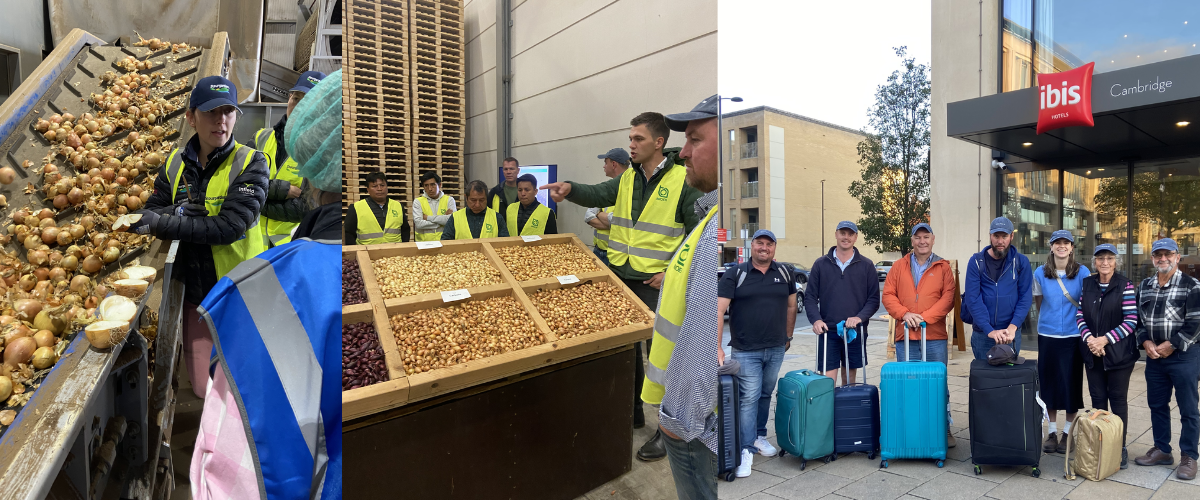
Study tour group
Funded by Hort Innovation (Project VG23002), the tour was one of a number of vegetable and onion industry study tours with the purpose of providing opportunities for growers and supply chain businesses to increase their awareness and knowledge of the research and innovations in the global horticulture industry. This is achieved through visits to strategic vegetable and onion growing regions, conferences, facilities and innovation centres around the globe.
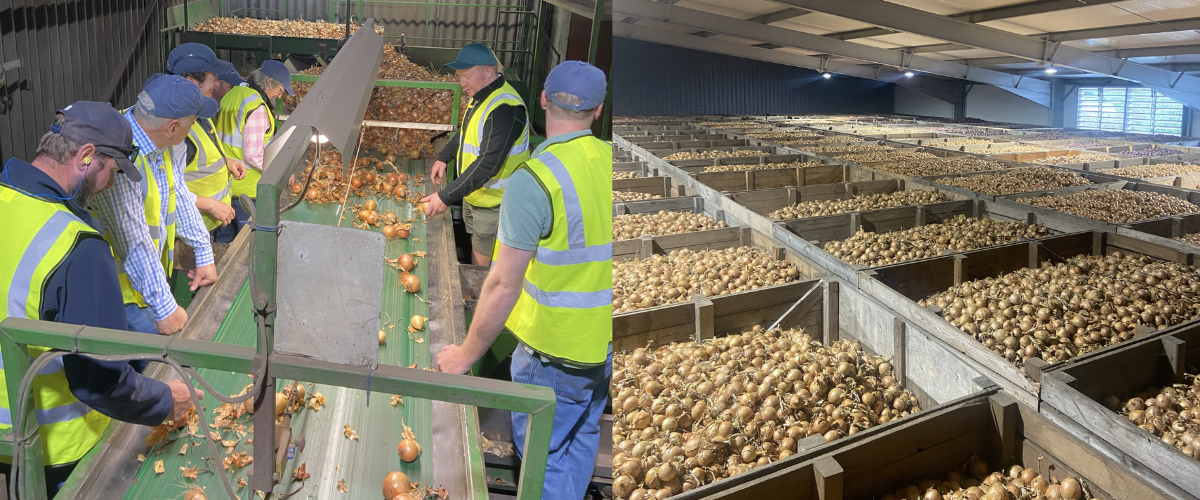
This tour provided the opportunity to see a diverse range of onion-focused businesses, ranging from growers, packers, machinery manufacturers, seed companies and research organisations. The UK and the Netherlands are at the forefront of implanting new technology to increase automation, reduce labour costs, increase efficiency, improve disease management and incorporate digital technologies and AI.
Scale of operations
Both countries are powerhouses of onion production, and the scale of that production was something the Logan’s noticed immediately.
“Just the size of the operations,” Lynette said.
“We didn’t see so much big farms, but we saw big grading facilities, and they had a lot of farmers growing for them and working to produce and send all around the world. I was amazed at the size of the sheds, the size of the packing lines, and they didn’t just have one grading machine, some of them had four or five or six machines doing the job.
“Everything’s mechanised. And the pack houses themselves are getting to the stage of having limited staff, with robots taking over all the packing roles.”
What the Logans saw in Europe is strikingly different to their Lockyer Valley operation.
“We’re long-term farmers in the area,” Glenroy said.
“My great grandfather came out from Scotland in 1860. In 1869, he selected 300 acres (121.4 hectares) of land here, and we’re still farming most of that today.
“I started farming in 1979 with my father, and [when] he passed away in 1999, we took over the farm and [have] been here ever since. 156 years of Logans have been on this property.”
In that time the Logans have witnessed firsthand the changes in how farming is practiced.
“You’d be able to drive from here to Gatton, and there’d be twice as many farmers out there as what there is today. The bigger boys have bought up a lot of farms,” Glenroy said.
As well as onions, the Logans grow potatoes, pumpkins, lucerne and beetroot, also trying out some other specialist crops too.
But onions remain a major part of the mix. Lynette pointed out, with some pride, that Glenroy is “very good at growing onions”.
The Logans decided that seeing how the crop is grown on the other side of the world was too good an opportunity to miss.
“We saw five of the biggest producers and handlers of onions in the Netherlands and the UK,” said Glenroy.
“It was just phenomenal that for one packing shed just 20 percent of their onions were sold in the Netherlands. The rest was all exported all around the world.
“They’re in a pretty good place where they are, because container ships going backwards and forwards pass them the whole time. One company told us they’ve worked out it costs just five cents a kilo to send their onions around the world to most of their markets.
“They’ve got the finances and everything worked out really well.”
Glenroy believes much of what they saw would work in Australia, but not at the scale it does in Europe.
“Honestly any of it would work here, but it’s on such a grandiose scale over there. Like, we would just want one of those grading sheds to cover everything in Australia.”
“You’re looking at about half a million tonnes of onions being packed over there and sent around the world. We don’t compare to anything like that, so most of it could be introduced here, but on a very small scale,” Lynette added.
EU chemical limits
For the tour group there was special interest in how growers in the UK and the Netherlands are controlling weeds and insect pests. There are major restrictions on chemical uses in the European Union which has led to some creative solutions to find alternatives. For Australian growers there are concerns that those EU restrictions will be enforced here in the future, which will end access to the chemicals they rely on to farm effectively.
“There’s companies and farms over there working on different aspects of how they treat their ground,” Glenroy said.
“More, I guess, organic ways of farming.” “We did see a couple of things,” Lynette said.
“One was slow moving machines that were zapping a weed with lasers as it went. But that has probably got a massive price tag and at this stage, very few of us could afford one.”
But Glenroy learnt about one other pest control solution which is unique to the Netherlands and its geography: “The Netherlands is protected by a huge dike and a lot of it is three, four or five metres below sea level, which is a little bit daunting to think about.
“One farmer we talked to said their biggest pest problem was nematodes. To control them they put galvanised iron walls up all around the paddock and just flood it, and they do that for six months. Just keep it topped up with water. They find that’s a good way of getting a result of getting rid of the nematodes.”
Study tour opportunity
The Logans have described the study tours as an opportunity which every grower should grab if they get the chance.
“I’m sure their eyes would really just about pop out of their head when they see the size of these operations over there, it was an excellent time,” said Glenroy.
But Lynette wanted to make it clear, a study tour is a long way from a visit to a resort, and wants anyone interested in going on one to be prepared to be busy the whole time.
“For the two weeks that we were on the tour it was no holiday. By the time you got out of bed in the morning, had breakfast, you were on the go. We’d stop and have a quick lunch, and we were on the go again. We’d be getting back at five or six, have shower, dinner then to bed. There was no sit down and relax time. It was busy.”