



VegNET National Autumn 2026: Innovation in Action – Spotlight on VegNET’s 2026 projects
2 March 2026
VegNET SA: Boosting farm resilience through industry collaboration
3 March 2026
Reading Time: 5 minutes
Regional Support Officer for VegNET Tasmania, Prue Rothwell, recently had a chat with Matt Young, Owner and Manager of Elphin Grove Farm, to learn more about how their diversified business model came to fruition, and what their key drivers are to continue this model into the future.
Elphin Grove Farm is a 220-hectare mixed farming enterprise situated in East Sassafras in Northwest Tasmania. It has been run by the Young family since 1980.
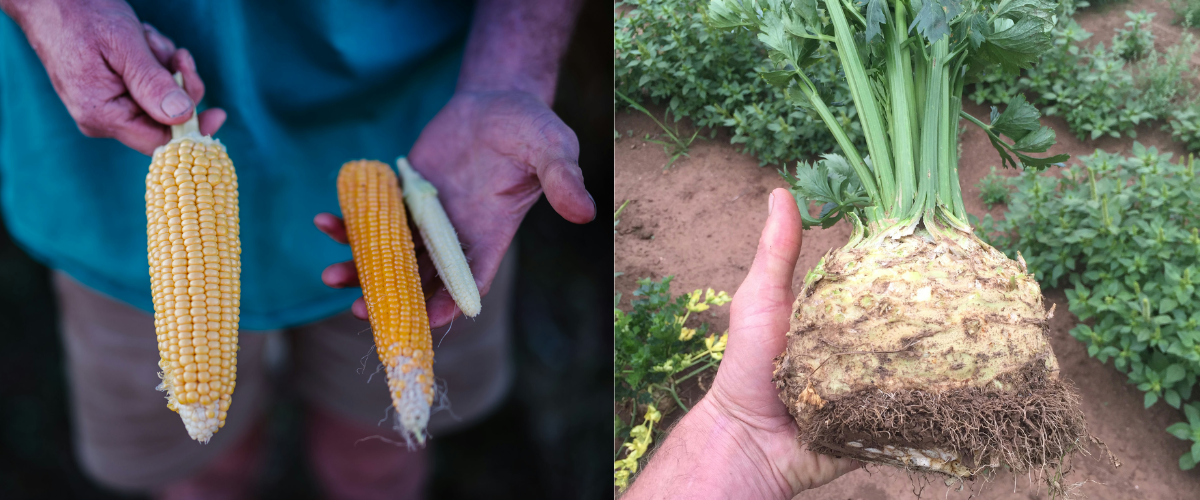
Like many vegetable farming businesses in Tasmania, the Young’s introduced diversification into their business to reduce risks and assist with managing crop rotations. They grow peas and potatoes for processing, poppies for alkaloid extraction, grass and oat seed, as well as sweet corn, celeriac and baby corn for the fresh market. They produce sheep and cattle that are sold to local butchers, which allows soil resting during crop breaks.
Most Tasmanian vegetable producers rely on contracts from several processors and packers. What sets Elphin Grove Farm’s operation apart is its direct-to-customer marketing to wholesalers and retailers. The Young’s supply celeriac, sweet corn and baby corn to local greengrocers, farmers’ markets and supermarkets in Tasmania, and a speciality hospitality fruit and vegetable wholesaler in Melbourne.
Being open to opportunities is something that Matt and his family are clearly comfortable with, and it has been key to them getting into the direct market business for the fresh vegetables.
VEGNET: How did you find the gap in the market to grow and sell a particular line of produce directly to fresh markets?
MATT YOUNG: A friend of mine was the manager at Tasfresh Wholesalers. One year at their AgFest stall, he tossed me an ugly-looking bulb and said, “You should grow that.” I said, “That’s fine, but what is it?” It turned out to be celeriac (a very common vegetable in Italy and Germany).
As a business, we looked into it and decided to give it a go and have now been growing it for almost 20 years. In the first year, we grew 1,500 bulbs, and slowly increased this, eventually peaking at around 60,000 bulbs supplied into the Melbourne market. But relying on this market alone, pricing became an issue, and the arrangement [with the wholesaler] eventually broke down, so we no longer supply into the [open wholesale] markets. We’ve since consolidated and now only sell directly to [selected] wholesalers and retailers.
VEGNET: What business decisions did Elphin Grove Farm make in expanding to direct market sweet corn?
MATT YOUNG: My dad, Ian, was delivering celeriac to a greengrocer in Spreyton. The owner said, “you should grow sweet corn, no one is growing it locally.”
Years earlier, we had grown sweet corn for McCain before they took the contracts to New Zealand, so between Dad and I, we already had a fair amount of knowledge of how to grow corn. We started producing sweet corn and initially sold some directly to local greengrocers, with the bulk going through a pack house.
One day, while delivering celeriac to Young’s Vegie Shed in Launceston, I noticed the sweet corn on display and, as strange as it sounds, recognised it. When I asked the manager where it came from, it turned out the bin they had was the one I’d picked the day before. It had come to the retailer from a packer we supplied. I asked if they wanted to buy directly from us, and they agreed. That allowed us to sell the corn for 20 cents more per cob than the pack-house price, with no real change to our system other than adding a bin of sweet corn to our regular celeriac deliveries.
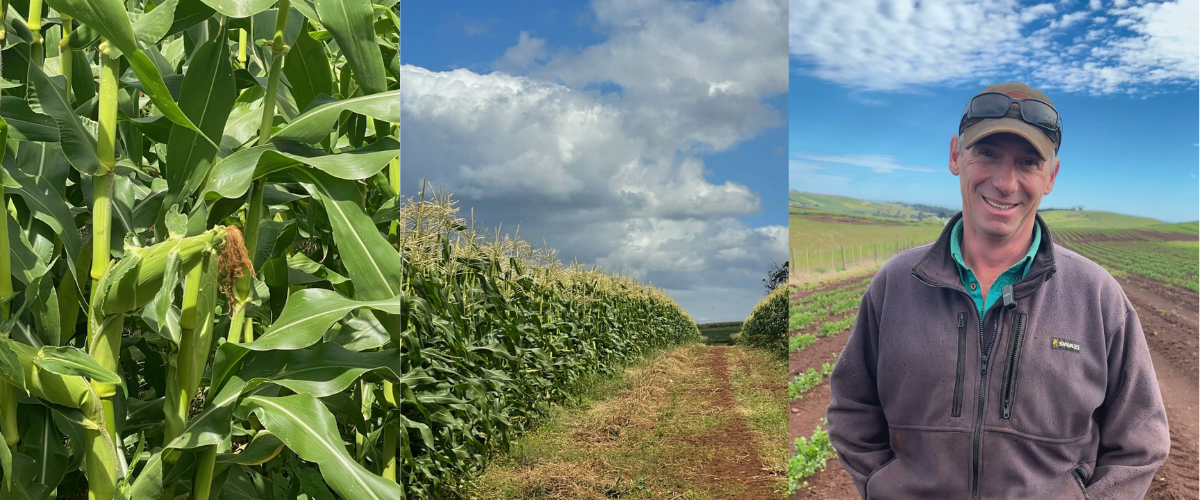
Elphin Grove Farm and Matt Young. Images ©Matt Young. ©VegNET Tasmania.
VEGNET: You had a grower profile in the Australian Grower magazine back in 2019 with a focus on your popcorn. What’s changed over the past six years?
MATT YOUNG: A lot has changed, particularly how we manage sweet corn and controlling the Heliothis grub. This usually relies on a consistent spray program, but we’ve moved away from mainstream chemicals, partly due to withholding periods, and instead are now using a biological virus product, ViVUS Max, that kills the grub. We’re hoping this will be very effective this year. The first couple of years came with some teething issues, including UV damage when it was sprayed at the wrong time of day.
We now have a strong support network that helps us with Integrated Pest Management (IPM) and the latest research and techniques, in the same way agronomists support chemical programs. Rebecca (Bec) Addison and the team at IPM Technologies are great. Bec does crop walks, inspecting plants and often picking up things in the paddock that I don’t see myself.
We’re always open to new crop opportunities. We still grow popcorn, but outside of the sweet corn season we don’t often have the time to actively promote it with customers. We’ve also changed our sweet corn variety to ‘super sweet’, as the previous variety was superseded and no longer available. We’re currently trialling a new popcorn variety for baby corn, which is increasingly becoming our focus for the fresh market rather than popcorn itself.
VEGNET: Based on your journey, what would you say to vegetable growers who are thinking about diversifying their business to include direct marketing?
MATT YOUNG: Look at your business – if you can make it work within your business then it is certainly profitable. Talk to the people you want to supply and see what they need and how much.
There is nothing worse than supplying a customer and then running out – planning and logistics can be the biggest headache to manage and get right.
VEGNET: How does selling direct financially compare with the larger commodity markets?
MATT YOUNG: Selling direct means we set our price right through the supply chain. Some people will tell you you’re too expensive, while others will say you’re too cheap. But if you know your costs and the margin you need, it can be financially worth it.
But it’s worth noting that it’s [our fresh market crops that are] the most labour-intensive part of our business, as everything is hand-harvested. That said, we only sell what we harvest, so it’s about improving growing efficiencies and product quality, because that’s where income really changes.
Getting the quality right in the paddock makes everything else flow better. With celeriac, we’ve been concentrating on improving sizing, as last year we lost three weeks of growing time due to a weather event in November. With sweet corn, we’ve increased the crop area, but harvested volumes haven’t risen due to ongoing grub issues. Hopefully though we’ve got this sorted with IPM this year.
VEGNET: What has kept Elphin Grove Farm continuing with direct marketing as a part of your business diversification?
MATT YOUNG: It works financially for us to direct market. The past couple of years have been a bit tight, largely due to Heliothis in the sweet corn crop affecting quality and therefore volume. But that’s vegetable growing, it happens.
Direct marketing has been good for recognition. All the farmers I know do the best they can, yet the only feedback from the processing companies is a piece of paper at the end of the season saying what was taken, what was rejected and what you’re being paid. Whereas, with direct marketing, I know within a couple of days whether a crop is good or if something needs addressing.
When top chefs call to say it’s some of the best corn they’ve ever had, it makes you feel good. That kind of feedback keeps you going during the peak harvest period from February to April, which is also alongside the poppy harvest and straight after grass seed harvest. During these busy times there are moments in the week when you question why you do it, but then you get the positive feedback, and it gets you up and going again.