


VegNET National: VegNET at Hort Connections 2026
31 August 2026
VegNET WA: Connecting growers, driving innovation and supporting Western Australia’s vegetable industry
31 August 2026
Reading Time: 4 minutes
Since launching in early April, VegNET Tasmania’s Growing Regeneratively program has brought together 10 Tasmanian commercial vegetable growers and advisors.
The 12-month hands-on initiative brings together a mix of on-farm learning, expert sessions, study tours and networking opportunities. The program is designed to equip the group with the skills, knowledge and confidence to implement change in their farming operations and businesses to build healthy, resilient soils and crops.
The VegNET Tas team has been energised by the group’s keen interest and commitment to learning and is pleased to share the activities and insights to date.
APRIL
Laying the groundwork with clear goals
Growing Regeneratively kicked off with a dinner session bringing together the participants; eight growers and two advisors. Everyone shared why they joined the program and what they hoped to gain, with the following themes emerging:
- Reducing chemistry / synthetic inputs and costs
- Building a toolbox of non-chemistry tools and biological products
- Prioritising inputs that work, and using them more efficiently
- Getting the timing right with implementation
- Gathering ideas to trial that suit their own farm and context
- Increasing nutrient cycling
- Improving existing cover cropping programs
- Transitioning to more regenerative practices without compromising profit.
MAY
Onto the farm and straight into practice
Cradle Coast NRM and Harvest Moon hosted an event to showcase the value of multi-species cover crops on-farm, with VegNET Tas partnering to facilitate a panel discussion with Josh Wing (Harvest Moon) and Ali Dugand (Farm Agri-ecologist and cover crop specialist). Within a week of attending, two participants had implemented practice change, putting multi-species covers in the ground.
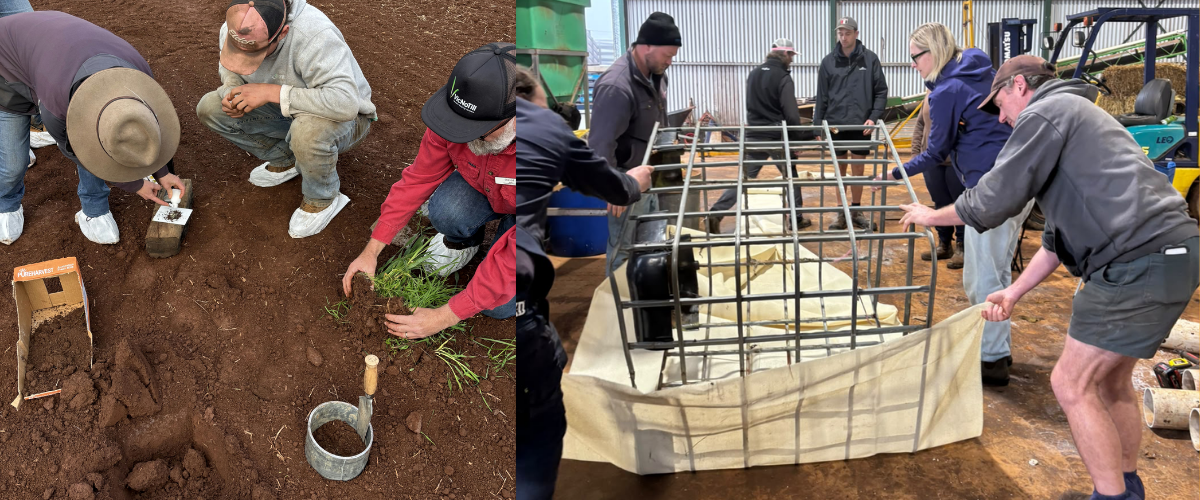
In late May, David Hardwick (Soil Land Food) joined us to lead an interactive soil biology session, including an on-farm component hosted by Joseph Chaplin on his family’s farm in East Sassafras. The day started with a ‘healthy’ competition with each grower bringing their own cube of soil to then assess and judge the best soil and reasons why. The day ended with growers feeling more confident in assessing the biology and health of their soils through both observation and interpretation of soil test results.
JUNE
Shared trials and learning
Coby Badcock from Badcock Ag hosted a Johnson Su compost making workshop, led by farm ecologist and consultant Robin Tait. It was all hands-on to re-purpose an IBC and mix the compost ingredients. The materials were all sourced from Coby’s property and included autumn leaves, sheep manure and crutchings, old hay and green clippings. Small additions of wheat bran, seaweed, rock phosphate and blood and bone were sourced locally.
The compost will break down over the next 12–18 months, with Coby managing regular watering and the addition of worms in a couple of months’ time. Updates will be shared with the group, and another session will be held on how to make and apply the liquid extract, a highly fungal and microbial bio-inoculant, from the compost. Pending how the mix breaks down, we’re anticipating approximately 200 kg of compost from one IBC to make an extract from, which should be able to extend across 200 ha either through seed coating or liquid application in-paddock.
“Seeing the benefits of the cover crop to your soil in data form, confirms the benefit and astronomical difference between grass and cover crop. Being able to obtain the literature also helped me in our business [to] justify why I have put the cover crop in over winter, instead of the usual grass.” PARTICIPATING GROWER.
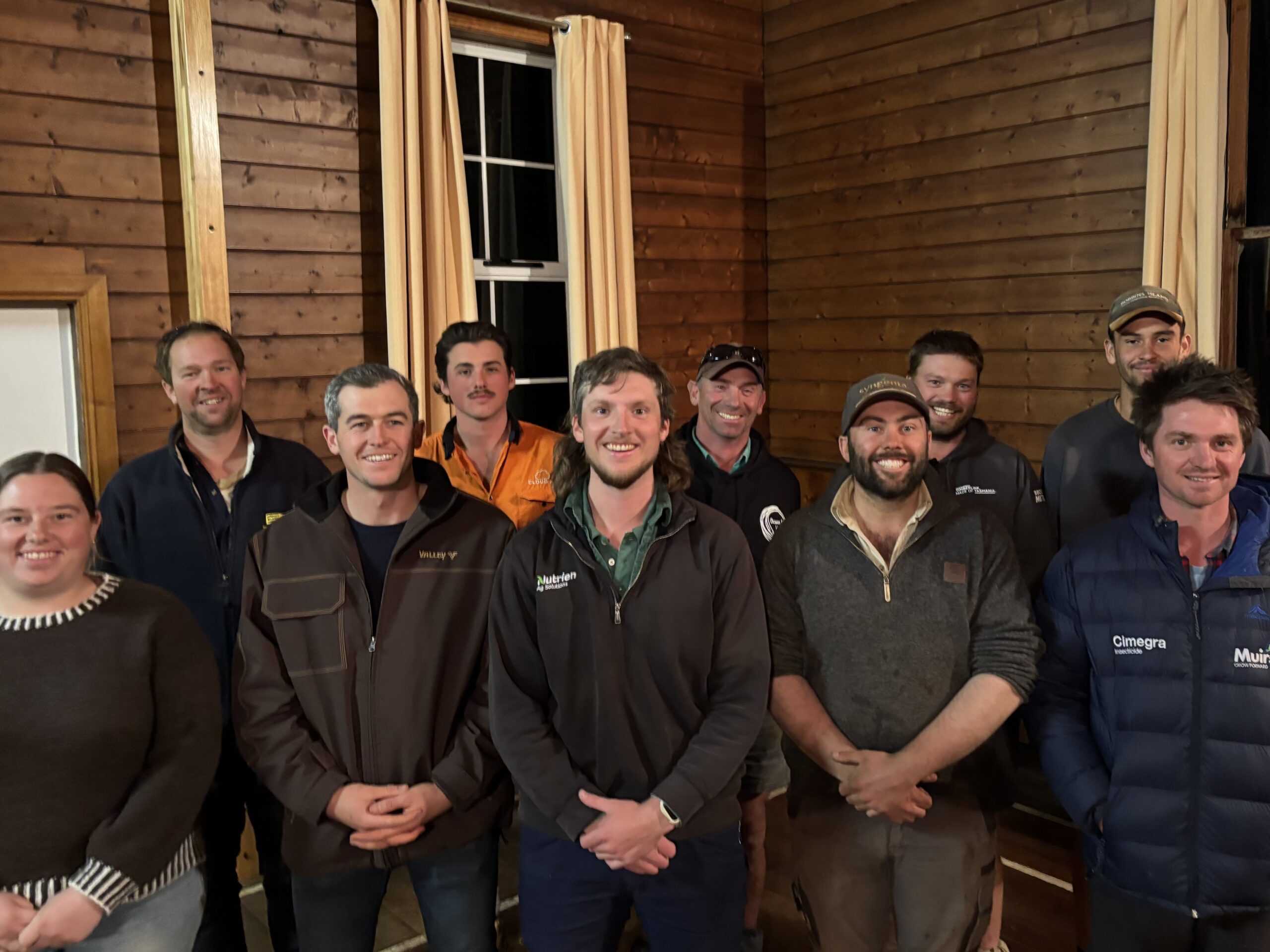
Growing Regeneratively cohort
L-R. Bree How (Charlton Farm Produce), Yuri Wolfert (Wolfert Farming Co), Coby Badcock (Badcock Ag), Archer Nugan (Cloud Ag), Jason Taylor (Nutrien Ag), Matt Young (Elphin Grove Farm), Dylan Bellchambers (Harvest Moon), Owen Woolley (Radco Ag), Joseph Chaplin (Chaplin Bros), Tom Killalea (Muirs).
What’s growing on with Coby Badcock, Badcock Ag
Coby Badcock of Badcock Ag in North Motton operates a mixed farming enterprise with onions, potatoes, carrots, poppies and oats, alongside sheep and beef production. Coby began shifting his on-farm practices to a regenerative ag approach five years ago, starting with on-farm trials and many conversations to build his knowledge.
Already in practice at Badcock Ag:
- Cutting chemical and granular fertiliser use by using selective chemicals and taking plant sap tests to understand what nutrients the plants require.
- Transitioned 35 ha of previously fallow paddocks over winter to having green manure cover crops.
- Reducing tillage as much as possible.
- Sheep have been an important tool for cleaning up volunteer potatoes between crops, reducing reliance on chemical inputs while removing hosts of potential disease.
- Introduction of Halter virtual fencing and collars for cows to improve strip grazing practices, allowing the cows to graze in a day rather than seven. This has significantly reduced labour costs and enabled better pasture utilisation and growth.
- Working with farm ecologist consultant Robin Tait to introduce multi-species pastures and increase biodiversity.
- Partnering with a local beekeeper, adding hives to the farm with plans to expand.
Coby’s next steps and regenerative goals:
- Use more biological products and foliar fertilisers in the upcoming season.
- Experiment with different techniques to ideally drill onions straight into the terminated cover crop, without the need for spring soil tillage.
- Introduce multi-species plant breaks along the linear pivot tracks, to be planted at the same time as potatoes in October.
- Introduce laying hens into the grazing rotation in 2026, using them as natural muck spreaders behind cattle and sheep, insect control and adding chicken manure to the pasture.
A key reason Coby joined Growing Regeneratively was to become part of a network:
“To bring multiple heads together rather than us all just nutting it out on our own. It’ll be great to have young, like minded people all working together and I feel it could really fast-track some regen practices not just on our own farm but hopefully in Tasmania.”
“Given the current economy and tight margins in farming, it’s having the confidence to make a change and trying not to take a financial hit. Our practices and soils have become so reliant on a high amount of inputs and they also combat [the effectiveness of] biological products, it’s having the knowledge to know how to make that shift and how quickly to make it.” COBY BADCOCK