


Food Security Discussion Paper welcomed as vegetable industry issues need urgent attention
13 August 2025Exploring Agritourism for Australian Growers webinar recording
22 August 2025
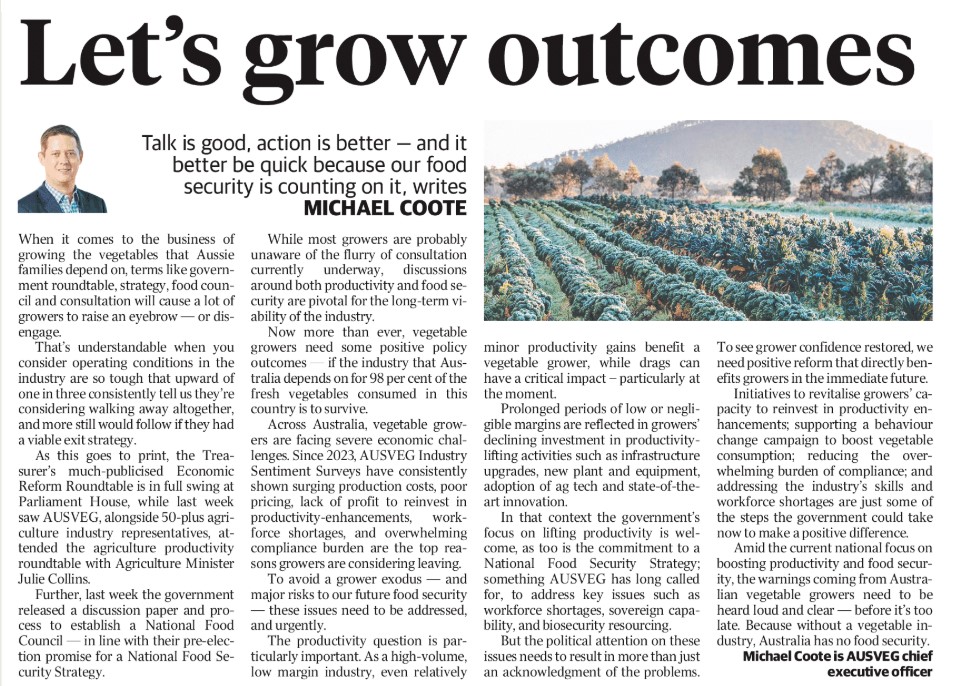
TALK IS GOOD, ACTION IS BETTER — AND IT BETTER BE QUICK BECAUSE OUR FOOD SECURITY IS COUNTING ON IT, WRITES MICHAEL COOTE
Published in the Weekly Times 20 August 2025
When it comes to the business of growing the vegetables that Aussie families depend on, terms like government roundtable, strategy, food council and consultation will cause a lot of growers to raise an eyebrow — or disengage.
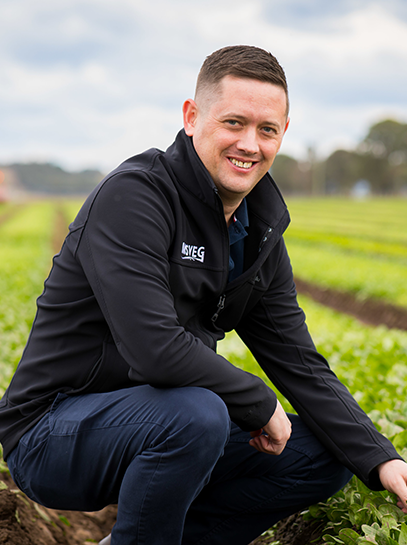
AUSVEG CEO Michael Coote
That’s understandable when you consider operating conditions in the industry are so tough that upward of one in three consistently tell us they’re considering walking away altogether, and more still would follow if they had a viable exit strategy.
As this goes to print, the Treasurer’s much-publicised Economic Reform Roundtable is in full swing at Parliament House, while last week saw AUSVEG, alongside 50-plus agriculture industry representatives, attended the agriculture productivity roundtable with Agriculture Minister Julie Collins.
Further, last week the government released a discussion paper and process to establish a National Food Council — in line with their pre-election promise for a National Food Security Strategy.
While most growers are probably unaware of the flurry of consultation currently underway, discussions around both productivity and food security are pivotal for the long-term viability of the industry.
Now more than ever, vegetable growers need some positive policy outcomes — if the industry that Australia depends on for 98 per cent of the fresh vegetables consumed in this country is to survive.
Across Australia, vegetable growers are facing severe economic challenges. Since 2023, AUSVEG Industry Sentiment Surveys have consistently shown surging production costs, poor pricing, lack of profit to reinvest in productivity-enhancements, workforce shortages, and overwhelming compliance burden are the top reasons growers are considering leaving.
To avoid a grower exodus — and major risks to our future food security — these issues need to be addressed, and urgently.
The productovity question is particularly important. As a high-volume, low margin industry, even relatively minor productivity gains benefit a vegetable grower, while drags can have a critical impact – particularly at the moment.
Prolonged periods of low or negligible margins are reflected in growers’ declining investment in productivity-lifting activities such as infrastructure upgrades, new plant and equipment, adoption of ag tech and state-of-the-art innovation.
In that context the government’s focus on lifting productivity is welcome, as too is the commitment to a National Food Security Strategy; something AUSVEG has long called for, to address key issues such as workforce shortages, sovereign capability, and biosecurity resourcing.
But the political attention on these issues needs to result in more than just an acknowledgment of the problems. To see grower confidence restored, we need posiOve reform that directly benefits growers in the immediate future.
Initiatives to revitalise growers’ capacity to reinvest in productivity enhancements; supporting a behaviour change campaign to boost vegetable consumption; reducing the overwhelming burden of compliance; and addressing the industry’s skills and workforce shortages are just some of the steps the government could take now to make a positive difference.
Amid the current national focus on boosting productivity and food security, the warnings coming from Australian vegetable growers need to be heard loud and clear — before it’s too late. Because without a vegetable industry, Australia has no food security.
Michael Coote is AUSVEG’s Chief Executive Officer