


New tech, new hope: fighting FAW with RapidAIM traps
Gippsland farmers primed to spot an advancing fall armyworm invasion
Exotic Plant Pest Profile: Carrot rust fly
Tasmania’s Spud Doctor reflects on seed potato progress
Growing Leaders
Benchmarking essential to profitability, sustainability
Onions star at events in Sydney and Melbourne
Sowing the seeds of innovation: enhancing onion production through soil and water management
Developing an integrated pest and disease management strategy for fusarium basal rot
By Dr Michael Rettke, South Australian Research and Development Institute (SARDI)
The project Epidemiology and management of fusarium basal rot in onions (VN20006) aims to develop an integrated pest and disease management (IPDM) strategy to reduce the impact of fusarium basal rot in onions.
Fusarium basal rot is one of the most significant soilborne disease threats to onion production in warm production regions of Australia. Management of fusarium basal rot requires an integrated approach targeted at reducing the buildup of disease risk in the soil (soil inoculum) and managing the crop to reduce likelihood of disease infection and development.
Conditions that have been associated with increased disease risk of fusarium basal rot include short rotations and previous occurrence of disease, prolonged lower or higher than optimum soil moisture levels, uneven crop growth, high bulb nitrogen levels, salinity issues, growing mid to late season crops, and susceptible varieties.
Soil inoculum – disease risk
Fusarium oxysporum f. sp. cepae (FOC) has been identified as the main pathogen that causes fusarium basal rot of onions in Australia. Spores of FOC produced on infected onions can remain in the soil for at least four years, with the potential to infect the next onion crop. Extending rotation length beyond four years is beneficial to reducing the risk of fusarium basal rot. In paddocks with a high incidence of disease in the previous crop, rotations longer than four years may be required to be of benefit.
Testing as part of this project found root infection by FOC can occur on crops that are grown in rotation with onions (such as cereals and legumes), along with weeds (including annual ryegrass and sow thistle). However, based on quantitative DNA testing of roots, cereal and legume rotation crops do not have the potential to cause the large increase in soil inoculum that occurs when an infected onion crop is grown.
They are sometimes referred to as reservoir hosts, as they help maintain inoculum levels in the soil, rather than build them up. Rotation crops infected by FOC do not show obvious symptoms. These rotation crops are usually, but not always, grown in winter when conditions are less favourable for infection and growth of FOC. Temperatures of 26-28°C are considered optimum for growth of FOC, with minimal growth below 15°C.
Barley used as a nurse crop for late season onions showed higher levels of infection than winter grown crops, and this is likely due to that higher soil temperature. When crops such as barley and faba beans were inoculated with FOC and grown in controlled environment rooms at 26°C, higher levels of root infection were detected than on roots of the same crops collected from winter grown crops in naturally infected fields.
Limited testing of winter grown canola from an infected field site suggested it is a poor host of FOC. However, canola is a good host of the nematode Pratylenchus neglectus, which poses a significant yield risk to onion production. Additionally, canola does not support arbuscular mycorrhizal populations that are already present in the soil of some onion production systems and can be beneficial to onions.
Choosing rotation and cover crops that have positive effects on soil condition and microbiology is important prior to planting onions, and this should be considered along with their potential impact on inoculum levels of soilborne diseases. Other aspects to be considered include their suitability for conditions and time of year to be established, compatibility with weed control strategies and ability to provide ground cover.
Long-term studies are required if we are to more thoroughly understand the impact that specific rotation and cover crop strategies have on the risk of soilborne diseases, including fusarium basal rot, on soil health and on onion productivity more generally.
Reducing crop risk
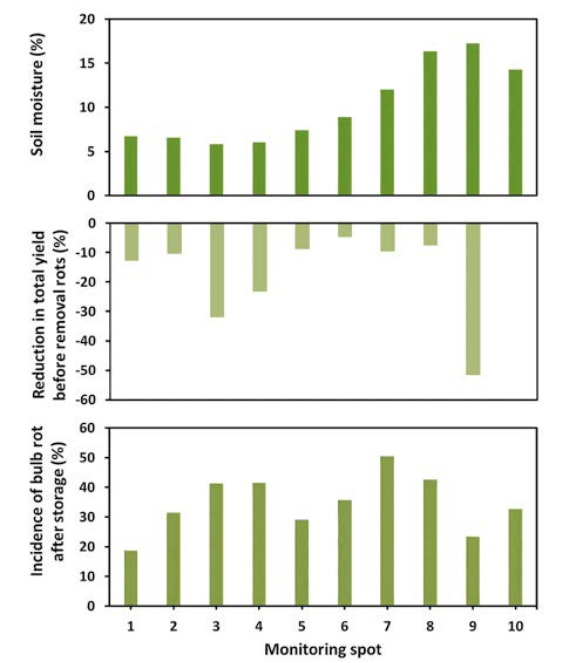
FIGURE 1. Impact of prolonged differences in irrigation output and topography on, a) soil moisture as recorded 4 weeks prior to harvest, b) reduction in total bulb yield at harvest (before removal of rots) compared to highest yield recorded at monitoring spot 10 and, c) the cumulative incidence of rotted bulbs caused by fusarium basal rot after two months ambient storage. (Spot nine was waterlogged for prolonged periods, each monitoring spot had three replicates).
Project results indicate the importance of managing irrigation and plant nutrition as part of an integrated program to reduce the risk of fusarium basal rot.
Monitoring of crops and trials in South Australia has identified relationships between soil moisture level and the incidence of fusarium basal rot. Both higher and lower than optimum soil moisture levels can increase the risk of fusarium basal rot, with an example of findings presented in Figure 1.
Soil moisture conditions were considered close to optimal at spots five and six, maximising yield and lowering incidence of fusarium basal rot. Prolonged waterlogging which occurred in spot nine was not favourable for either onions to grow or fusarium basal rot to develop. Total yield was reduced by approximately half at spot nine. At spots eight and 10, soil moisture was high but not waterlogged.
These conditions supported high yields but were also conducive to diseases such as bacterial bulb rots, as well as fusarium basal rot. At the other end of the moisture spectrum at spots three and four, where plants suffered prolonged water stress, total yields were reduced by around 25 percent, and had a higher level of fusarium basal rot when compared with spots having optimum moisture conditions.
Management of both irrigation and nitrogen are a critical part of maintaining even growth of the onion crop, helping protect the basal plate from infection.
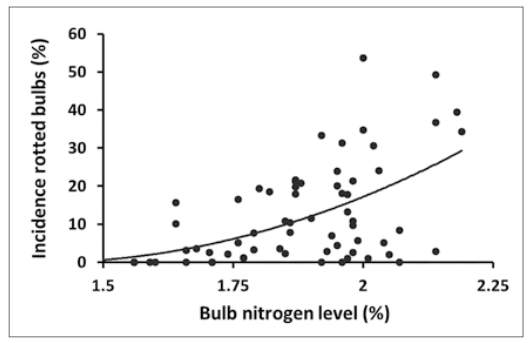
FIGURE 2. Association between bulb nitrogen level (percent) measured at harvest and the incidence of fusarium basal rot at monitoring locations assessed within 20 crops in two seasons. is present and environmental conditions are suitable.
Crop monitoring has revealed an association between higher bulb nitrogen level at harvest and higher incidence of fusarium basal rot, as presented in Figure 2. Lower nitrogen level in the harvested bulbs was not related to reduced yield, suggesting nitrogen level was not yield limiting within the range monitored in these commercial crops.
This indicates there is scope to manage nitrogen to reduce risk of fusarium basal rot without jeopardising yield, i.e. applying sufficient but not excessive nitrogen will reduce fusarium basal rot without limiting yield potential.
Other bulb quality attributes need to be considered when adjusting fertiliser programs. The level of nitrogen in the bulb was not solely influenced by the nitrogen application rate, which indicates that other crop management practices and soil conditions are important drivers of bulb nitrogen status and the crops susceptibility to fusarium basal rot.
Management of both irrigation and nitrogen are a critical part of maintaining even growth of the onion crop, helping protect the basal plate from infection. Sudden growth spurts or plant stress may increase risk of fusarium basal rot developing if the pathogen
Treatment options
There are currently no fungicides registered in Australia for the control of fusarium basal rot in onion crops. Several active ingredients and formulations have been demonstrated to suppress the disease in trials conducted as part of this project.
These results provide support for progressing some treatments towards commercial availability.
A number of biological products that are available to growers in Australia contain micro-organisms (e.g. Trichoderma
harzianum, T. viride, Bacillus subtilis, Pseudomonas fluorescens, Funneliformis mosseae) for which overseas studies have demonstrated their ability to reduce the incidence of fusarium basal rot in field trials. Achieving meaningful disease reduction depends on the suitability of each biocontrol strain to site-specific field conditions and the level of disease pressure.
Monitoring of crops has shown that infection can be present at the seedling stage, even though symptoms may not be visible until close to harvest. Monitoring in mid to late season grown onions has shown that most infection of plants in the crop appears to have already occurred by the time of bulb initiation. This indicates implementation of control strategies needs to start early in the crop, if not at or prior to planting
Where inoculum levels of FOC in the soil are high and conditions are favourable for disease development, fusarium basal rot can lead to substantial losses or even crop failure. In these situations, fumigation is an option to reduce the level of inoculum in the soil prior to planting. Such treatments should be followed up with practices to re-establish a favourable soil biology for onions and the implementation of other management practices as part of an integrated strategy to reduce disease risk.
Effective management of fusarium basal rot involves reducing the buildup of inoculum or its reduction before planting, coupled with managing the crop in ways that reduce likelihood of disease infection and development, including irrigation, nutrition, and soil health management.
Find out more in the Fusarium Basal Rot guide.