


The Skye’s the limit for smart nutrient management
3 September 2025A national effort to grow vegetable demand and a healthier Australia
3 September 2025
BY UMBERTO CALVO AND PAULETTE BAUMGARTL
APPLIED HORTICULTURAL RESEARCH
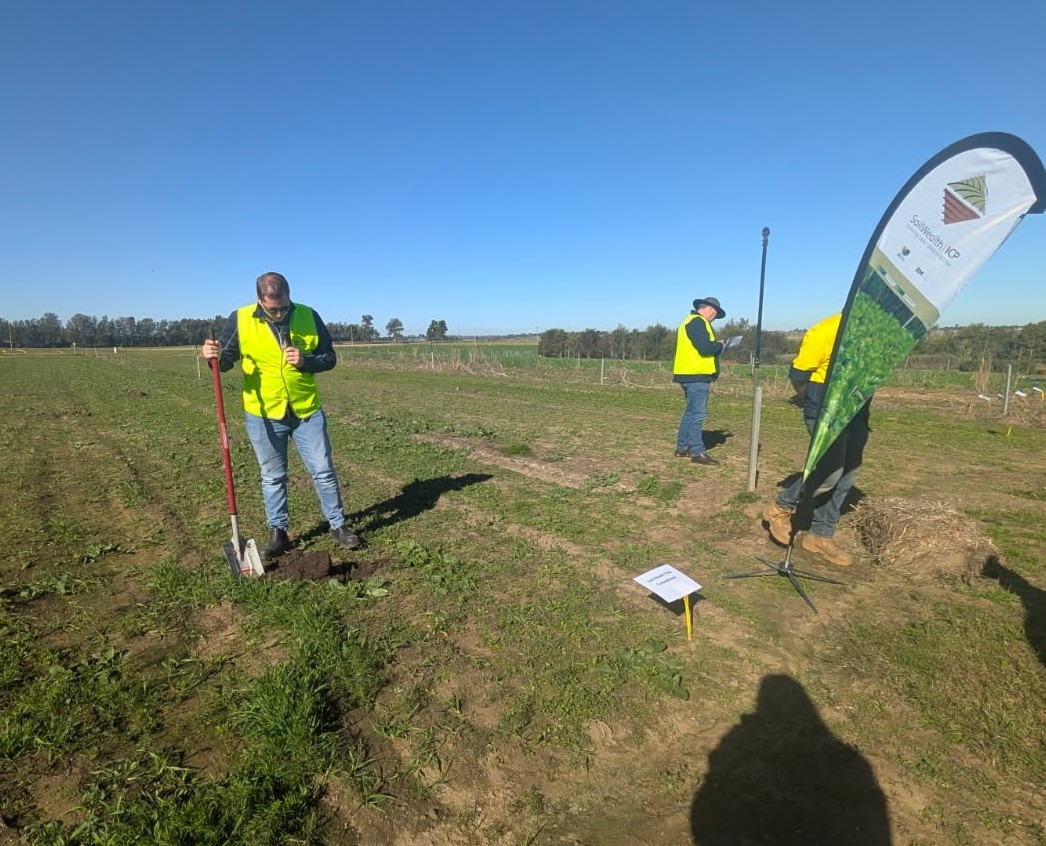
Soil Wealth ICP team member Umberto Calvo explaining the trials and showcasing an emerging oats and vetch cover crop at a field day on 17 June 2025.
Led by the Soil Wealth ICP team in partnership with Local Land Services (LLS), the initiative aims to give growers real-world insights into how they can enhance soil structure and fertility, while reducing the intensity of soil disturbance.
The trial, which began in 2024 and will run until 2026, is testing a wide range of cover crop options and residue management techniques across two demonstration bays.
“Our goal is to help growers reduce their reliance on rotary hoeing and other intensive cultivation practices,” Soil Wealth ICP team member (AHR) Umberto Calvo said.
“These practices, while familiar, can contribute to long-term soil degradation and poor structure, especially in flood prone or heavily worked paddocks.”
Hands-on trials for real impact
Designed with input from growers, agronomists and researchers, the trial compares conventional and reduced tillage approaches across a sequence of crops.
Initially, multiple cover crop mixtures – including oats, rye, barley, wheat, vetch and pollinator blends – were planted in autumn to build biomass, protect soil and introduce biological diversity.
After cover crop termination (via slashing and herbicide), the team tested two tillage approaches to plant sweet corn: traditional full rotary hoe versus a strip rotary hoe (ST) technique. Crop emergence, weed pressure, soil structure and residue breakdown were then compared.
“The results have been a little surprising,” Umberto said.
“While reduced tillage showed promise in saving on time and costs, suppressing weeds and maintaining residue cover, other results were quite variable.”
Corn germination and emergence were inconsistent across both systems, particularly in areas where high-biomass grass species were used, possibly due to allelopathy, nitrogen tie-up, or mechanical issues related to residue handling.
Notably, better results and yields were generally observed where legume cover crops had been used, suggesting they may offer a more favourable pathway into corn for this region.
Learning by doing – adapting to challenges

A young vetch plant showing nitrogen-fixing nodules on its root system and soil particles sticking to the roots – a good sign of biological activity and soil health
Soil biology and fertility are key focus areas for the trial, with the team using soil testing to assess nutrient levels before and after each cropping phase. Adjustments, such as targeted fertiliser applications and the potential use of lime, are being trialled as needed.
Several challenges emerged early on. In addition to the poor corn emergence, seed quality, hard pans in the soil, and equipment compatibility needed to be addressed.
“It’s all about giving growers confidence to try new approaches that build healthier, more resilient soils.”
However, these hurdles sparked valuable discussion among the team and the broader grower community, fuelling iterative improvements and helping to refine the approach.
One particularly promising innovation is the use of the strip rotary hoe, a relatively accessible tool that many growers already own or can easily modify. Taking out all but two blades and running it in narrow bands rather than across the whole bed disturbs only a small portion of the soil, retaining surface residues and protecting soil biology. While it doesn’t fully eliminate compaction or replace deep ripping in hard pan conditions, it represents a practical step toward more sustainable soil management.
Next crop: brassicas and beyond
As the trial progresses, the next phase involves transitioning from corn to brassicas, with buckwheat sown as a bridging cover crop. When initial attempts to establish buckwheat struggled due to seed viability, extreme weather events and weed competition, the team missed a useful window to plant the warm season cover crop.
The team therefore decided to trial a cold-season grass and legume cover crop (oats and vetch) and terminate it before planting brassicas in winter. In addition to comparing soil and crop performance across tillage treatments, future phases will examine how cover crop residues influence pest pressure, water retention, and soil structure in the following vegetable crop. The addition of beneficial insect-attracting floral strips is also under consideration.
Engaging with growers: field days and knowledge sharing
Central to the project is its focus on grower engagement. Two field days (December 2024 and June 2025) provided key opportunities to showcase findings and gather feedback.
At the most recent event, Soil Wealth ICP team members Isabella Ellmers and Umberto Calvo from AHR were on hand to guide growers through the trials and discuss the soil improvements, answer questions, and share practical tips for implementing similar practices on-farm.
“It’s all about giving growers confidence to try new approaches that build healthier, more resilient soils,” Isabella said.
Additional information on the Richmond demonstration site can be found at soilwealth.com.au
FIND OUT MORE
The Soil Wealth and Integrated Crop Protection (Soil Wealth ICP) project provides research and development (R&D) extension and communication services on improved soil management and plant health to the Australian vegetable and melon industries.
For further information, contact project leaders Dr Gordon Rogers at gordon@ahr.com.au and Carl Larsen at carll@rmcg.com.au