


Delivering critical permits that matter
9 December 2025
VegNET National: VegNET team get together
9 December 2025
BY VIVIAN MENDEZ AND REHAN SILVA, MACQUARIE UNIVERSITY
The project Effective Fall armyworm pheromone blends for improved monitoring and population estimation in Australia, led by Researchers from Macquarie University, is investigating the geographical variation of the sex pheromone in Fall armyworm populations in Australia. This information will assist in optimising pheromone blends in lures for monitoring and mass trapping and application in mating disruption.
The analysis of pheromone blends of Australian populations of Fall armyworm will inform the development of regionally effective products that the horticulture industry can adopt to improve surveillance and develop an integrated pest management system involving biological control and cultural practices aimed at reducing the use of chemical pesticides.
Comparison of commercial lure performance across Australia
Pheromone-based traps attract insects by using synthetic pheromones that mimic the natural pheromone of the targeted species as a lure. Such traps are key tools for monitoring and early detection of pests such as fall armyworm. However, overseas studies have shown that monitoring of fall armyworm using pheromone-based traps can be difficult due to regional variation in the sex pheromone composition, a lack of direct correlation between crop damage and number of moths captured in traps, and attraction of large numbers of non-target species (‘bycatch’), particularly the False armyworm.
Ideally, lures are highly attractive to the targeted species, and so are sensitive even when numbers are low, and are not attractive to non-target species so that there is minimal need for sorting and identifying samples. We aimed to determine the effectiveness of four commercially available lures in Australia that are currently used for monitoring fall armyworm, including Frugilure (Chemtica), Pherolure (Insect Science), Pherocon (Tréce) and Iscalure (ISCA).
To assess regional patterns, each lure product was assessed at 30 field sites across Western Australia, Northern Territory, Queensland and New South Wales. The lures were tested for a year at each site, with samples collected weekly, to compare lure efficacy based on the number of fall armyworm and false armyworm captured in traps. Access to sites on commercial properties was facilitated by regional collaborators in government agencies and local institutions that regularly assist growers.
The four commercial lures attracted similar numbers of fall armyworm across sites in Queensland, but there was considerable variation in the performance of the lures across sites in the Northern Territory, Western Australia and New South Wales (Figure 1). In Queensland only Chemtica and Iscalure attracted false armyworms while at other field sites across New South Wales and Western Australia, Pherolure and Tréce also attracted false armyworms (Figure 2). Numbers of fall armyworm moths captured varied with crop type, which is influenced by location and climate, with sweet corn and maize showing the highest numbers as was expected (Figure 3).
The observed differences in the performance of the four commercial lures are likely due to fall armyworm and false armyworm populations in the northern field sites (Queensland and the Northern Territory) being permanent, persisting throughout the year, and displaying characteristic attraction, in contrast to populations in the south (Western Australia and New South Wales) that are established seasonally by migrating moths.
Regional variation in female sex pheromone blends
Because overseas studies have found that fall armyworm tends to have regional variation in female pheromone blends, which have a significant impact on the pheromone blends that are most effective for attracting males, we assessed whether this might also be the case in Australia.
Rather than using insects from ‘domesticated’ colonies or rearing on an artificial diet, we collected eggs, larvae and pupae from sweet corn fields and reared them on organic sweet corn through to pupation. The egg masses and emerged larvae were maintained with organic sweet corn kernels, cobs and leaves, allowing the larvae to hide and feed without needing separate containers for individual larvae.
This method helped us reduce larval cannibalism and avoid the potential effects of artificial diet on the pheromone blend. Additionally, the larvae were allowed to pupate in vermiculite and soil media, as pupation with no substrate—commonly used in fall armyworm rearing— is a potential source of stress for the developing insect.
We have found substantial variation in sex pheromone blend of moths from different regions of Australia, highlighting the need to understand regional variants of pest insects rather than assuming that data collected using insects from laboratory colonies or any one region can be generalised to other regions across Australia.
The pheromone blends from wild fall armyworm populations in northern Australia differ from those in the south, supporting the hypothesis that established permanent populations differ from seasonal populations.
The research helped us to determine which combinations and concentrations of pheromone compounds are most effective at attracting fall armyworm moths in each region, thereby reducing the number of non-target moths caught and supporting the development of more effective lures for monitoring and control. We have developed region-specific pheromone blends that are currently being tested in the field.
Figures 1-3 by Tania Yonow and Darren Kriticos, Cervantes Agritech.
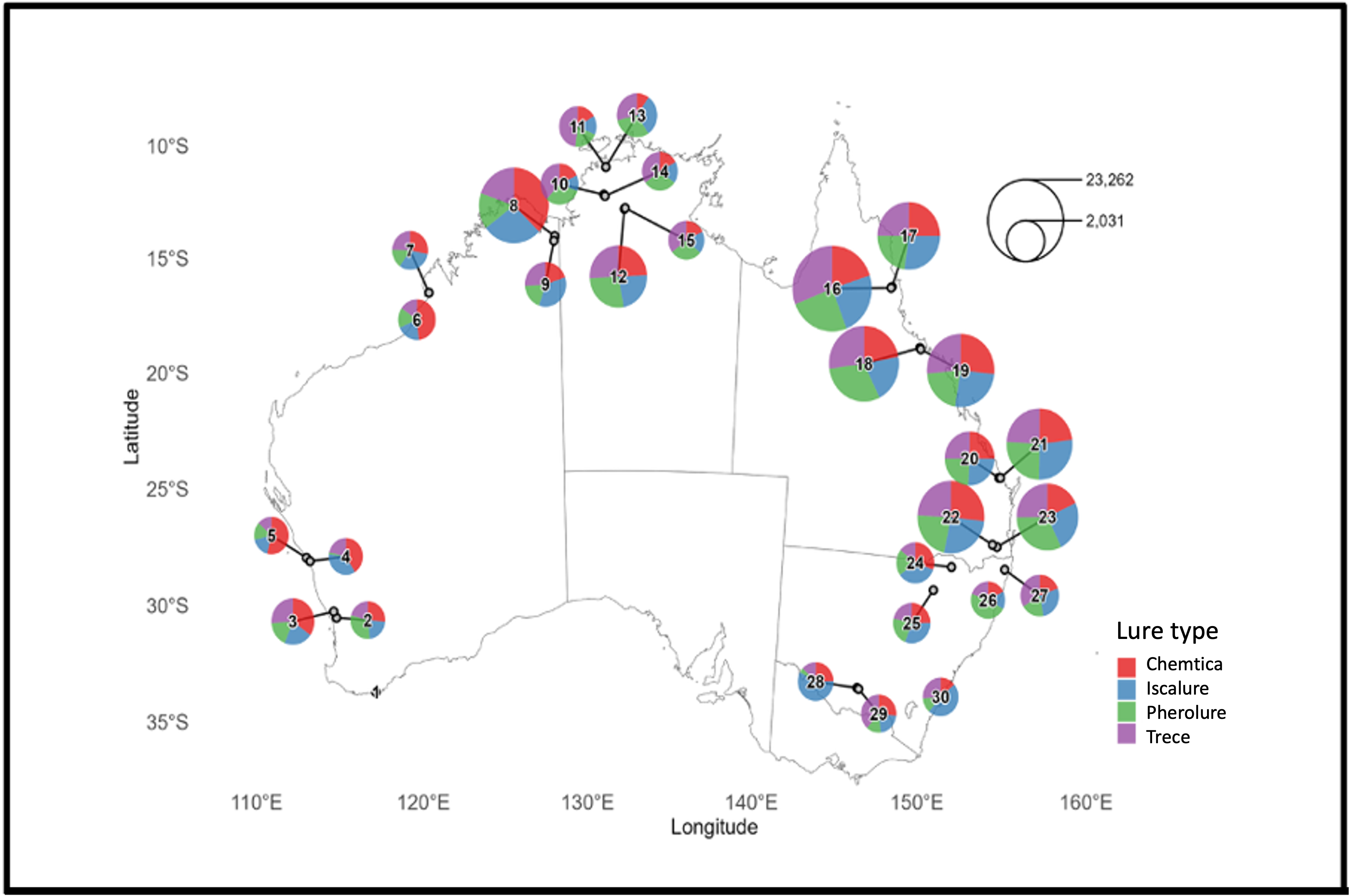
Total number of male and female fall armyworm caught by site and lure type. Each number inside a circle represents a field site. The size of the circle reflects the number of moths caught.
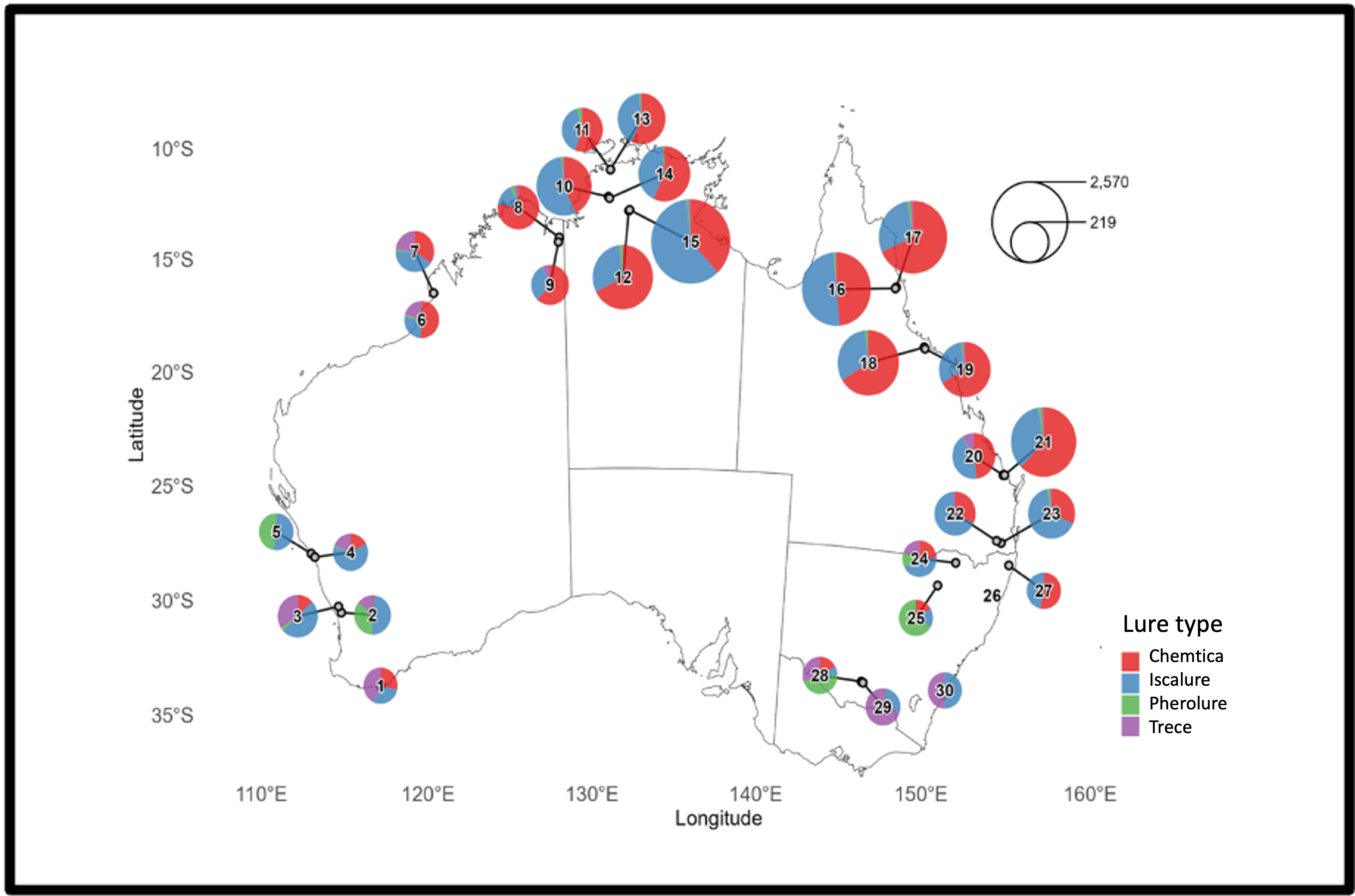
Total number of false armyworm caught by site and lure type. Each number inside a circle represents a field site. The size of the circle reflects the number of moths caught.
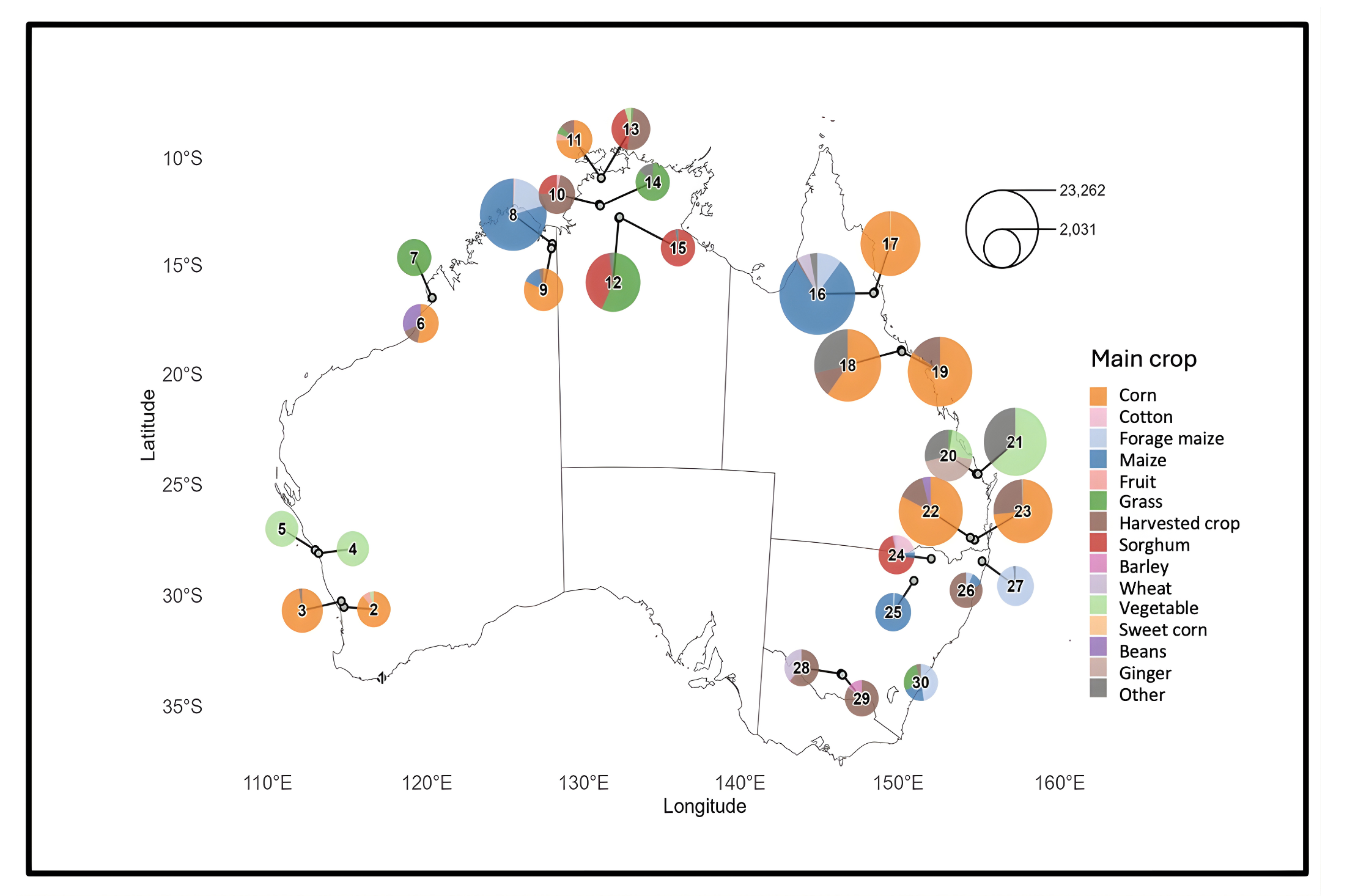
Total number of male and female fall armyworm caught by site and crop type. Each number inside a circle represents a field site. The size of the circle reflects the number of moths caught.