


VegNET Tas: From root causes to rotations – Practical approaches to integrated weed control in Tasmania
9 December 2025
VegNET WA: Practical AI for vegetable production in action Manjimup slide night
9 December 2025
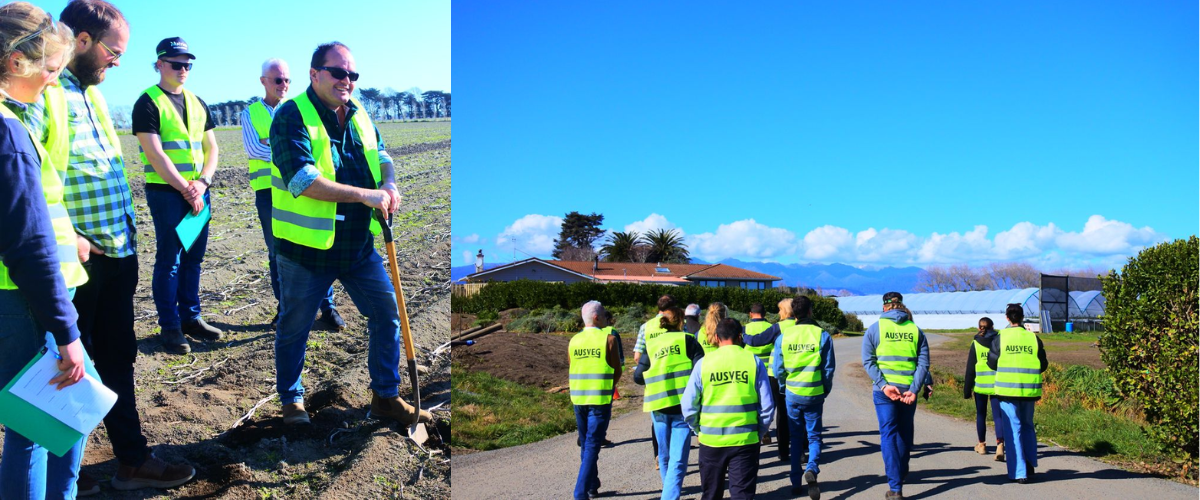
South Australian vegetable growers recently had the opportunity to participate in study tours both in New Zealand and closer to home in Queensland’s Lockyer Valley. These tours, the first ran by AUSVEG and the latter funded through the VegNET Innovation Fund, offered firsthand exposure to innovative practices, technology, and business strategies. Participants compared production systems, met industry peers, and brought home practical ideas to enhance both their own operations and the broader South Australian vegetable industry.
Sharing ideas across the Tasman
The New Zealand Study Tour, held in late August, took Australian growers on a five-day journey through a range of horticultural operations. Thirteen growers and industry professionals, including South Australia’s Monika Fiebig from Monika’s Organics, participated in an immersive learning experience that combined practical demonstrations, business discussions, and cultural exchange.
The tour began at Lewis Farms, north of Levin, where founder Geoff Lewis showcased hydroponically grown berries and a large-scale asparagus operation. Participants were impressed by the 120 kilometres of plastic tunnels that allowed asparagus to be harvested within 24 hours of spear emergence, capturing early-season market opportunities. The farm also features custom-built grading and bunching machinery and a bird-deterring laser system, prompting discussions on labour efficiency, workflow optimisation, and crop rotation strategies that maintain yield while improving soil health.
From there, the group visited Moleta’s Potatoes in Ōpiki, a farm with deep historical roots in the region. This area, once swamp and flax-growing land, was gradually reclaimed over decades. The Moleta family emigrated from Stromboli, Italy, bringing generations of farming knowledge. Growers learned how drainage, peat layers, and periodic flooding influence production and risk management. Mike Moleta shared insights into succession planning, workforce strategies, and adapting to changing markets, particularly as dairy farming increasingly replaces potatoes in the region.
Next was Moore Wilson’s, a family-owned retail business in Wellington. Participants observed New Zealand’s more relaxed produce standards, where vegetables with minor blemishes or irregular shapes are still marketable. For South Australian growers focused on reducing waste and exploring organic markets, this offered new perspectives on marketing and consumer education.
Biosecurity was a key learning area at Wellington Airport, where the Ministry for Primary Industries team demonstrated multi-layered protection systems including passenger declarations, luggage and cargo screening, and detector dogs. Pests such as the Brown marmorated stink bug are prevented from entering the country, both through an education campaign and reinforced by biosecurity dogs specifically trained on this pest. This visit emphasised the importance of vigilance, early intervention, and comprehensive farm biosecurity strategies. These themes were indeed relevant to horticulture in South Australia as we face pests like fruit fly and ToBRFV.
Innovation was highlighted at Hot Lime Labs, where a CO₂ enrichment system using waste wood and lime pellets boosts greenhouse plant growth. While best suited to fully enclosed glasshouses rather than the unheated tunnels common in South Australia, the concept of turning waste into productive inputs sparked ideas for circular approaches to farm management.
At the Horticulture New Zealand Conference, Australian and New Zealand growers discussed sustainability, labour, and profitability. These conversations highlighted how challenges such as climate variability, workforce shortages, and market pressures are shared across the Tasman and reinforced the value of open knowledge exchange.
In Hawke’s Bay, a region still recovering from Cyclone Gabrielle in 2023, growers visited Apatu Farms and LandWISE. Apatu Farms demonstrated financial discipline, evaluating each crop on its own profitability, while LandWISE showcased regenerative agriculture practices including cover crops, insectaries, nitrogen monitoring, and soil structure management. Participants observed improvements in microbial activity, water retention, and carbon capture, showing that regenerative practices can enhance both soil health and farm profitability. At Bayley Produce, the group saw biodegradable planting films, frost management techniques, and workforce strategies combining automation with skilled staff.
Technology in action at Gatton
Following the New Zealand tour, South Australian growers travelled to Queensland in October for the Gatton AgTech Showcase and Lockyer Valley Farm Tours. The Showcase provided live demonstrations of precision sprayers, drones, and laser weeders. The precision sprayers use camera-guided systems to target individual plants, reducing chemical use and spray drift, while drones are used for mapping, monitoring, and yield analysis. Laser weeders eliminate weeds without disturbing soil structure. These demonstrations allowed growers to evaluate the practical applications of new technologies and consider how they might fit on their own farms.
Workshops and presentations during the showcase added depth to the field sessions, including updates on protective cropping systems and technology integration. South Australian sprout grower Joshua Cranwell also participated, speaking in the Technology in Practice – Data Driven Decisions session bringing his experience and knowledge as a grower to the panel. Another South Australian grower on the tour, Darren Rathjen, highlighted the value of a practical session ran by AUSVEG on managing Stemphylium in onions.
Farm visits throughout the Lockyer Valley offered deeper insight into how technology and management practices are applied in different settings.
At Barden Farms, growers saw both an older NFT hydroponic setup and a modern greenhouse using conveyor benches to bring plants to workers, reducing repetitive labour and improving ergonomics. Automation also helped move product efficiently around the facility, allowing staff more time to focus on quality control. The farm’s national manager explained how production is coordinated across multiple sites, while local managers remain specific to their site in order build detailed knowledge of soil health and microclimates in each region, providing a practical model for managing multiple production sites efficiently.
A closer look at regenerative agriculture
Mulgowie Farming Company demonstrated regenerative practices in action, including cattle integrated into rotations, minimal tillage, and cover crops to enhance soil structure, fertility, and water retention. The farm’s agronomist Steve Martin walked participants through a bean crop, pointing out how leaf size, canopy structure, and plant spacing influence photosynthesis, airflow, and disease resistance. This reinforced the connection between soil health and above-ground growth. The day ended with a barbecue featuring Mulgowie’s own wagyu beef, corn, and beans, highlighting the farm’s integrated and circular approach while providing a relaxed opportunity for growers to network and exchange ideas.
At Withcott Seedlings, participants were impressed by the scale and precision of seedling production and the strict biosecurity measures, including footbaths at every entry point. Advanced grafting machines and seed washing processes ensure high-quality, disease-resistant transplants, offering insights into operational efficiency and quality control for larger-scale propagation in South Australia.
New networks and other takeaway
Throughout both tours, growers shared ideas on labour strategies, machinery innovations, and disaster response. Observing diverse production systems, from hydroponics and protected cropping to regenerative field operations, illustrated that innovation can be practical, scalable, and adaptable to South Australian conditions. Participants returned with tangible insights for trialling new technologies, integrating disease management strategies, enhancing soil health, and evaluating operational efficiency. As one grower summed up over a meal during the Gatton tour, “We could have gone anywhere with this group. It’s been more like a family.” The connections forged across the tours reinforced the value of peer networks for ongoing learning, collaboration, and support.
Both the New Zealand Study Tour and the Gatton AgTech Showcase and Lockyer Valley Farm Tours were delivered through the VegNET program, funded by Hort Innovation using the vegetable and onion research and development levies and contributions from the Australian Government. By supporting hands-on learning and peer networks, these initiatives help South Australian growers remain adaptive, connected, and prepared for the challenges and opportunities ahead.