


VegNET WA: Practical AI for vegetable production in action Manjimup slide night
9 December 2025
Connecting extension and innovation Insights from VegNET Gippsland at the 2025 APEN Conference
9 December 2025
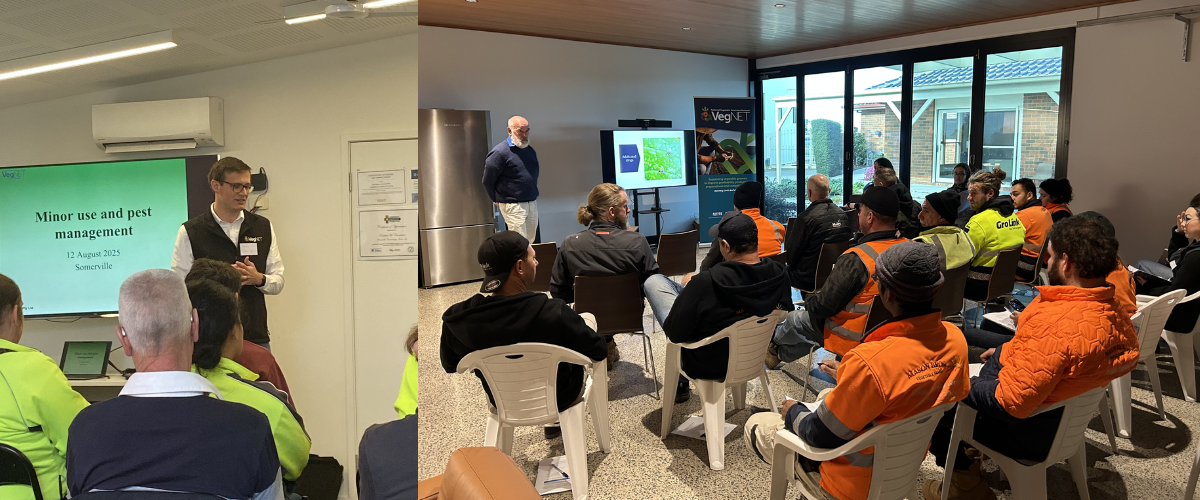
VegNET Victoria is delivering value to growers with its Winter Warmers program responding to the priorities growers have expressed.
IPM WORKSHOP
In Werribee, a workshop focused on IPM management of Serpentine leafminer (SLM), farm biosecurity, and White blister.
Serpentine Leafminer
Paul Horne (IPM technologies) presented his latest work managing SLM in spinach. While spinach is a highly vulnerable crop to SLM, Paul has helped one major grower to go insecticide free by building up beneficial parasitic wasps.
The beneficial wasps exist naturally in the environment but often at low levels. SLM populations boom when a susceptible crop is planted and the damage is done before the beneficial wasps build up to effective levels.
Paul described how sacrificial lure beds were planted six weeks in advance of the new cash crop. These beds of spinach were filled with SLM but by the time the spinach came up, the beneficials had controlled the population in the sacrificial beds. The high beneficial population protected the young crop, reducing inputs and reducing rejections on sales.
An alternative option was discussed involving using a trap crop to attract SLM and then using insecticide to wipe out that pest population instantly. The downside of this is that the beneficial wasps are much more vulnerable to chemicals than SLM and will also be affected.
The group discussion centred on the declining efficacy of several insecticides. Limited systemic options were available that penetrated the leaf layer to kill the larvae. Resistance issues had broken several of these options and others had to be used off-label with maximum residual level (MRL) testing.
Farm biosecurity and White blister
Shakira Johnston (AUSVEG Biosecurity Coordinator) presented AUSVEG farm biosecurity material to the group, using luminescent powder and a blacklight to demonstrate how spores from disease can be spread easily and the importance of ‘Come Clean, Go Clean’ principles.
A range of biosecurity tools were discussed with growers including washdown pads for machinery and vehicles, signage, visitor logs, and creating your own formal farm biosecurity plan. The AUSVEG Farm Biosecurity Manual: Your Guide to Farm Biosecurity Planning guide is now available at the AUSVEG website.
AGRICHEMICAL MASTERCLASS AND BIOFERT ADVANCEMENTS
An agrichemical masterclass by Peter Dal Santo (AgAware) and a presentation of microbiological farming and biofertiliser production by Daniel Hodges (Peninsula Fresh Organics) made for an unusual pairing but drew a good crowd in Somerville. This event sponsored by Muirs also allowed for the presentation of Prev-Am a contact insecticide and fungicide.
Minor Use Permits
Peter Dal Santo shared his extensive insights into minor use permits. Growers learned the complicated ins-and-outs of how and when Victoria’s unique laws allow them to use products off label with proper MRL testing and following correct application conditions. Peter also explained major crops vs minor crops, major pests vs minor pests, minor use criteria, and how to get a minor use permit.
Peter also explained the increasing challenges associated with MRL testing. Residual non-compliance comes with potential loss of clients, market access and contracts. Liability for MRL non-compliance can fall entirely on the farmer or also onto the agronomist if the farmer applied the active in line with their recommendations.
Australian Pesticides and Veterinary Medicines Authority (APVMA) updates and reviews
Peter explained which chemical actives the APVMA is currently reviewing. He provided the latest available information on chlorpyrifos, diquat, paraquat, neonicotinoids, chlorothalonil and others that are facing deregistration or changes to label.
Peter urged growers to engage with the AUSVEG Strategic Agrichemical Review Process (SARP). The SARP provides a comprehensive list of chemicals registered for pests on individual crops. They also provide an avenue for growers to give feedback to the APVMA about their chemical priorities and what is important to them. The APVMA uses the SARPs in their decision-making process around chemical reviews and whether to renew minor use permits when they expire.
For more information on SARPs or what AUSVEG is doing to maintain minor use permits can be found by contacting David Daniels at david.daniels@ausveg.com
Drone spraying
Peter explained how Victorian law allows growers to read chemistry labels in relationship to drone spraying. While drones spraying falls under the category of helicopter spraying, Victorian off-label law allows more flexibility if spray conditions are met and MRLs are done properly. The exception is if a label says ‘Do Not’ apply by air.
A recent presentation from the APVMA also informed industry partners that understanding spray drift from drones is causing the holdup for more chemistry being registered for drone spraying.
2.4 Microbiological Farming
Daniel Hodges kindly provided his insights into biofertiliser production and how it fits into a farming system. In the era of rising input costs and greater regulation on synthetic chemistry, some farmers are looking to make fertilisers with organic materials like composts and manures. Daniel highlighted a number of cheap additives that can be purchased off the shelf locally that can be mixed with biofertilisers to provide a broad set of micronutrients and macronutrients.
His message to growers looking to start making fertilisers at home. “Start small – have a go!”, it is easy to scale up later. There are hundreds of resources available for free online, and he was willing to have a chat to anybody and share his experiences. Daniel also encouraged using sap and tissue testing to back up results. Every crop and soil is different and may require a different mix to address deficiencies.
Ultimately, Daniel was encouraging growers to make the microbiology of the soil to do the work for you. ‘Soil is more than a medium to keep plants upright.’ Biofertilisers are one element within a broader holistic approach to farming. Peninsula Fresh Organics has embraced a system wide approach to maintaining organic matter and creating disease suppressive soil. This soil, according to Daniel can withstand continuous (crop in/crop out) cropping and no rotations while still maintaining 4 percent organic matter.