


VegNET WBB: Post-flood recovery in the Wide Bay Burnett
18 May 2026
VegNET NT: Key takeaways from the 2026 Thailand Vegetable Industry Study Tour
18 May 2026
Reading Time: 5 minutes
BY SANDRA GODWIN

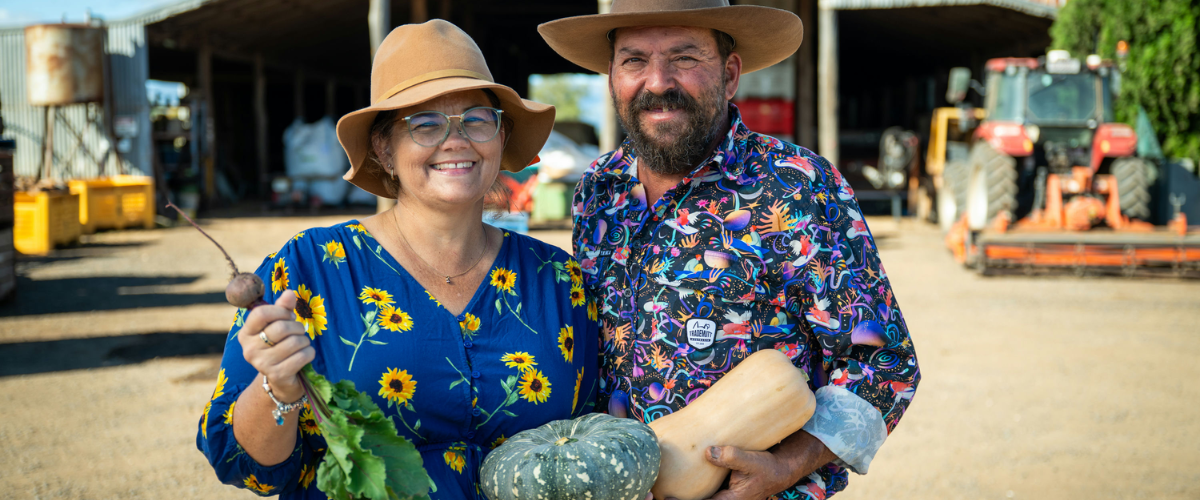
Gatton vegetable and onion grower Tim Logan from Glenette Produce.
Glenette Produce is using Level Up Hort to turn a century and a half of tradition into a more confident, modern farm business, without losing its family feel.
Glenette Produce grows potatoes, beetroot, onions, pumpkins and lucerne across 56 hectares of rich dark soils about 15km south of Gatton in South East Queensland.
Tim Logan is the latest in a long line of Logans farming the property, which has been in the family since 1869 and is thought to be the oldest continuously family farmed property in the Lockyer Valley.
His parents, Glenroy and Lynette, are still heavily involved, and Tim’s teenage son, Wyatt, is keen to return to the farm once he has a trade behind him.
Mr Logan has worked on the farm since finishing school, aside from a drought driven stint driving trucks, returning full time around 2017.
After a period when Glenette Produce focused on lucerne, the farm returned to producing vegetables in 2015.
Mr Logan has since added beetroot and watermelons to the crop mix and begun updating equipment to reduce constant repairs, while also taking on the job of learning cashflow budgeting with help from the accountant and bank.
“I’d never done them before, so I had no idea,” Mr Logan said.
“Over the last three or four years, I’ve slowly been learning how to do them and get them more accurate.”
Why they joined Level Up Hort
Glenette Produce has been in Level Up Hort from the start, after Mr Logan’s wife, Carley, saw the Hort Innovation levy-funded program mentioned in an AUSVEG newsletter.
At that point, Mr Logan’s mum handled all the bookwork and cashflow budgets and preferred to keep the accounts simple. This was fine for meeting their tax obligations, but not detailed enough for business analysis.
Mr Logan was looking to better understand where the business was making money and where it was going backwards, as well as answering basic questions such as how much herbicide they used each year or what each crop cost per hectare to produce.
The program’s confidential business analysis and benchmarking reports, along with guidance from RMCG consultant Lauren Jones, offered a way to compare Glenette’s performance against similar farms.
Early results were confronting, showing the business at the lower end of both cost and income per hectare, with margins thinner than many others.
The reports confirmed what Mr Logan suspected: the family had been running an extremely tight cost structure, influenced by his parents’ experiences farming through tough times, but that didn’t automatically translate into stronger profitability.
“No one wants to spend more,” he said.
“But if we spend in the right places, our income will then improve.”
Changing systems and conversations
To get more value from the program, the Logans changed how they collected and recorded information.
Mrs Logan took over data entry, restructuring the accounts so that individual chemicals, fertiliser and packaging were allocated more precisely across crops instead of being bundled together.
This has given Mr Logan and RMCG more accurate figures to work with and allows the family to pull up numbers such as total herbicide use or true per hectare input costs. The program has also supported a rethink of who does what on the farm.
For years the family tried to do almost everything themselves, from harvest through to packing, which meant ground work and planting slipped when crops were coming off. It also put everyone at risk of burnout.
With benchmarking data and Ms Jones’s input, Mr Logan has been able to make the case for bringing in local labour contractors and sending more produce to a Gatton packing house, even when that added 20-50 cents to the cost of a bag of onions.
“Our thing is time,” he said.
“The extra bit of expense isn’t much, it’s the time that it takes. We’ve now got that time over two weeks to get the ground worked and replanted again, instead of a month later.”
From tension to strategic planning
One of the biggest shifts has been in how the family talks about the business.
Mr Logan recalled a turning point after the initial call with an adviser, when his mother said, “I understand what you’re trying to do,” and offered to explain the changes to his father.
Now in their 70s, Glenroy and Lynette have become more open to using contractors, investing in inputs that lift quality and yields, and stepping back from the heaviest jobs. This has had the happy effect of freeing up their time in the past two years to travel Australia and join an industry study tour to Europe.
Regular cashflow budgets and Level Up Hort’s annual reports have also changed Glenette Produce’s relationship with its bank.
Mr Logan now aims to keep forecasts up to date so the bank can see in advance when the business is likely to dip into overdraft and why.
Being able to sit down with managers who understand what is happening across the valley, explain the impact of issues such as onion disease or oversupply of pumpkins, and back that up with detailed figures, has built confidence on both sides.
“They don’t mind helping you,” he said.
“It’s just they need to know when they’re going to have to help you. They don’t like surprises.”
Those same reports are laying the groundwork for future strategic decisions, including whether to drop or expand particular crops and how best to use the farm’s equity to invest in new equipment or systems.
While the Level Up Hort program cannot guarantee a profit in every season, Mr Logan said it had given him a clearer understanding of costs, the confidence to spend where it counted, and a framework for more constructive conversations.
What is Level Up Hort?
A five-year initiative fully funded through Hort Innovation, the Level Up Hort program provides high-value, specialised business reviews with a business consultant from experienced project partners Planfarm or RMCG.
It is open to vegetable and onion growers, who receive two annual reports – a full business analysis and a benchmarking report, both private and confidential, comparing their figures against others. Each year the participant data is de-identified, combined and reported on a per hectare basis or as ratios for a national report which completely anonymises growers.
The project team uses targets for key financial ratios enabling consultants to help businesses set internal goals and benchmark against themselves as well as the whole industry. These targets highlight priority areas to address within the business and drive continual improvement year on year.