


VegNET Gippsland: Farm World 2026: Showcasing innovation, resilience, and a strong future for Gippsland agriculture
18 May 2026
Demonstrating the future of weed management: OWL in action
18 May 2026
Reading Time: 5 minutes
Interest in managing soil biology and plant nutrition is continuing to emerge across Tasmania’s vegetable and onion industries.
Growers are increasingly looking at how regenerative agriculture principles can fit within commercial systems. Opportunities to improve input use efficiency and reduce reliance on synthetic products are key drivers. In response, VegNET Tasmania has developed Growing Regeneratively, a 12-month interactive program for young growers to build knowledge of regenerative approaches they can apply in their farming operations.
Growing momentum
In mid-2025, Julius Joel from G’s Group, one of Europe’s leading fresh produce companies, spoke at a VegNET Tasmania event following his presentation at Hort Connections. Julius shared G’s Group’s journey in trialling and adopting a range of regenerative practices, driven by the need to find alternative management approaches in response to rising input costs and the pressure to remain profitable.
G’s Group’s early success with its Johnson Su compost trial and other aspects of regenerative vegetable production, combined with farm visits such as the Mulgowie Farming Company farm tour during the VegNET Gatton Ag-tech Study Tour, has sparked strong interest amongst Tasmanian growers in using soil biology and smart plant nutrition management to lower input costs and increase system resilience.
Prue and Tayla, the VegNET Tasmania team, are responding to vegetable growers’ interest with a simple focus: how do we build the confidence needed to turn interest and ideas into practical, on-farm action?
That’s where the Growing Regeneratively program comes in.
Kicking off in April 2026, this new 12-month program has been designed specifically for Tasmanian vegetable and onion levy-paying growers, along with a small group of industry advisors. It will have a mixture of on-farm learning, study tours, and both in-person and online sessions with external experts.
Growing Regeneratively aims to support growers who want to build healthy, resilient soils and crops, and are ready to trial or implement change in their business. The program will focus on building confidence in starting small and trialling new ideas on farm, with the added support of a local grower and advisory group to share experiences and learn from each other.
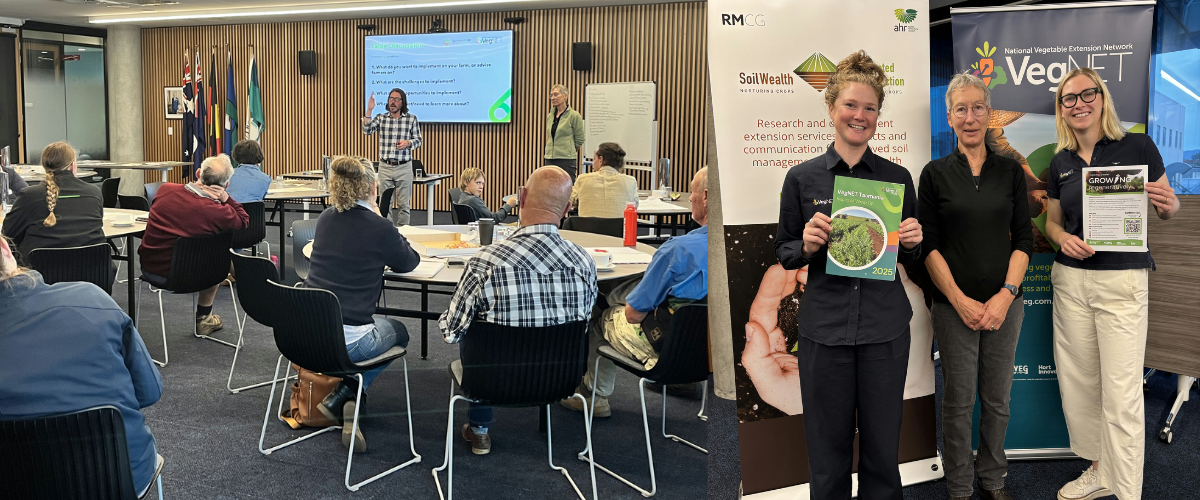
L-R. Group discussion at the Joel Williams guest speaker event. Prue Rothwell, Doris Blaesing and Tayla Field from the VegNET Tasmania and Soil Wealth ICP team.
Delivered by VegNET Tasmania and funded through Hort Innovation using the vegetable and onion R&D levies (with contributions from the Australian Government), the program is structured to be flexible and fit around the key production periods. The activities will evolve with the group’s interests to ensure the program remains relevant and valuable.
By the end of the 12 months, growers will have developed a simple, practical regenerative production plan for their farm with clear goals and actionable steps to take forward. They will also have the confidence to test new ideas and make decisions that suit their own operation. The VegNET team is committed to keeping the program practical and fun while equipping growers with the tools, ideas and networks needed to successfully apply regenerative approaches in vegetable production systems.
From theory to paddock
Joel Williams unpacks the ‘how’
In March, VegNET Tasmania welcomed Integrated Soils’ soil and plant health educator, Joel Williams, to talk with the Tasmanian industry about opportunities to reduce and replace inputs and redesign systems.
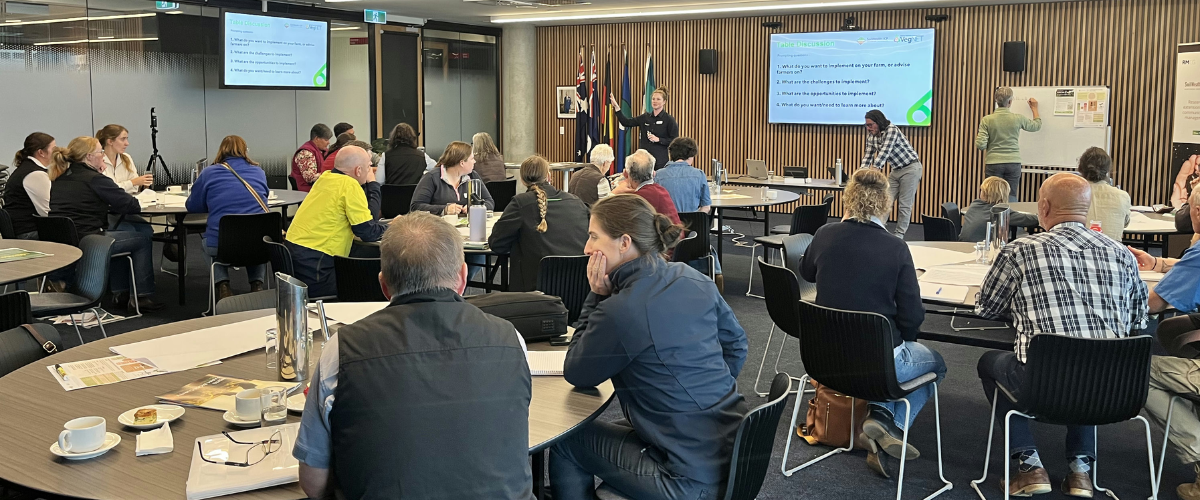
This was done in an all-day interactive event as part of the Growing Regeneratively program, in collaboration with the vegetable levy-funded Soil Wealth and Integrated Crop Protection Project. One of the key focus areas for the day was on integrated nutrient management, with a simple message that it’s not always about putting more on but getting more out of what you’ve already got.
Joel explained the concept of ‘losing less and using less’ – focusing on improving efficiency rather than increasing inputs. To help frame this idea, he introduced the ESR approach: Efficiency, Substitution, and Redesign.
HERE ARE SOME OF OUR KEY TAKEAWAYS
Efficiency
For most vegetable growers, the starting point is improving efficiency.
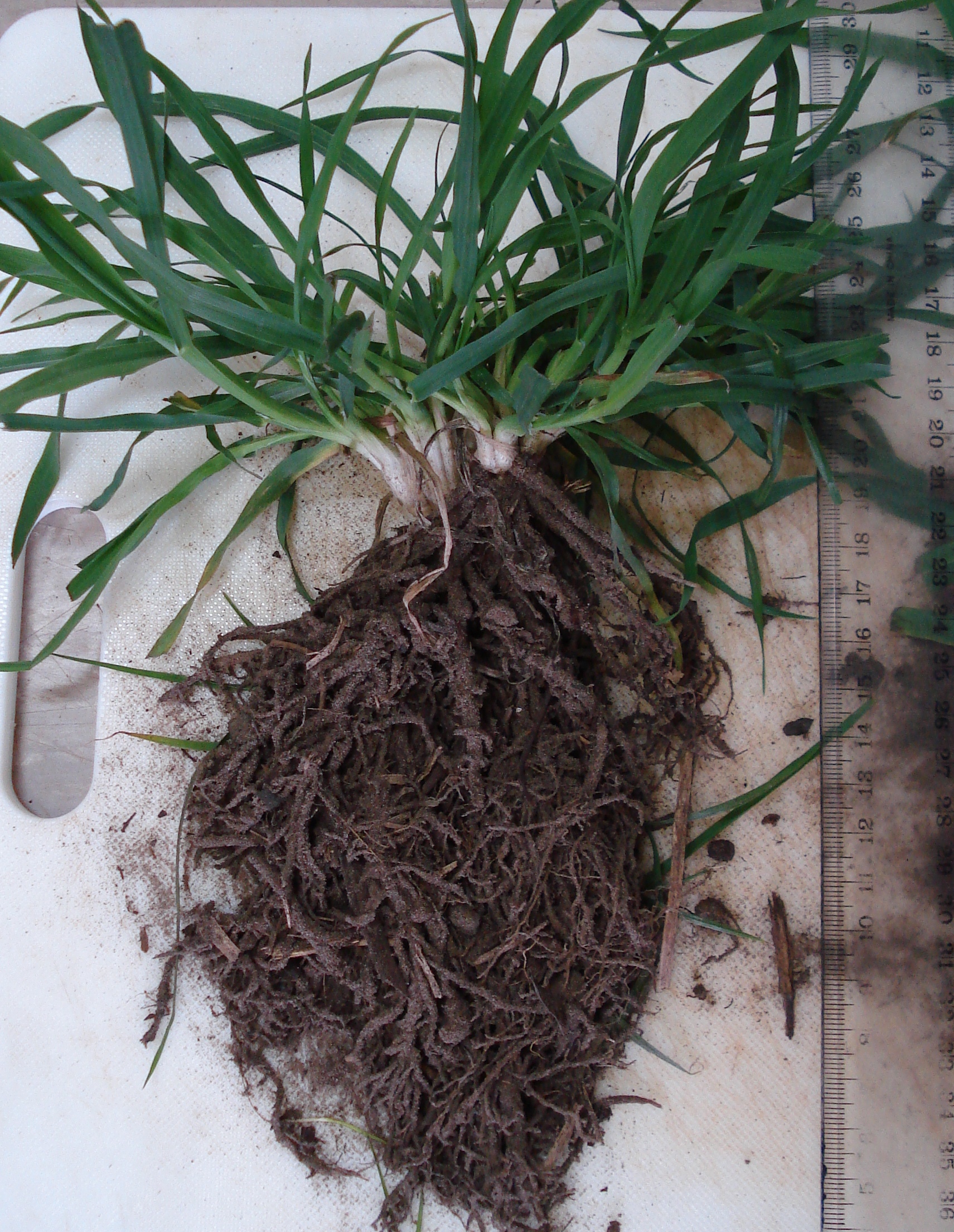
Plant rhizosphere sample
- For nutrient use efficiency, growers were reminded to start with good information – such as soil tests and data on crop nutrient removal – to make informed decisions about application type, rate, timing and placement. Utilising tissue or sap testing during the season can also help identify what the crop actually needs – because if it doesn’t need it, it’s not going to take it up.
- Targeting input timing based on crop growth stages.
- Testing spray water quality is often overlooked, but it can impact how well any foliar applied product works before it’s even left the tank. Salinity and pH >6 as well as turbidity can reduce efficacy.
- Foliar feeding was positioned to complement soil nutrition rather than replace it, useful for targeting deficiencies or imbalances especially when root uptake is delayed or hindered due to soil conditions or weather. By applying nutrients directly to the leaf, growers can work around inefficiencies in the soil such as root zone restrictions, nutrient tie-up or leaching or effects of extreme temperatures, and have a much faster plant response with lower input costs.
- Adding organic matter in different forms can improve soil health, support soil life diversity and enhance nutrient use efficiency.
Substitution
Substitution of inputs involves looking at alternatives like biological products or carbon-based inputs.
- An easy win for growers is integrating a carbon source with nutrient application such as a humic or fulvic acid, which can act as a sponge, binding to the nutrients and making them more available to plants.
- Joel advised growers to always ask questions and look for the data behind new products, rather than taking claims at face value.
- Applying biology as a seed treatment can be a simple, effective way to support early crop establishment. It targets root development and rhizosphere interactions, often more efficiently than trying to shift the whole soil microbiome. Seed already carries its own natural microbiome, and applying a suitable treatment can support its function. Fungicide coating may interfere with biology around seed, and this area warrants further exploration.
Re-design
How can a production system be re-designed to be sustainably efficient and less susceptible to pests, weeds and diseases?
- Joel emphasised that diversity, especially functional diversity, should be the ultimate goal. This can be achieved through crop rotations, multispecies cover crops and pastures, or even variety blends within the same crop. Increasing above-ground diversity will supports soil biological diversity. Incorporating plant diversity in the productive landscape (e.g. remnant bush, riparian plantings, wind breaks, hosting beneficial insects) is also key part of re-design. When done well, it can improve pest and disease management, enhance resource use, and build overall system resilience.
Across the board, one theme kept emerging: roots matter and soil compaction is a major challenge. Building root mass below ground plays a big role in crop resilience and building soil carbon. Large, healthy root systems in well-structured soil support microbial activity, improve nutrient cycling, reduce reliance on external inputs, and reduce irrigation needs. On the flip side, crops with plenty of top growth but limited root systems tend to need more support to get through the season.
For those in the room, the value of the day was in keeping things grounded. No silver bullets, unicorns or ‘silver unicorns’ as they were named on the day – just a range of practical ideas that can be tested, adapted and applied depending on the farm. Growing Regeneratively will carry this approach forward as it gets underway this season.