


Protected cropping in action
18 May 2026Pricing squeeze on vegetable growers confirmed in latest official statistics
18 May 2026
Reading Time: 4 minutes
VEGNET
South Australia
REGIONAL UPDATE
Exploring how South Australia’s horticulture sector is navigating fuel, fertiliser, and biosecurity challenges through the combined strength of skilled growers and extension, this piece highlights the vital role of extension in translating policy into practice, supporting decision-making, and feeding real-time insights into advocacy – ensuring growers remain informed, connected and resilient in an increasingly complex and uncertain risk environment.
The expanding role of horticulture extension in times of systemic risk
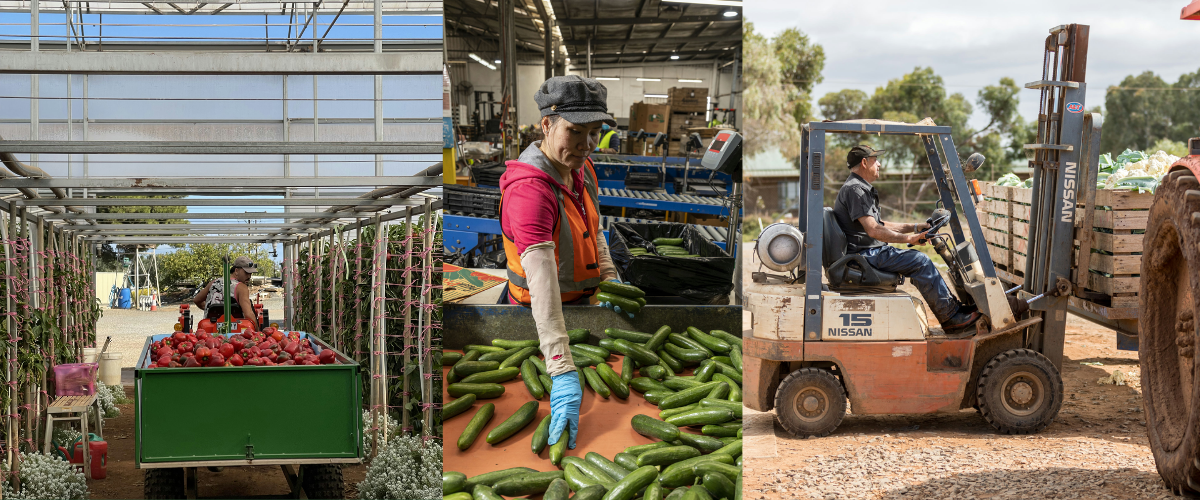
South Australia’s horticulture sector has long been defined by its adaptability, technical capability and the deep, practical knowledge of its growers. From intensive protected cropping systems to broadacre vegetable production, growers operate at the intersection of biology, climate, logistics, and markets – making complex decisions daily that directly influence productivity, profitability and food supply.
In recent months, however, this complexity has intensified. Ongoing uncertainty around fuel supply, fertiliser access and mounting biosecurity pressures has created a layered risk environment unlike anything seen in recent years. In this context, the role of the horticulture extension officer has evolved significantly. No longer confined to knowledge transfer alone, extension now operates at the critical junction between agri-politics, policy, biosecurity and on-farm decision-making – ensuring that growers are not only informed but equipped to act.
At the centre of this system are the growers themselves: highly skilled, deeply experienced business operators who continually adapt to shifting conditions. Extension does not replace this expertise – it amplifies it, providing the clarity, coordination and confidence needed to respond under pressure.
Grower capability at the core
It is important to recognise that South Australian vegetable growers are not passive recipients of information or support. They are active problem-solvers, innovators, and risk managers, demonstrating a high level of technical and operational competence.
The recent fuel and fertiliser challenges have once again highlighted this capability. Faced with rising costs, uncertain supply and logistical constraints, growers have responded with resourcefulness – reviewing input efficiency, negotiating supply arrangements, exploring alternative products, and adjusting crop scheduling where necessary.
However, even the most capable operators require access to accurate, timely and relevant information to make confident decisions, particularly when conditions are changing rapidly. This is where extension plays a critical role.
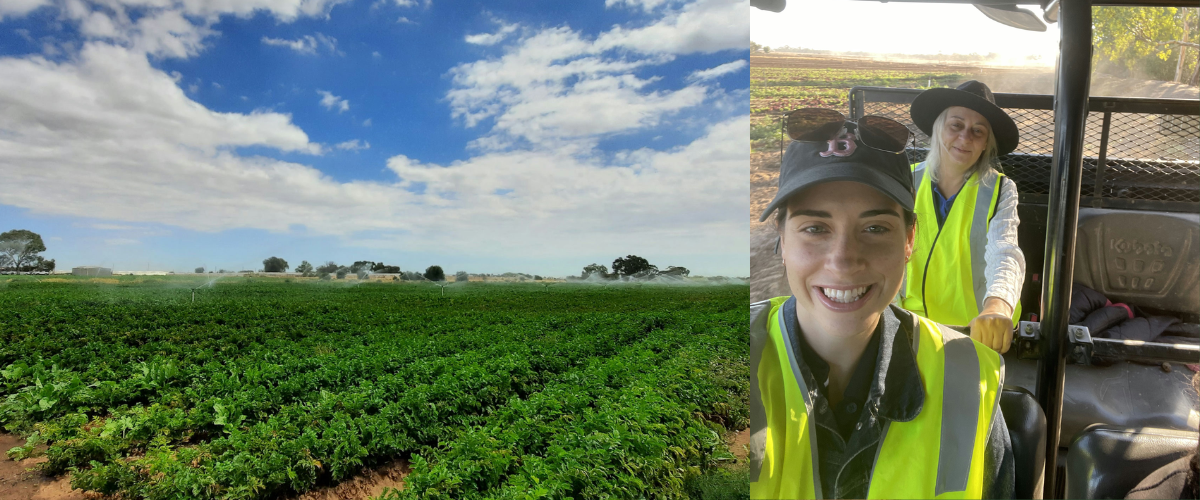
L-R. Extension Officers Kirsty and Peta on farm. Lettuce crops, Northern Adelaide Plains.
The agri-political landscape: turning insight into influence
The response to fuel and fertiliser concerns has underscored the importance of coordinated agri-political engagement. While government efforts have focused on maintaining national fuel reserves and stabilising supply chains, the realities in regional production zones have been more nuanced.
Industry bodies such as AUSVEG SA carry the responsibility of representing these realities, ensuring that decision-makers understand the operational impacts of policy settings, market volatility and supply chain disruptions. But effective advocacy depends on credible, real-time evidence and extension, particularly through programs like VegNET.
Extension officers act as interpreters of uncertainty. They distil government briefings, policy updates and market signals into clear, practical insights that growers can apply immediately. At the same time, they ensure that grower experiences – often diverse and region-specific – are captured and communicated back to advocacy channels.
In times of disruption, information becomes one of the most valuable resources available to industry. Extension officers play a central role in gathering, validating and distributing this information, effectively operating as an intelligence network across the horticulture sector.
This network functions in two critical directions:
- It translates external developments into on-farm implications. Government policy, biosecurity directives, fuel supply updates and fertiliser market trends are analysed and contextualised, allowing growers to understand not just what is happening, but what it means for their business.
- It captures the lived experience of growers. Extension officers engage directly with producers to identify emerging risks such as regional fuel shortages, AdBlue constraints, fertiliser delivery delays, workforce disruptions and cost pressures. These insights are then fed back into advocacy and policy discussions.
This two-way flow of information is essential. It ensures that growers are not operating in an information vacuum, and that policymakers are not making decisions without understanding their practical consequences. Importantly, it also reinforces the value of grower knowledge. The observations and decisions made on-farm are not isolated – they contribute to a broader understanding of industry conditions and inform responses at a systemic level.
Navigating complexity on farm
The convergence of fuel and fertiliser challenges created a particularly complex decision-making environment for growers. Fuel underpins nearly every aspect of production – powering irrigation systems, machinery, harvest operations, freight and biosecurity responses. Fertiliser, meanwhile, directly influences crop performance, yield potential and soil health.
These inputs are not independent. Disruptions in fuel supply can affect fertiliser distribution. Fertiliser shortages can alter crop scheduling. Together, they have implications for market supply, pricing and long-term sustainability.
Growers are responding to this complexity with a high degree of skill. Many are reassessing input use efficiency, optimising application timing, and exploring alternative nutrient sources. Others are strengthening relationships with suppliers, coordinating logistics more closely, and building contingency plans into their production systems.
Extension officers support these efforts by providing context and clarity. They help growers interpret market signals, understand potential scenarios, and evaluate options within the framework of their specific enterprise.
Crucially, extension also provides confidence. In situations where information is incomplete or rapidly evolving, having access to a trusted, knowledgeable advisor can make the difference between reactive decision-making and strategic action.
The road ahead: a coordinated approach
As ongoing uncertainty around fuel supply, fertiliser access and mounting biosecurity pressures continues to shape the operating environment, the horticulture sector is navigating a level of layered risk unlike anything seen in recent years. In this landscape, the combination of grower expertise and a strong, responsive extension network will be critical. Growers bring the skill, experience and adaptability to respond, while extension ensures they are supported with the intelligence, connections and clarity needed to act with confidence. Together, they form a system that is not only capable of managing disruption, but of adapting and strengthening through it.