


VegNET WA: Supporting growers across WA
18 May 2026
VegNET SA: Skilled growers, strong systems – Extension in a time of disruption
18 May 2026
Reading Time: 3 minutes
While protected cropping has long had a place in Australian horticulture, it has previously been considered a niche sector compared to traditional growing methods.
This perception is partly due to the investment required to do it properly, including building glasshouses, installing irrigation and nutrient systems, and managing the conditions inside them to ensure optimal growing environments.
But this view is beginning to shift.
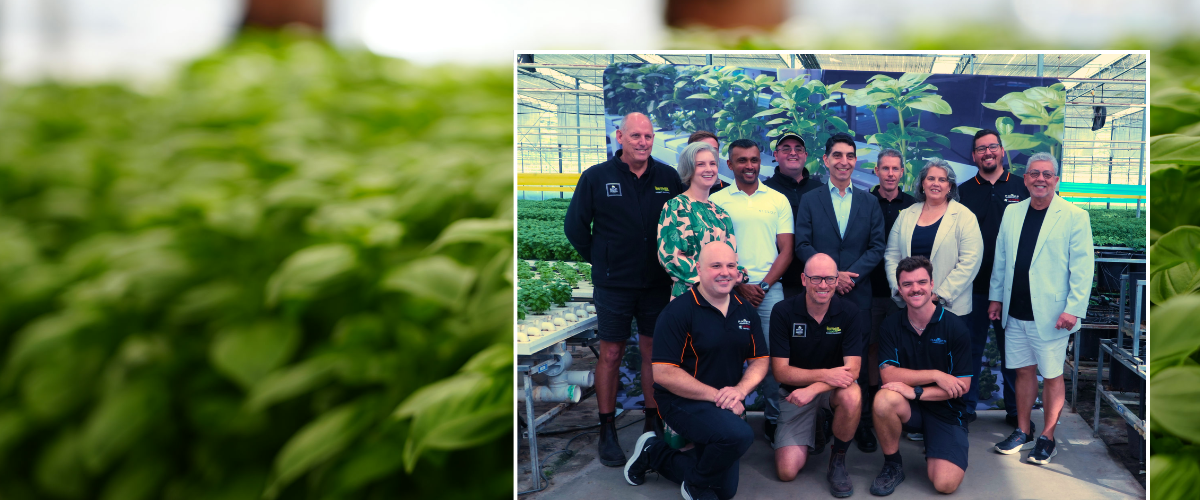
Butler Market Gardens operates 12 cropping sites across various locations, growing fresh herbs and vegetables that it supplies to major retailers. This includes its operation at Lyndhurst near Melbourne, where they predominantly grow herbs in 3000 square metres of protected cropping space.
“We’ve been here for about eight years, and historically, this facility was a flower farm,” Chief Executive Officer Rick Butler said.
“Demand for herbs and flavour really grew from about 2010 onwards, aligned to popular TV shows like Master Chef. This also aligned to new formats of units sold like punnets and sleeved herbs. An opportunity came along to get access to this great facility with winter heating via an environmentally friendly biomass boiler.”
Mr Butler said there is a very simple reason why protected cropping has a place in horticulture and is becoming increasingly popular.
“They aren’t making any more land now, and in and around Melbourne a lot of the good soil now has houses on it. Protected cropping plays a role in growing products with a smaller amount of area.
“Not for every crop, there’s certain things that you can’t grow. You obviously can’t grow carrots and onions and things like them in here because they need to be grown a certain way. But I think from an environmental and sustainable perspective, we’re growing products and turning them around in four weeks. Our record here is 18 days from planting to harvest with the product within spec for our customers, so that’s nice and quick.
“I think that moving forward more leafy green products are starting to be grown in projected cropping. Probably spinach, kale, cos lettuce. Some of those other soft, short shelf life, products. They’re the ones that need to be close to the consumer because they have to have the shortest distance and timeframe from where it’s grown to the consumer being able to buy it.”
YieldX trial
Since November last year Butler Market Gardens’ Lyndhurst greenhouse has hosted a commercial trial of a high-density growing system, designed to unlock unused space and boost production capacity.
The system was developed by YieldX using technology originally engineered by NASA for its deep space food program.
“It’s a bit hard to explain, but basically the system grows with the plants,” YieldX Chief Executive Officer and Chief Technology Officer Nadun Hennayaka said.
“As the plants grow, the ‘white space’ gets smaller to accommodate the plant size. Very simple concept, very simple model, but by doing that, we can increase the plant density.”
“I do a lot of reverse engineering work as a hobby. So being a hobby tinkerer, I figured this would be a nice way to change things.”
Mr Butler explained that he was drawn to the project as it addresses two key inefficiencies in his operation.
“One is maximising the actual yield that I can get from the space within the glasshouse. We’re standing in a 1000 square metre glasshouse here that predominately grows basil and soft herbs. So, we want to maximise the space and to have as much product in here as possible, especially during the winter.
“The second most important thing was labour efficiency. Walking all the way down the end of the row and walking all the way back is time consuming, and you’ve got the cost of labour going up year by year. And we’re not necessarily getting too much more for a product.
“So, economies of scale must come into play here to remain viable long term – fundamentally, more volume at lower cost, [especially when] labour is making up nearly 50 percent of most farmers’ costs.”
Protected cropping is moving beyond its niche status as growers seek more efficient, sustainable ways to produce fresh food close to consumers, securing its growing role in Australian horticulture.