



No potato left behind: How Daly Farm is creating value from every crop
31 August 2026From model to field: How VegWatch surveillance works on the ground
31 August 2026
Reading Time: 4 minutes
BY DANIEL SUTTON
Twenty years ago, the introduction of tomato-potato psyllid (TPP) changed New Zealand potato production forever. What began as the arrival of a new insect pest quickly developed into one of the country’s most significant biosecurity and production challenges. Over the following two decades, growers, scientists and industry worked together to better understand the pest, develop practical management strategies and reduce its impact. Today, that shared knowledge is helping Australian growers prepare before TPP becomes a widespread challenge.
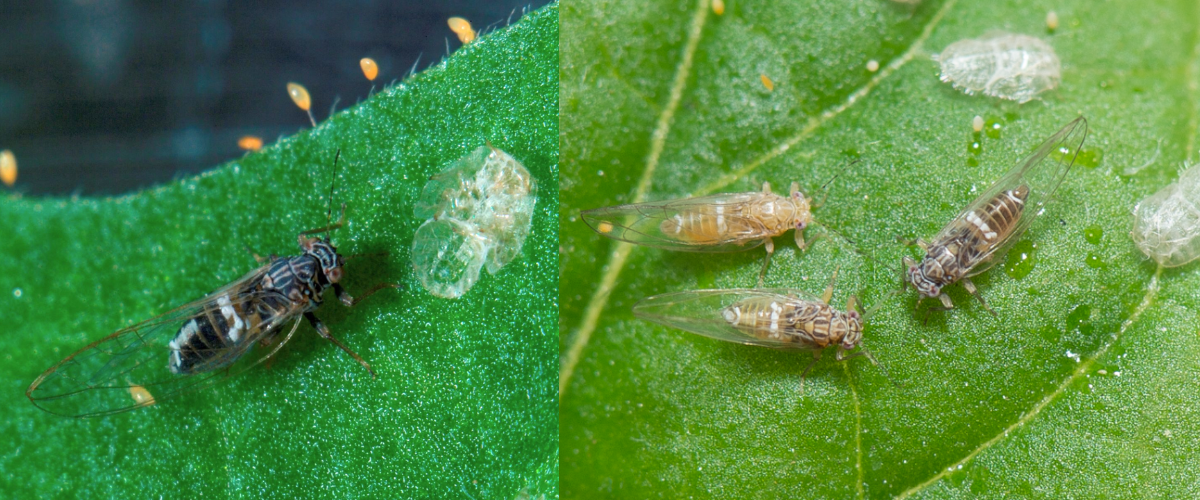
TPP is a small sap-sucking insect that feeds on solanaceous crops, including potatoes, tomatoes, capsicums and tamarillos. While feeding damage alone can reduce plant vigour, the greatest threat comes from its ability to transmit the bacterium Candidatus Liberibacter solanacearum (CLso), which causes zebra chip disease in potatoes. Tubers affected by zebra chip develop characteristic brown striping that becomes highly visible after frying, making them unsuitable for processing and significantly reducing crop value.
Following its arrival, TPP spread rapidly throughout New Zealand’s potato-growing regions. The impacts were immediate and significant. Growers experienced substantial yield losses, production costs increased dramatically, and management programs had to evolve rapidly to respond to an entirely new pest. The experience highlighted just how vulnerable potato production could be to an insect capable of transmitting a devastating plant pathogen.
The experience highlighted just how vulnerable potato production could be to an insect capable of transmitting a devastating plant pathogen.
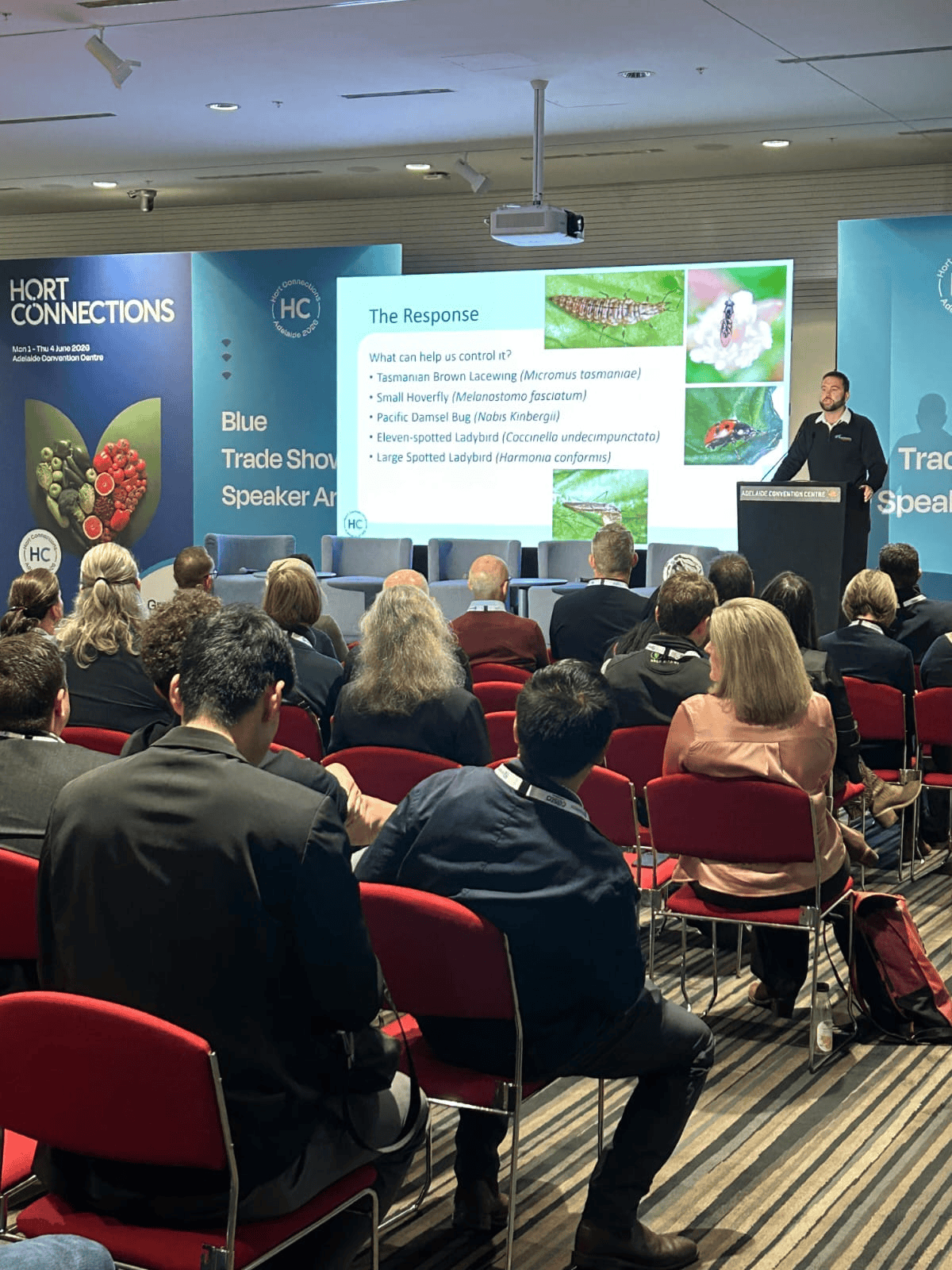
Daniel Sutton presenting at Hort Connections.
Building a coordinated response
While the initial response focused on protecting crops with insecticides, it quickly became clear that long-term sustainability would require much more than simply increasing spray programs.
One of the greatest strengths of New Zealand’s response was the coordinated research and industry effort that followed the pest’s arrival. Scientists from the Bioeconomy Science Institute worked alongside Potatoes NZ, Tomatoes NZ, growers, agronomists, agrichemical companies, government agencies and other research partners to rapidly build the knowledge needed to manage this new pest. This collaborative approach ensured that scientific discoveries could be readily translated into practical tools and advice for growers, while industry experience helped shape future research priorities.
Extensive efficacy testing identified which insecticides were most effective against different life stages of TPP and how these products could be integrated into resistance management programs. This work provided growers with confidence that products were being used at the right time and in the most effective sequence, while also supporting product registrations and label improvements over time. Oils as an alternative to insecticides were also tested with some outstanding results at farm-scale.
Researchers also recognised that sustainable management required working with nature rather than against it. Studies identified several naturally occurring predators capable of suppressing TPP populations, including Tasmanian brown lacewings (Micromus tasmaniae), hoverflies (Melanostoma fasciatum), Pacific damsel bugs (Nabis kinbergii), eleven-spotted ladybirds (Coccinella undecimpunctata) and large spotted ladybirds (Harmonia conformis). Understanding how to conserve and encourage these beneficial insects has become an increasingly important component of integrated pest management (IPM).
Success has come from integrating world-class science, grower experience and practical on-farm management into a coordinated approach.
Driven by industry, New Zealand also introduced the specialist parasitoid Tamarixia triozae, following approval from the Environmental Protection Authority, to target TPP nymphs. Alongside this, scientists developed a greater understanding of the native predatory mirid Engytatus nicotianae, which feeds on eggs and young nymphs. Together, these biological control agents demonstrated how natural enemies can complement insecticide programs and contribute to long-term suppression of TPP populations.
Scientists from the Bioeconomy Science Institute also recognised that managing TPP extended well beyond the crop itself. Several alternative host plants, including African boxthorn, poroporo, thornapple and apple of Peru, were identified as reservoirs that allow psyllid populations to survive and reproduce between cropping seasons. Understanding these hosts has improved knowledge of where TPP populations originate, how they move through the landscape and when crops are most vulnerable. This information now plays an important role in surveillance, monitoring and seasonal risk assessment.
Knowledge drives better decisions
Crop monitoring has become one of the cornerstones of New Zealand’s management strategy. Effective monitoring is about far more than simply detecting the presence of psyllids. Correctly identifying TPP, distinguishing it from other psyllid species and accurately assessing population levels became essential skills for growers and crop scouts.
Regular crop scouting, combined with sticky trap networks and regional surveillance programs, provides valuable information on when psyllids are moving into production areas and how populations change throughout the season. Degree-day models add another layer of information, allowing growers to predict pest development under local conditions. When combined with knowledge of alternative hosts and seasonal weather patterns, these tools enable growers to make informed management decisions rather than relying solely on calendar-based insecticide applications.
Importantly, New Zealand’s experience has shown that monitoring is not simply about managing psyllid numbers. The real objective is understanding the risk of CLso entering the crop. Because a psyllid carrying Liberibacter can infect a plant within minutes of feeding, management decisions need to focus on reducing the likelihood of infected psyllids establishing within crops. Bringing together information from crop scouting, trap catches, degree-day modelling, regional surveillance and knowledge of alternative hosts provides growers with the best opportunity to assess this risk and respond appropriately.
Following a highly challenging 2020 season, which saw a resurgence in zebra chip pressure across Canterbury potato crops, growers and processors established the Canterbury Potato Liberibacter Initiative (CPLI). Recognising that the industry’s understanding of TPP had advanced considerably, but that significant knowledge gaps remained around Liberibacter itself, CPLI renewed investment in understanding the disease, strengthening surveillance and forecasting, investigating biological and cultural management options, and supporting research into disease epidemiology and future technologies. The initiative demonstrates the value of growers driving research priorities to address emerging industry challenges.
Looking ahead
After nearly two decades of research and industry collaboration, New Zealand’s greatest lesson is that there is no single solution to TPP. Success has come from integrating world-class science, grower experience and practical on-farm management into a coordinated approach. Effective insecticides, biological control, crop monitoring, trapping networks, alternative host research, disease epidemiology and coordinated extension all play an important role, but it is their integration that has made the greatest difference.
As Australia prepares to combat TPP, it has the advantage of learning from New Zealand’s experience rather than repeating it. By applying the lessons of the past two decades, Australian growers have an opportunity to build resilient management programs before the pest reaches the level of impact experienced in New Zealand.