


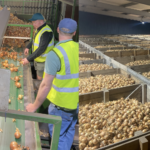
Onion study tour shows industry scale in the European Union
2 March 2026January to November 2025: Australian potato export performance overview
2 March 2026
BY DAVID DANIELS | NATIONAL AGRICHEMICAL MANAGER, AUSVEG
The Onion Strategic Agrichemical Review Process (SARP), published 12 months ago, provided a clear and credible snapshot of the crop-protection landscape facing Australia’s onion industry. It documented where key chemistries have already been lost, where regulatory pressure is building, and where future risks are most likely to emerge. For growers and advisers, it served as a useful point of reference rather than a revelation.
The past few years have fundamentally reshaped crop protection in onions. The loss of chlorpyrifos and diazinon has left significant gaps in pest management, with no viable options currently available for controlling onion maggot or cutworms – both identified as high-priority pests in the SARP. The banning of chlorthal dimethyl (Dacthal), with no forward notice, has also created substantial gaps in weed management programs, with few (if any) alternative pre-emergent herbicides available.
Synthetic pyrethroids are another important class of chemistry coming under increasing scrutiny. These highly effective insecticides, including alpha-cypermethrin and lambda-cyhalothrin, have long played a role in managing rasping feeders in onion crops. Internationally, synthetic pyrethroids are attracting regulatory attention due to concerns about toxicity to non-target organisms, particularly aquatic species, and their broader environmental impacts. Australia is no exception. Alpha-cypermethrin is scheduled for regulatory review within the next five years, which provides some breathing room but also a clear signal. Planning for a future with reduced reliance on this chemistry needs to start now. In regulatory terms, five years can pass very quickly.
At the time of writing, the industry is awaiting final regulatory decisions from the Australian Pesticides and Veterinary Medicines Authority (APVMA) on diquat and paraquat, following the release of proposed decisions in July 2024. While outcomes cannot be predicted, the proposed decisions of 2024 offered little reassurance for onion growers, with almost all current use patterns for onions placed under a cloud of doubt.
Looking further ahead, dithiocarbamate fungicides, including mancozeb, are scheduled for regulatory review commencing in early 2027.
Internationally, progressively tighter restrictions are trending for dithiocarbamates, reinforcing the importance of early awareness and preparedness rather than last-minute reaction. For many crops, including onions, it is difficult to envisage effective diseasemanagement programs without mancozeb remaining part of the rotation.
Identifying these pressures, however, is only the first step. The critical question now is where to focus effort. The onion SARP identifies close to 200 potential pest–product solutions that could, in theory, be pursued. However, not every option is commercially viable, supported by registrants or likely to achieve regulatory approval. The task ahead is therefore to prioritise – to identify where genuine opportunities exist, where registrant support is likely, and where there may be low-hanging fruit that can deliver meaningful gains for onion growers in the short to medium term.
The next phase, through Project MT24024, is about action – distilling the SARP into a small number of genuinely critical priorities with a strong likelihood of success, and then actively prosecuting those priorities. This will involve constructive engagement with growers and agronomists who want to contribute, ensuring on-farm experience and practical insight are captured in a clear and targeted way. That input will then be translated into concise, evidence-based cases and taken forward to agrichemical companies, Hort Innovation and other solution providers to help drive practical outcomes.
To date, there has been strong engagement from leaders across the onion industry, and this cooperation will be critical as the work progresses. AUSVEG welcomes constructive input from growers or advisers, and those wishing to contribute to the strategic priority setting for onions are encouraged to review the SARP and make contact.
AUSVEG welcomes constructive input from growers or advisers, and those wishing to contribute to the strategic priority setting for onions are encouraged to review the SARP and make contact.