


Guava root-knot nematode identification and management: research update from the Northern Territory
2 March 2026Understanding pest notifications: From detection to decision
2 March 2026Strengthening insecticide resistance management for fall armyworm

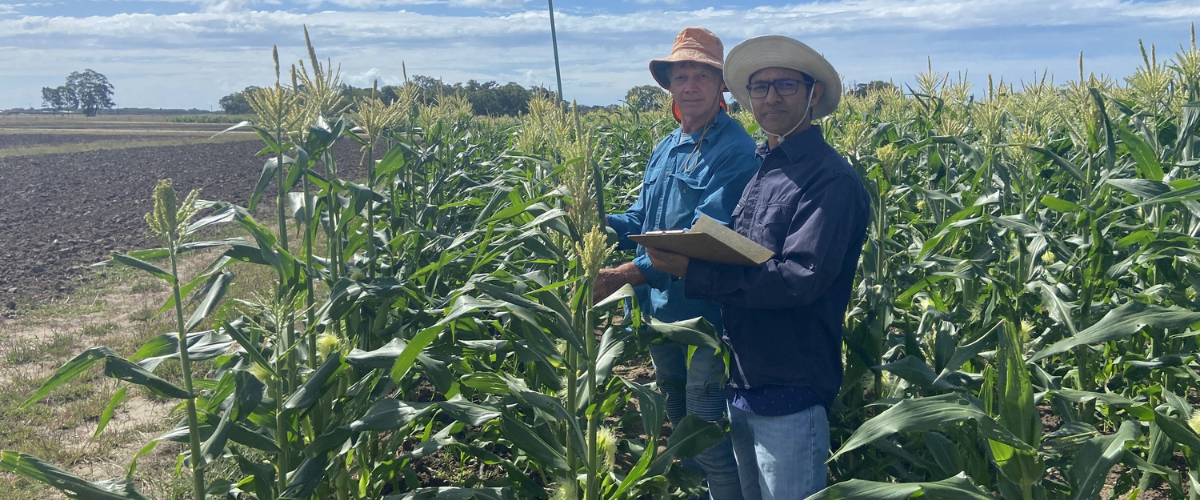
L-R. Dr John Stanley and Dr Ramesh Puri from the Queensland DPI monitoring a fall armyworm management trial in sweet corn at the Bowen Research Facility in August 2025; John and Ramesh are working on insecticide resistance management in fall armyworm as part of the vegetable-levy funded VG22006 project.
BY RAMESH PURI, HEIDI PARKES & ALISON WATSON
DEPARTMENT OF PRIMARY INDUSTRIES, QUEENSLAND ASEAN FAW ACTION PLAN
Three experts from the USA and Asia shared their experience of managing fall armyworm insecticide resistance in a webinar in December to help Australian growers address this challenge.
Insecticide resistance in fall armyworm (FAW) is an increasing global concern, particularly in intensive cropping systems characterised by continuous host availability and frequent insecticide use. To support Australian industries in preparing for this challenge, a webinar in December 2025 brought together three experts from the USA and Indonesia to share their knowledge and experience of managing FAW insecticide resistance with Australian industries and researchers.
The webinar was delivered jointly by the National fall armyworm innovation system for the Australian vegetable industry project (VG22006) led by the Queensland Department of Primary Industries (DPI), and the ASEAN FAW IPM Action Plan.
This event was part of a broader effort to enhance insecticide resistance warning capability, support coordinated decision-making and promote sustainable FAW management across horticulture and mixed-cropping systems.
The global picture:
Rapid resistance under high pressure
Dr David Mota-Sanchez
Michigan State University
Dr David Mota-Sanchez opened the session by highlighting that fall armyworm (FAW) is already one of the top 20 most insecticide-resistant pest species worldwide. To date, 272 cases of resistance have been recorded across 47 active ingredients spanning eight Modes of Action. He emphasised that high spray frequency, lack of pest-free periods and continuous host availability create a perfect storm for resistance development, as exemplified by Puerto Rico. Dr David Mota-Sanchez advised that rotating insecticides and implementing area-wide management programs are crucial for resistance control, which requires integrating additional tools.
Visit here to view the webinar presentation.
Grower decisions matter
Dr Dominic Reisig
North Carolina State University
Dr Dominic Reisig’s presentation was centred on the idea that managing BT (Bacillus thuringiensis) resistance depends on people as much as biology. Effective resistance management isn’t just technical; it requires incentives, governance and coordinated stewardship. Outlining the USA’s experience of Helicoverpa, Dr Dominic Reisig explained that the use of moderate-dose traits and fragmented stewardship allowed resistance to develop gradually and spread quietly, only becoming obvious during high-pressure seasons. Resistance management is most effective when biological principles are aligned with human behaviour.
Visit here to view the webinar presentation.
Emerging resistance risks in Indonesia
Prof. Andi Trisyono
Universitas Gadjah Mada
Prof. Andi Trisyono provided an overview of the current status of FAW resistance management in Indonesia. Although major resistance issues have not yet been reported, early warning signs are emerging. Key priorities include improving farmer awareness so growers can recognise early signs of resistance and know how to report control failures, as well as strengthening laboratory infrastructure. Early detection of resistance will depend on stronger local monitoring systems, along with accessible training and education for growers on resistance management and reporting.
Visit here to view the webinar presentation.