


Nuffield Scholar aims to improve farm planning
27 February 2026January to November 2025: Australian onions international trade overview
27 February 2026
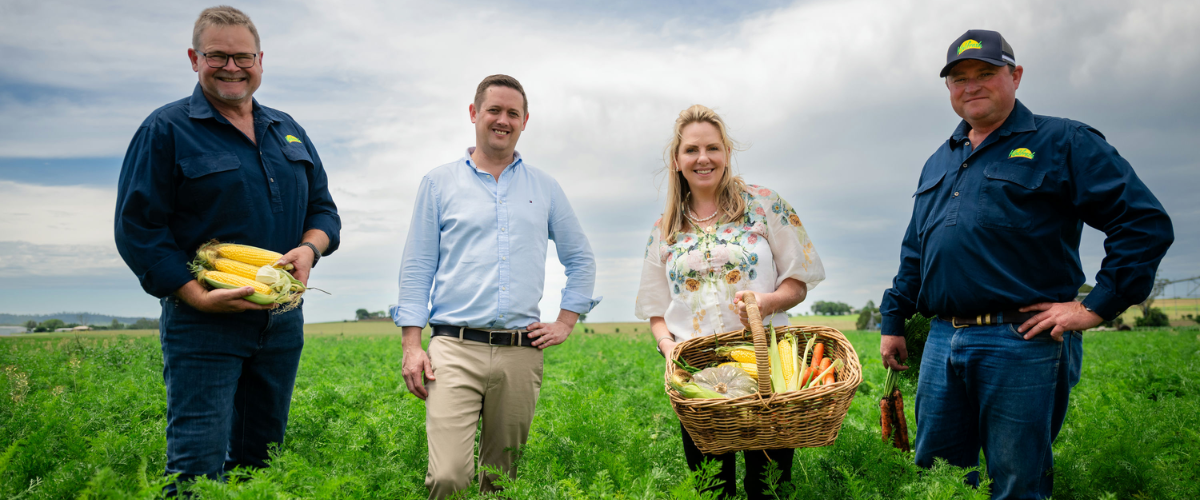
Vegetable consumption in Australia remains well below recommended levels, with average intake sitting at around 1.8 serves per day. This decline has implications not only for public health but also for the commercial sustainability of the vegetable industry.
Australia’s vegetable industry continues to deliver high-quality, nutritious food under increasingly challenging conditions. Rising input costs and ongoing volatility are further compounded by low consumer demand.
We know that Australians are still eating far fewer vegetables than recommended. While this is often framed as a public health issue, for growers it has direct commercial consequences, influencing demand stability, price confidence and long-term investment decisions across the supply chain.
In response, AUSVEG has sharpened its focus on tackling vegetable consumption through the Plus One Serve program – working across media, retail, educators and public health organisations to help encourage Australians to choose vegetables more often every day.
Two key initiatives have recently been implemented through innovative partner- ships to champion and grow healthy eating right across Australia at a key time of year – back-to-school and back-to-work. These include a multi-million dollar national outdoor advertising campaign, and retail integration at the point of purchase to strengthen and drive consumer engagement.
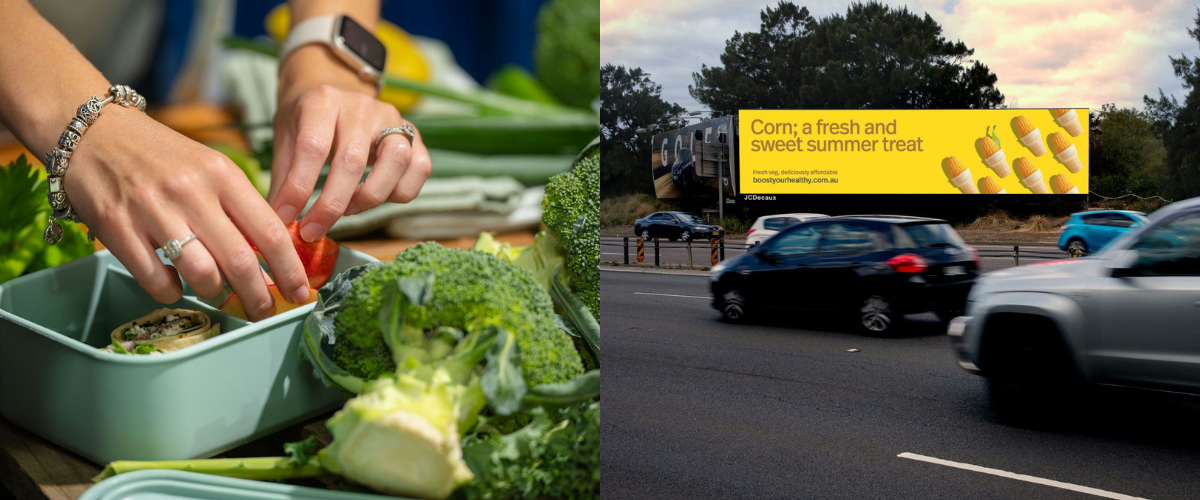
L-R. Samples of the Fresh veg, deliciously affordable Out of Home advertising campaign.
Building demand at scale: Fresh veg, deliciously affordable
Throughout February, Australians across metropolitan, regional and rural areas were met with a powerful and highly relevant message: Fresh veg, deliciously affordable.
Delivered in partnership with the Outdoor Media Association (OMA) and Health and Wellbeing Queensland, the national outdoor media campaign ran from 2nd February to 1st March 2026. Its aim was to support Australian growers by encouraging more Australians to include vegetables in everyday meals and snacks during a period of sustained cost-of-living pressure.
The campaign deliberately avoided guilt-based messaging or complex nutrition advice. Instead, it focused on small, achievable behaviour changes that fit everyday life. Creative executions such as “Broccoli: slice, dice and mix with rice” and “Corn: a fresh and sweet summer treat” positioned vegetables as familiar, affordable and easy to use.
The underlying message was straightforward: vegetables don’t require extra time, extra money or major lifestyle changes. They can be added, swapped or enjoyed as snacks alongside meals people already choose.
This approach reflects growing evidence that people are more likely to act when changes feel low-effort and realistic. By meeting Australians where they are – on the commute, near shops and in local communities – the campaign helped reinforce vegetables as a normal, everyday choice.
For growers, the scale of the activity was significant. Through OMA’s national network, Fresh veg, deliciously affordable appeared on thousands of Out of Home advertising assets across the country, with the outdoor media industry again donating substantial advertising value under its National Health and Wellbeing Policy.
From awareness to action: why retail matters
While national visibility helps shape attitudes, the real test comes when shoppers stand in front of the shelf.
Supermarkets are where food decisions are made quickly, often on autopilot. That makes retail one of the most powerful settings for behaviour change. For growers, what happens in store can determine whether good intentions translate into vegetables in the trolley.
This insight underpins AUSVEG’s growing focus on retail engagement, including its Retail Setting Action Plan, developed as part of the AUSVEG-led Plus One Serve program, supported by Hort Innovation which identifies supermarkets as a critical pathway to increasing vegetable consumption at scale.
One of the strongest examples of this work to date is the Ritchies Veg Digital Challenge.
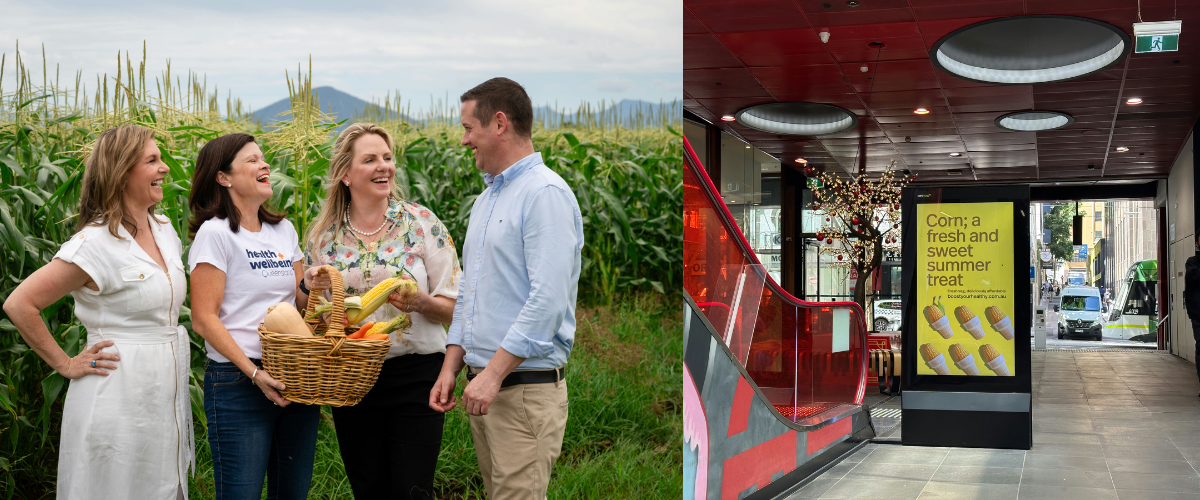
Elizabeth McIntyre, CEO, Outdoor Media Association, Dr Robyn Littlewood, CEO, Health and Wellbeing Queensland, Justine Coates, Managing Director, Plus One Serve – AUSVEG, Michael Coote, CEO, AUSVEG. Samples of the Fresh veg, deliciously affordable Out of Home advertising campaign
Retail action delivering results: the Ritchies Veg Digital Challenge
Developed in partnership with Ritchies Supermarkets and leading researchers, the Veg Digital Challenge was designed to test whether small, low-cost changes in store could increase vegetable purchasing – without discounting or undermining product value.
A central feature of the trial was the introduction of per-serve pricing. Alongside the traditional price-per-kilogram, vegetables were displayed with a price per recommended serve (75 grams), helping shoppers quickly understand both value and dietary guidance at the point of purchase.
Importantly, this was not a promotion or price cut. It was about reframing value.
Research led by Monash University, in collaboration with Deakin University and Ritchies, analysed loyalty card data before and after the change. The results showed average daily vegetable purchases by semi-regular shoppers increased by 46.3 grams (a 25.7 percent lift), while purchases by less frequent vegetable shoppers increased by 60.6 grams per day (a 28.4 percent lift).
For growers, this distinction matters. The largest increases came from shoppers who were not already heavy vegetable buyers, meaning overall demand grew rather than simply shifting between customers.
Chris Jonker from Ritchies Supermarkets said the trial highlighted the value of testing behaviour-change ideas where decisions are made.
“Retail is where food decisions actually happen. Through the Veg Digital Challenge, we’ve seen how small, practical changes in-store can help shoppers better understand the value of vegetables and choose them more often. Partnering with AUSVEG and researchers allows us to test what works and generate insights that can be scaled.”
What this means for growers
Taken together, these initiatives point to a clear direction for the industry.
First, increasing vegetable consumption doesn’t require discounting or short-term price tactics that erode value. Clear messaging, smarter framing and better information can lift demand in a more sustainable way.
Second, growers don’t have to carry the consumption challenge alone. Retailers, media owners, health agencies and researchers all have roles to play – particularly in the environments where choices are made.
Finally, evidence matters. Trials like the Ritchies Veg Digital Challenge provide credible data that can be used to engage other retailers and government, strengthening the case for scaling what works across the system.
Part of a broader national strategy
Both Fresh Veg, Deliciously Affordable and the Ritchies Veg Digital Challenge sit within AUSVEG’s Plus One Serve by 2030 ambition to increase vegetable consumption by one extra serve per person per day.
Plus One Serve brings together growers, retailers, researchers and health partners to apply evidence-based behaviour change strategies at national scale. Outdoor media builds awareness and normalises vegetables in everyday life, while retail trials help convert that awareness into purchasing.
For growers, the message is clear: coordinated action is underway across the system to strengthen demand for Australian-grown vegetables – today and into the future.