


VegNET Gippsland: Promoting safe & smart spray use – Insights from the Gippsland Agrichemical masterclass
8 September 2025
VegNET WA: OWL project update – advancing AI precision weed control
8 September 2025
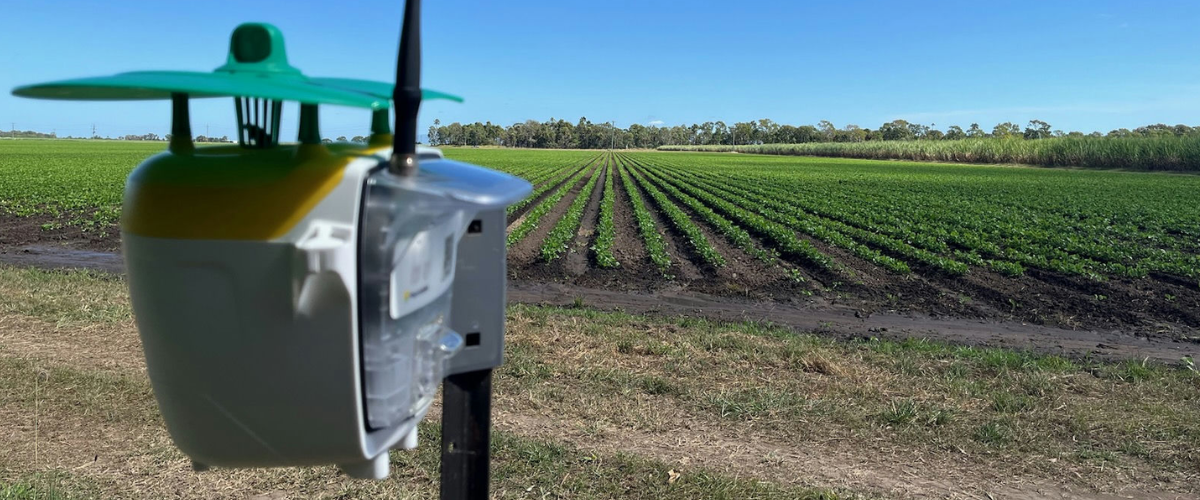
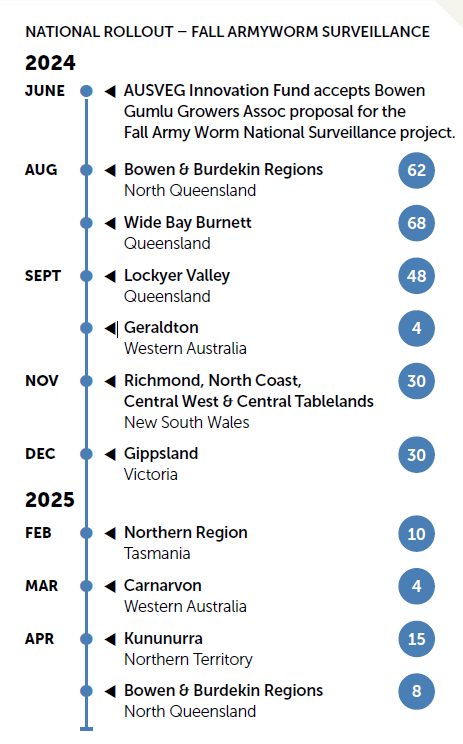
In June 2024, the proposal for a large-scale project for on-farm technology to monitor the destructive pest was accepted by AUSVEG and, in partnership with RapidAIM, Bowen Gumlu Growers Association began to implement the project to trial the RapidMEGA Fall Armyworm sensor units.
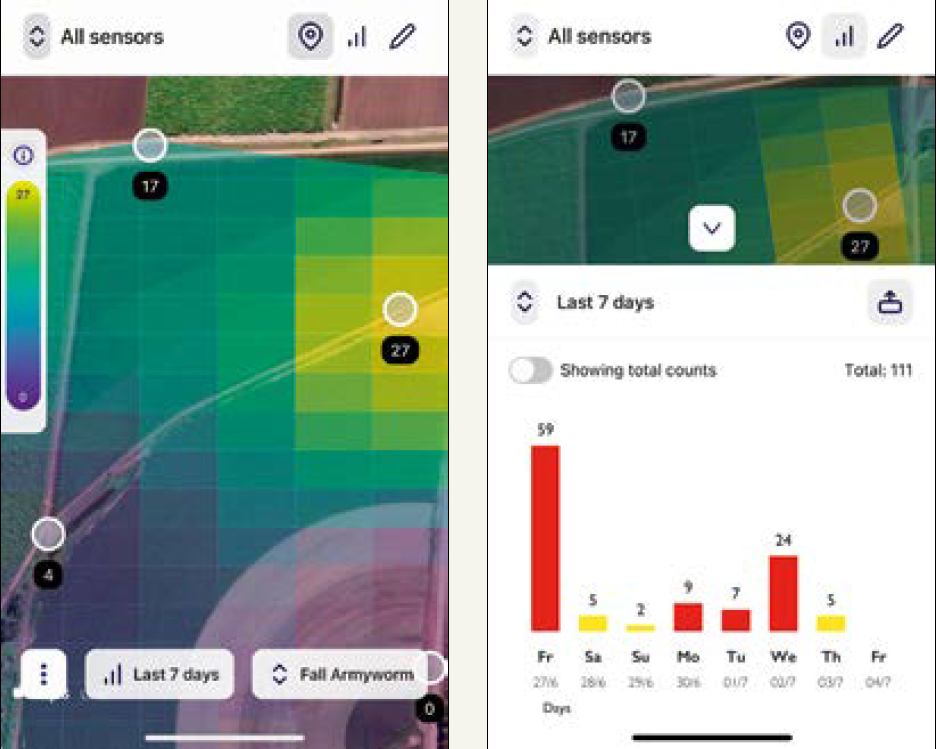
L-R. Screenshot of the RapidAIM app showing the counts for three sensors. Screenshot showing the total counts for the same three sensors seven days prior
A year later and with close to 300 of these units deployed around Australia, a robust data set is being generated every day so growers have a better chance of tracking movement throughout the country and of understanding potential impending risk to their crops.
This data will also help stakeholders work towards understanding fall armyworm (FAW) habits to better manage the pest through chemical application and integrated pest management, and potentially develop a new management strategy in the future. Data generated from these sensors is available online to every grower and researcher in Australia to track population movement, and growers who are hosting sensors on their farms can see their own sensor data on the go on their mobile devices to make better informed decisions in real time.
With the issue of fall armyworm affecting so many growing regions and a selection of vegetable varieties, researchers, agronomists and industry representatives are working together to find a way to manage the pest, as eradication is not possible. The availability of data generated from the on-farm RapidAIM sensors is vital for a nationwide snapshot of the FAW population and hotspots. This data can be broken down further by time of day, weather, crop type, and locality, which could in turn lead to a better prediction of heavy pressures and better offensive moves by the growers.
This has been a huge exercise in cross-region collaboration for the VegNET Regional Development Officers who manage the sensors in their own growing district. The RDOs work with their growers to maintain the sensors, change the lures at six-weekly intervals, and report what is working and what needs improvement.
The Bowen Research Facility of the Queensland Department of Primary Industries (QDPI) received a sensor and deployed mid-April so that FAW entomologists have data to compare to their own monitoring methods and counts. This is considered a valuable collaboration and will provide an excellent source for data and data interpretation on the habits of FAW.
QDPI has a project running called National fall armyworm innovation system for the Australian vegetable industry (VG22006), which is also funded by Hort Innovation, and the collaboration between this project and the VegNET Fall Armyworm National Surveillance Program is providing a robust dataset delivered through a far-reaching network of websites, newsletters, webinars, events, and workshops.
The Fall Armyworm National Surveillance Program utilises the detection technology of RapidMEGA, and it is important to note that the technology is developing and being continually improved throughout the trial to meet the needs and challenges encountered along the way.
 Feedback from VegNET Regional Development Officers and Regional Support Officers, as well as QDPI entomologists, has provided valuable guidance for the RapidAIM team about where improvements can be made in an effort for the most accurate reporting. One such instance is battery life; given that these are quite remote units that may not be easily or frequently accessed, the batteries have undergone an upgrade to ensure minimal time offline and a continuation of data generation, and growers will likely be able to ‘set and forget’ until the six-week lure changes.
Another issue that has been flagged is unwanted guests in the units. Some regions encounter higher numbers of pests taking up residence in the units, with ants, spiders, geckos, frogs and wasps purportedly interfering with readings by reducing the ability of the FAW moths to be registered in the unit (or potentially triggering false readings), and RapidAIM is working to reduce this interference.
While some may query the accuracy of the numbers being reported, QDPI entomologist John Stanley says that it is also about a bigger picture – that the relative size of the fall armyworm populations are being monitored (sampled) from region to region.
“It’s very early days, so largely anecdotal, but we are seeing a reasonable correlation between daily, manually checked pheromone trap catches and the real time fall armyworm data, despite occasional disrupted counts,” he said, noting that disrupted counts are a problem for all pheromone trapping.
“The strength of the data from these networks is expected to come from the high resolution [daily recording] of many sensors at a regional scale, quickly identifying changes in fall armyworm populations.”
Feedback from RDOs indicate that there is quite a number of growers and their agronomists who are watching their apps closely and factoring the RapidAIM counts into their integrated pest management plan. A quick look at the app will tell them if there is increased activity and this will have the growers checking their paddocks to help plan their next moves.
For RapidAIM, it’s been a massive undertaking with unforeseeable issues being worked out on the run that, by the end of the trial next year, will likely see a capable and hardy end product that generates a steady flow of data, whatever the season.
“This has been a very successful collaboration with Bowen Gumlu Growers Association and all the wonderful VegNet RDOs who’ve helped us roll out the national RapidMEGA grid,” said RapidAIM COO Rebecca Feddema.
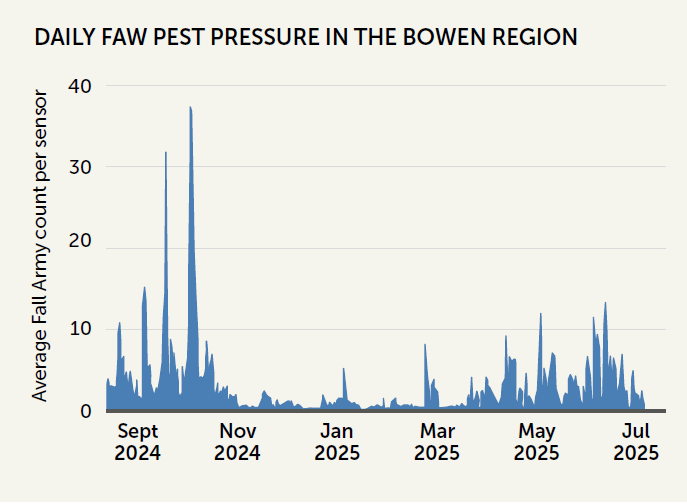
An example of the daily updates on FAW detections, in this case for Bowen, available to growers through the project. ©RapidAIM.
“We’re already receiving positive responses from growers about how this is helping provide early visibility of pest pressure and we really value the candid feedback about the challenges we need to solve for, too. As we collect more real-time data over the coming season to continue to train our models, this will only serve to make our information even more accurate.”
FIND OUT MORE
Please contact Richelle Kelly, Bowen Gumlu Growers on 0419 429 808 or email rdo@bowengumlugrowers.com.au