


VegNET Tasmania: Direct reward at Elphin Grove Farm
2 March 2026
VegNET VIC: VegNET supports Victorian leafy vegetable growers facing biosecurity restrictions
3 March 2026
BY KIRSTY KITTEL, VEGNET SA REGIONAL SUPPORT OFFICER
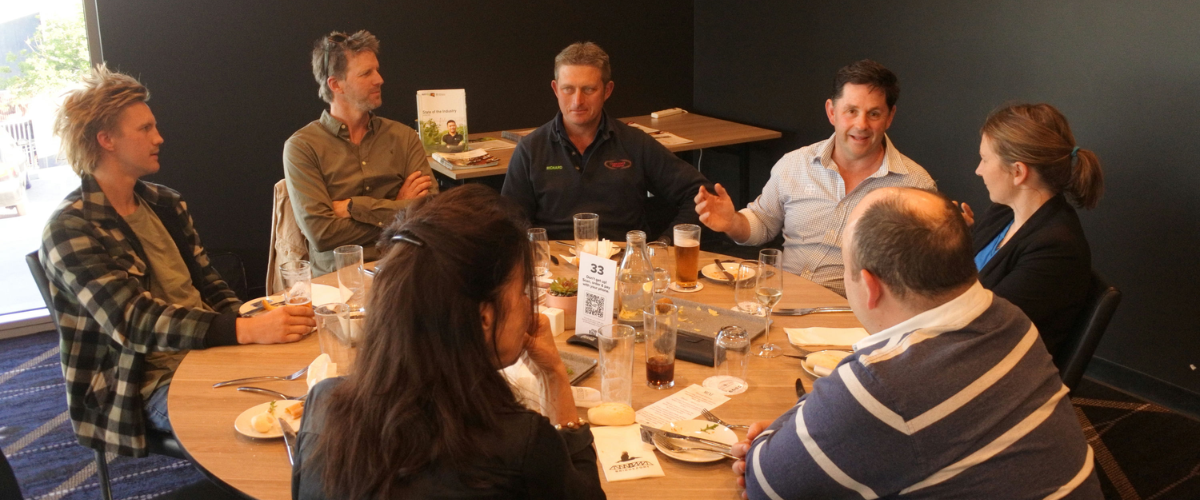
We brought a myriad of speakers along to discuss topics ranging from recent agri-political issues to current Hort Innovation projects and a debrief of grower learnings from AUSVEG study tours. Most notably, we collaborated with two key organisations in horticulture reinforcing the value of collaboration in building resilient farm businesses:
- Planfarm, the consultancy firm which gives expert guidance in Farm Business and Agronomy and provides financial benchmarking through its Level Up Hort Program.
- South Australian Research and Development Institute (SARDI), which delivers applied science that grows South Australia’s primary industries through the work of highly skilled scientists backed by dedicated technical, field, and support staff.
Planfarm’s Level Up Hort Program
Stephanie Carstairs, Planfarm’s Horticulture Project Manager in Western Australia, presented at the Northern Adelaide Plains Regional Roundup. Her presentation gave growers a clear and practical understanding of how Level Up Hort is helping vegetable and onion businesses strengthen their financial position and make more informed decisions.
The program is in its third year of a five-year national initiative funded by Hort Innovation through the vegetable and onion levies and delivered by Planfarm and RMCG. Stephanie explained that Level Up Hort was developed in response to increasing pressure on vegetable businesses, with many growers facing higher costs, labour challenges, shifting markets and general uncertainty since the COVID-19 pandemic.
With these added pressures, Stephanie said, “Sometimes we become frozen with decision-making, but if we know our true financial position, we can use this to form basis of decisions and to move our business forward.”
Benchmarking is as necessary a tool in growing as soil and leaf testing, where results only make sense when measured against accepted standards. “If you are not measuring your key financial metrics within your operation, then your decision-making will be compromised and based on gut feel only,” Stephanie added. Financial benchmarks reveal whether a business is performing above or below industry norms.
Stephanie also informed the growers of the reality that the average vegetable business is working on margins too tight to support long-term sustainability. This message, delivered clearly and backed by data, will hopefully inspire the growers in the room to make practical decisions around labour, seed, fertiliser, packing and freight in their growing businesses.
Growers who attended the Murray Bridge Regional Roundup heard from Thea Walker, Horticultural Business Consultant at Planfarm. Thea was nominated for the Premier’s Horticulture Awards Researcher/Advisor of the Year in 2025 and has worked one-on-one with growers to help them understand their financial data, identify opportunities for growth and implement long-term business improvements. In her presentation, she demonstrated how Level Up Hort can help growers to assess profitability, manage labour costs effectively, and make informed decisions that ensure the sustainability of their businesses.
The key messaging to growers from both Stephanie and Thea was to focus on the controllables and start with one simple measure – operating efficiency, which growers can calculate in minutes using their own financial records. Improvement begins with measurement, and many growers left the session motivated to take that first step.
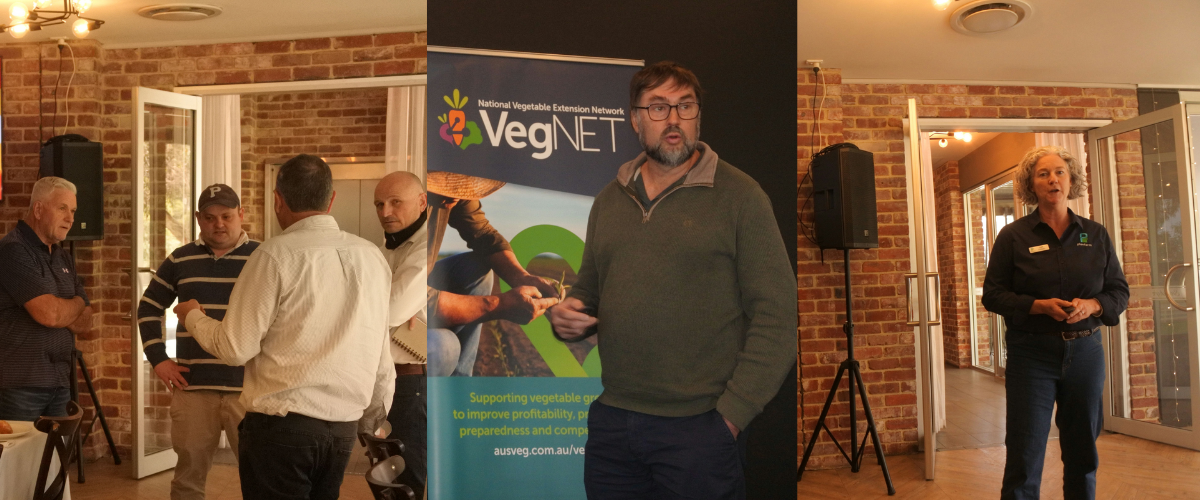
L-R. Growers catching up before the Regional Roundup event. Dr Michael Rettke (centre) and Stephanie Carstairs (right) presenting at the Regional Roundup Plains
SARDI’s pest and disease update
Research scientist Dr Michael Rettke shared the latest findings from SARDI, highlighting cutting-edge advances in vegetable research. SARDI’s work is strongly focused on soilborne diseases, exploring a diverse range of control strategies supported by robust diagnostics and monitoring. Much of this research is delivered through trials conducted directly on grower sites, combining innovative in-crop disease management approaches with a strong local focus, while contributing to and drawing from national research collaborations.
The National Potato Project, led by the University of Tasmania (UTAS), is placing strong emphasis on integrated disease management for soilborne diseases, with particular attention to pre-plant inoculum management, innovative in-crop disease control strategies, and a deeper understanding of the environmental drivers that influence disease epidemics. Building on the PREDICTA® Pt platform delivered by SARDI, the project is also developing new diagnostic tools for bacterial pathogens such as blackleg and Dickeya, as well as Verticillium albo-atrum, a seedborne wilt disease.
Research for the onion fund has been on Fusarium basal rot, where the key strategy to reduce your risk is through crop management including, crop rotation, using different varieties, optimising irrigation, balancing nitrogen and nutrition, managing other pathogens and pests, and implementing controls to reduce disease. Other onion research has been on bacterial rots, pink root and root lesion nematodes. Research trials are comparing the incidence of rotted bulbs, root health and productivity using biologicals, chemicals and bio stimulants.
SARDI has done research on soilborne diseases in South Australian and Victorian carrots, which is now part of a larger national project led by the Department of Primary Industries and Research Development (DPIRD) WA. Additionally, SARDI has developed tests for the two species of cyst nematodes that impact brassicas in the Adelaide Plains.
Finally, SARDI has been working with a national guava root knot nematode project led by DPI Qld, aiming to provide quantitative DNA based test capability to assist in monitoring its spread and in evaluating control strategies.
It was invaluable to have Michael at our event, to help growers identify what they can be doing to mitigate the risk of soilborne disease and see what research is being done to advance our industry and protect yields.
Creating networks between growers, scientists, and advisors
VegNET SA prioritises industry collaboration and connecting growers with the right people to help increase their productivity, profitability, preparedness and competitiveness. Enabling growers to connect directly with organisations like Planfarm and SARDI, brings insights into the business tools, research and support available to growers. These interactions help translate data and research into practical considerations, while also strengthening the professional networks growers can draw on when navigating financial, production and soil health challenges.
Maintaining connections across industry, research and advisory sectors will continue to play an important role in supporting the long-term sustainability and longevity of South Australian vegetable businesses.