


Nuffield Scholarships
2 September 2023
AUSVEG Farm Biosecurity Project
22 September 2023
Investing in biosecurity tools and systems to provide security against potential pest incursions
VegWatch, the Vegetable Industry Biosecurity and Business Continuity Strategy (VG22004), is a national, industry-led program, funded through Hort Innovation using the vegetable levy.
VegWatch brings together biosecurity and R&D expertise from vegetable growers, state and territory agencies, research providers and the private sector. The partnership is developing tools, systems and skills to support detection and rapid identification of new pests and inform decision-making about eradication and management of new and emerging pests. A key goal is to support vegetable farming businesses to move produce based on evidence of risk associated with a new pest.
What will the vegetable biosecurity program deliver?
The program is based on three themes:
- Surveillance and diagnostics
- Data and informed decision making
- Business continuity and trade
Over five years, the program will:
- Update the list of pests and diseases that pose a risk to the Australian vegetable industry
- Apply risk mapping to support the early detection of key priority pests and diseases (Technical Reference Guidelines)
- Develop protocols for the identification (National Diagnostic Protocols) of key priority pests and diseases
- Prepare business continuity plans for priority pests and diseases to support control and management options
- Pilot industry-led pest and disease monitoring and the application of this data to support evidence of absence of pests for business continuity and market access
- Support farm biosecurity implementation with a new Farm Biosecurity Guide, high health practices and digital technologies to support visitor management
Why VegWatch?
Potential impact on trade is a common concern when a new pest arrives, often leading to a hesitancy to report. Experience shows that when the vegetable industry is prepared and informed, it is better equipped to respond and adjust to a new pest. Examples where improvements can be made include confirmation of host lists, overcoming diagnostic challenges, understanding of phytosanitary and management options and monitoring for early detection. VegWatch is investing in the development of tools and systems to ensure the industry is better prepared to respond, adjust and return to trade sooner
Prioritising the pests
Plant Health Australia is leading the update of the Vegetable Industry Biosecurity Plan. The new Plan sets out a range of activities to mitigate risks from exotic and emerging pests of vegetable crops. The plan includes an update to the priority pest list for vegetable crops – a list that started with more than 800 organisms! The priority list of 27 insects, pathogens and nematodes will help us focus our biosecurity preparedness and recovery efforts.
Mapping to support targeted surveillance
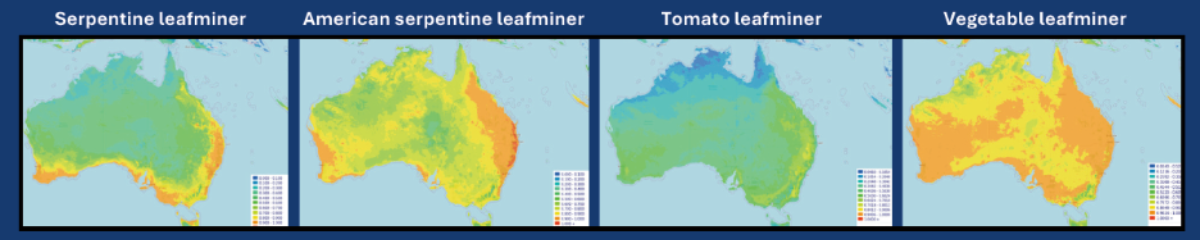
The Centre of Excellence for Biosecurity Risk Analysis (CEBRA) at the University of Melbourne is using Biosecurity Commons to develop national risk maps for priority pests of vegetables. These risk maps inform where to focus surveillance efforts based on risk of entry or risk of spread of priority pests. Potential pathways of entry, climate suitability and biotic suitability are used to model where the pest is more likely to come into the country and where conditions are suitable for it to establish. The maps below show an example of climate suitability for a range of established and exotic leaf miners. National Technical Reference Guides and Diagnostic Protocols are being developed for selected priority pests.
In February 2026, VegWatch is also commencing an industry-led pilot to establish a framework for monitoring of pests.
For more information and to sign up click here.
Farm biosecurity planning
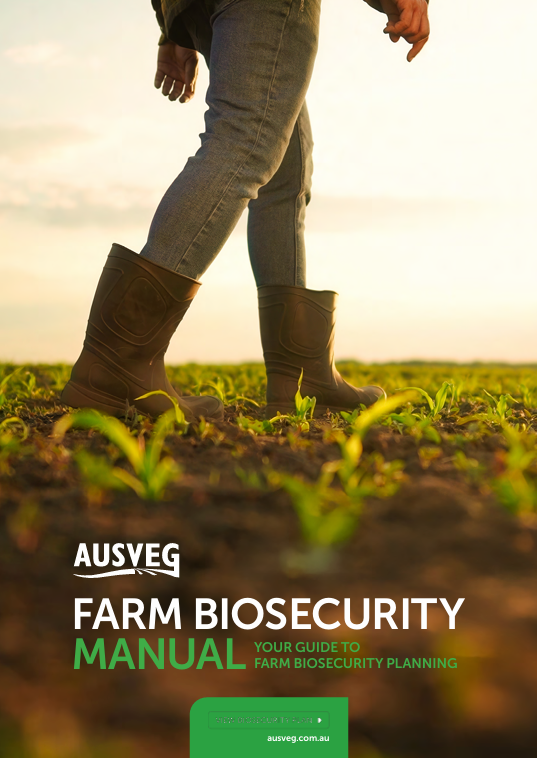 The Farm Biosecurity Program has developed Healthy Farms Pest and Disease Preparedness: The essential guide to farm biosecurity planning. This interactive guide provides support to assess and mitigate farm biosecurity risks and prepare a farm biosecurity plan.
Digital support for farm biosecurity and response activities.
VegWatch evaluated the potential for visitor movement networks to support speedier response activities and a risk-based return to trade. Onside offered a mobile app that registered visitors and contractors digitally from anywhere on the property. Visitors were able to acknowledge farm biosecurity practices upon arrival. While more than 70 vegetable farming properties connected, more connections are required to form a ‘denser’ network to support movement and connectivity for emergency pest response activities.
Want to know more?
Contact AUSVEG on (03) 9882 0277 or email at science@ausveg.com.au
Further information
- Interactive Farm Biosecurity Manual and Planning Guide (Nov 2025)
- Collaboration key for biosecurity preparation (Feb 2025)
- Contracts and leasing arrangements in Tasmanian vegetable farms add to complexities in good farm biosecurity practices – could digital technology provide the solution? (Sept 2024)
- Investing in biosecurity preparedness to protect against potential pest incursions (Feb 2024)
- A bug on your farm can harm your crop, and your market (Dec 2024)
- Digital defence to streamline farm biosecurity (Aug 2024)
- Vegetable industry biosecurity and business continuity strategy (VG22004)
- Watch the video interview with Mike Fielden of Boratto Farms about Onside
- Hear our Vegalogue podcast story (Jan 2024)
Project partners
VegWatch is a partnership between AUSVEG, Plant Health Australia, Department of Environment and Climate Change, Victoria, Queensland Department of Primary Industries, Centre of Excellence for Biosecurity Risk Analysis at the University of Melbourne, RM Consulting Group.

This project has been funded by Hort Innovation, using the research and development levies listed below and contributions from the Australian Government. Hort Innovation is the grower-owned, not-for-profit research and development corporation for Australian horticulture.