



What Europe is teaching Australia about protected cropping
18 May 2026
Pledge for More Veg: Backing growers by driving demand
18 May 2026
Reading Time: 2 minutes
VEGNET NORTH, WEST & SOUTH-EAST
Victoria
REGIONAL UPDATE
VegNET Victoria has rolled out an Innovation Fund initiative designed to increase access to ChemCERT certification for CALD (Culturally and Linguistically Diverse) workers across key vegetable-growing regions in Victoria.
A ChemCERT certification is a legal requirement in Australia for anyone working with hazardous agricultural chemicals. It underpins safe, compliant pesticide and chemical use on farm.
However, many Registered Training Organisations (RTOs) can only deliver the course in English, which creates a significant hurdle for workers who are more confident learning and being assessed in another language. For CALD workers, this barrier can limit employment options, restrict progression into higher-responsibility roles, and reduce confidence when dealing with chemical labels and safety directions.
For growers and employers, limited availability of qualified staff increases pressure on existing teams, reduces flexibility during peak periods, and can create business risk if chemical tasks cannot be allocated to appropriately trained personnel. The Innovation Fund initiative addressed this skill and access gap by offering a subsidised pathway to certification with bilingual delivery.
While the program was not restricted exclusively to CALD participants, it was intentionally structured to remove language barriers that can prevent capable workers from meeting mandatory chemical-handling requirements. The initiative was subsidised by Hort Innovation through the Vegetable Fund and coordinated by VegNET Victoria as part of its broader focus on workforce capability building.
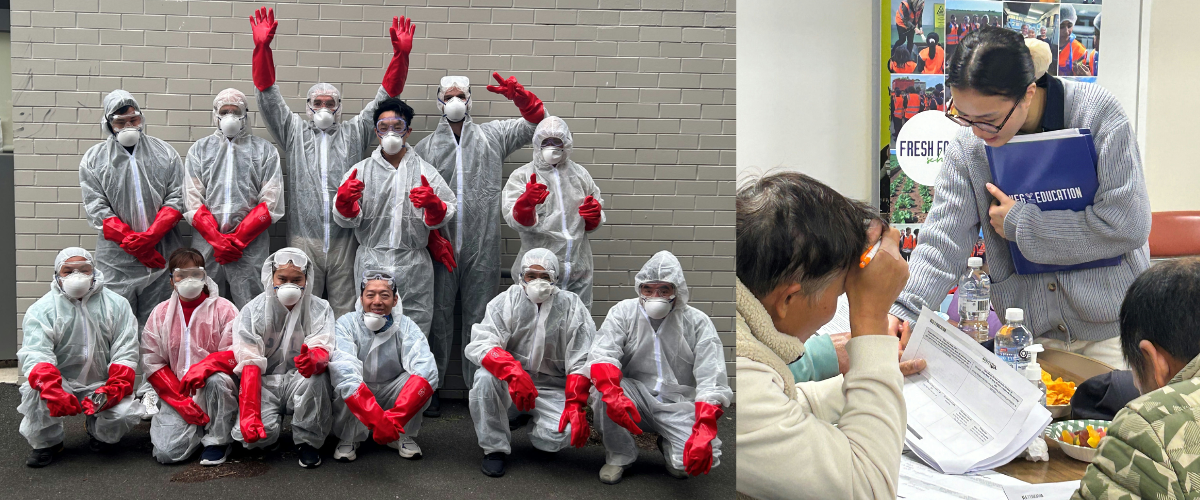
Training was delivered in both English and Vietnamese by VEG Education, an award-winning RTO. Where required, the format supported clarification of complex concepts in Vietnamese, while reinforcing the standard compliance language used in Australia.
A key focus of the rollout was the large Vietnamese community in the Werribee, Lara, and Springvale districts, many of whom own and operate farms that make up a significant portion of the workforce in surrounding areas. Feedback to VegNET Victoria indicated that access to accredited training in participants’ first language would meaningfully improve participation and outcomes.
The core goal of the project was to support Vietnamese-speaking growers and farm workers to access ChemCERT training in Vietnamese, while still ensuring participants could engage with the English terminology commonly used on labels, safety data sheets, and workplace documentation.
The Vietnamese Growers’ Association played a crucial role in supporting the initiative by covering the participant contribution on behalf of its members, which significantly boosted uptake and trust.
In total, 25 students successfully completed the training and received a ChemCERT qualification, with the strongest uptake in Lara, reflecting its high concentration of independent Vietnamese growers. The result is an increased pool of ChemCERT-qualified workers and growers who can safely and legally manage agricultural chemicals, improving workforce capability and supporting compliance at farm level.
Michael Tran, a leader and agronomist in the Lara Vietnamese community, noticed many positive changes in the farms that completed their ChemCERTs. Growers developed a better understanding of the risks associated with the chemicals they use, were able to convert application rates more accurately, understood withholding periods and used corrective protective equipment. Growers were also able to get FreshCare-certified, enabling access to a wider range of markets. This represents real change with economic and health benefits for Victorian vegetable farmers.
High levels of satisfaction were reported for the training, with the majority of participants indicating they were very happy with the outcomes. The next step for VegNET Victoria will be to assess whether this program should be extended to additional skills or language groups.