


Pioneering White Asparagus in Tasmania
18 May 2026
VegNET VIC: ChemCERT upskilling for CALD workers
18 May 2026
Reading Time: 8 minutes
BY ALEXANDRA LASHCHUK
Earlier this year, a group of Australian vegetable growers travelled across Europe as part of the AUSVEG Europe Study Tour, taking in Berlin’s global showcase at Fruit Logistica before heading south into Spain’s intensive production regions.
Following the tour, AUSVEG spoke with several participating growers to unpack their key takeaways, especially in protected cropping, an area that emerged as both eye-opening and highly relevant to Australian production systems.
While the tour covered everything from seed breeding to retail trends, it was the scale, diversity and evolution of protected cropping, particularly across Murcia and Almería, that left the strongest impression.
Across a tightly packed itinerary visiting major producers, greenhouse technology providers, and R&D hubs – such as G’s Fresh, Auxprotec Hydroponic, Novagric and Technova – growers were exposed to a variety of protected cropping production systems spanning various levels of technological adoption.
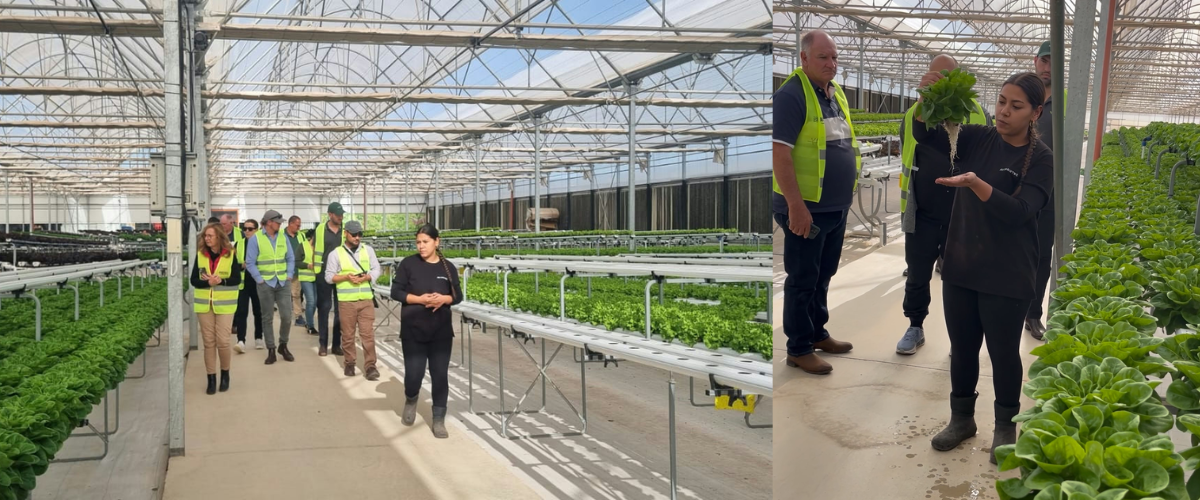
Auxprotec, lettuces are packed and dispatched to order across Europe
A landscape defined by protected cropping
The group’s journey into southern Spain provided a striking visual introduction to the scale of protected cropping in Europe.
For Lynley Van Latham from Rugby Farm in Queensland, the sight was immediately impactful and overwhelming.
“When we were driving into Almería, it was just a sea of white,” she said. “I’d never seen anything like it, it just goes on and on.”
That ‘sea of white’ – thousands of hectares of plastic-covered greenhouses – is one of the most productive horticultural regions in the world.
South Australian grower Andrew Braham from Braham Produce noted the stark comparison to Australia.
“In South Australia, we might have 1,500 to 2,000 hectares of protected cropping,” he said. “In Almería, they’re up around 40,000 hectares.”
This difference in scale is driven not just by climate or geography, but by market access. European growers are producing for a population of more than 500 million people, supplying major supermarket chains across multiple countries within tight timeframes.
“They’ve got a market that justifies that level of investment,” Andrew explained. “Everything they do is geared towards supplying that market consistently.”
This scale also allows for a level of specialisation and integration that is difficult to replicate in Australia, but not impossible to learn from.
A spectrum of systems, not a single model
One of the most valuable insights from the tour was that protected cropping in Europe is not defined by a single approach.
Across visits to infrastructure providers like Novagric, and innovation centres like Technova, growers saw a wide range of systems tailored to different crops, markets and investment levels.
At one end are relatively simple plastic structures – low-cost, high-volume systems that rely on favourable climate conditions and efficient management. At the other end are highly controlled environments, incorporating hydroponics, fertigation, climate control and advanced monitoring systems.
“Some of it is actually quite basic, but it works extremely well,” Andrew said. “And then you’ve got the high-tech setups, it really depends on what they’re trying to achieve.”
At Novagric, the focus was on infrastructure design, particularly around water management, fertigation systems and greenhouse optimisation.
Given the semi-arid conditions of the Murcia region, efficient water use is critical. Growers saw how greenhouse systems are designed to maximise water efficiency while maintaining consistent crop performance.
At Technova, this was taken further, with demonstration systems showcasing how greenhouse design, irrigation and environmental control can be integrated into a single, highly efficient system.
Designing for the end market
While much of the tour focused on production systems, the visit to the Rijk Zwaan Retail Centre in Berlin highlighted how protected cropping ultimately connects to the consumer.
The facility simulates real supermarket environments, allowing growers, breeders and retailers to test how different varieties perform on the shelf. From lighting and layout to packaging and presentation, each element is used to assess how consumers respond to different products.
For growers, this reinforced the role that protected cropping can play in delivering consistent, specification-driven produce.
“It showed the possibilities of vegetable variety and packaging changes,” one grower noted.
Unlike open-field production, protected cropping systems offer greater control over traits such as size, colour, texture and shelf life, all of which influence purchasing decisions.
The centre also demonstrated how consumer preferences vary across markets, shaping what is grown and how it is presented. There was also a much greater adoption of branded vegetables, such as peppers and snacking tomatoes, which helped drive higher returns.
For Australian growers, the takeaway was clear: protected cropping is not just about production efficiency, but about reliably delivering a product that meets increasingly specific market expectations.
The key takeaway was not that one system is better than another, but that successful protected cropping is highly context-specific.
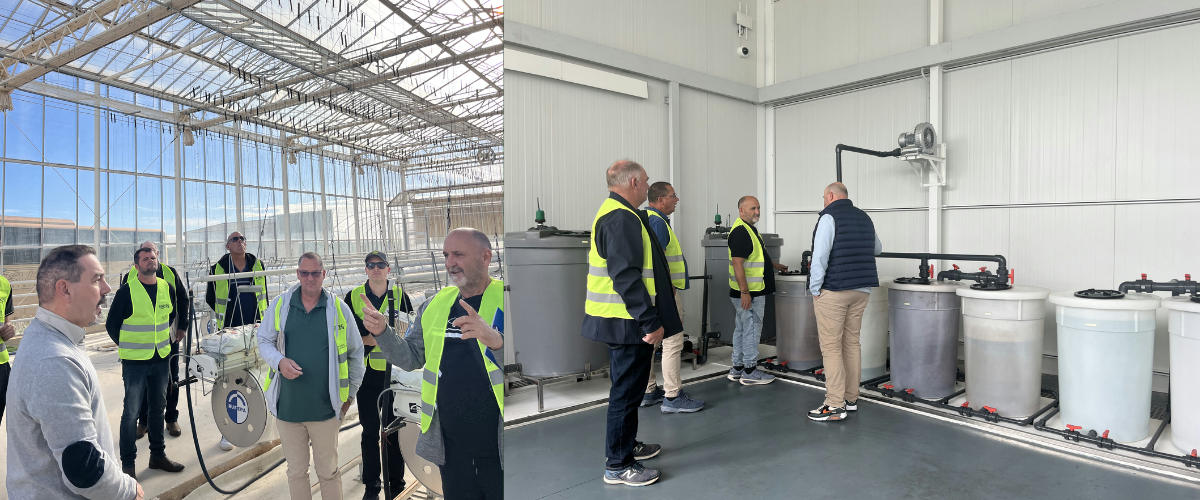
Rufepa’s modern research greenhouse. Novagric, vats where fertiliser is mixed for hydroponics
Hydroponics and modular expansion
Hydroponic systems featured prominently across the tour, particularly in facilities focused on innovation and scalability.
For Bryce Lamb (Wickham Farms, QLD), one of the most interesting aspects was how these systems were structured.
“There’s a big capital cost to set it up,” he said. “But once it’s there, it’s very modular and easy to scale.”
This concept of modularity was reinforced at both Technova and Novagric, where greenhouse systems are often designed to allow staged expansion.
Rather than committing to large-scale investment upfront, growers can build incrementally, adding capacity as demand grows.
“That’s something that could work really well in Australia,” Bryce said. “You could build it out over time, rather than doing it all at once.”
This approach reduces financial risk while maintaining flexibility – a key consideration for Australian growers operating in a more volatile market environment.
Efficiency starts with system design
Across all visits, one message came through clearly: efficiency is not something you add later, it’s something you design from the beginning.
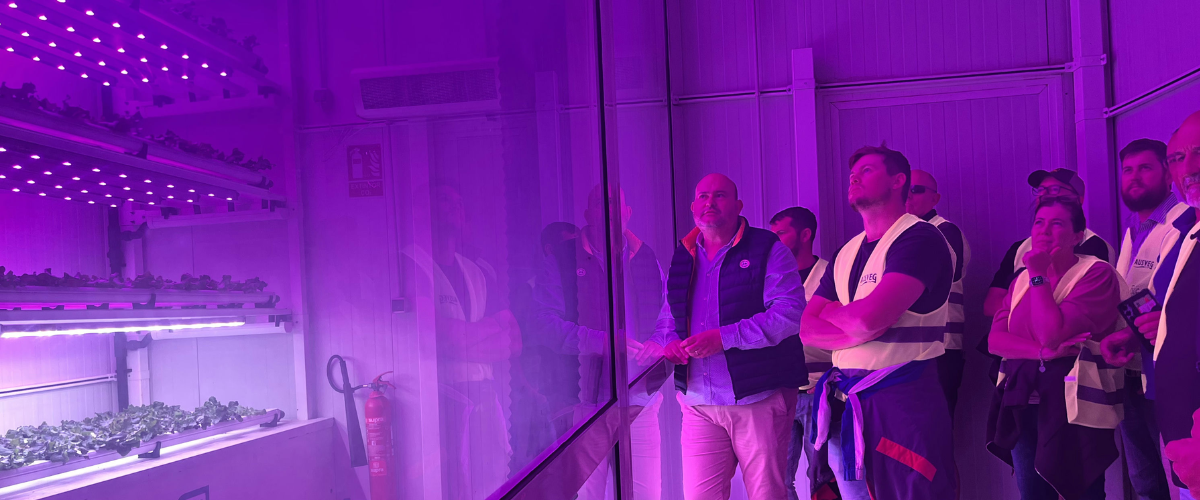
This was particularly evident during the visit to Auxprotec’s hydroponic demonstration facility in Murcia, where growers saw a fully integrated protected cropping system operating under commercial production conditions, producing fancy lettuces for retail markets.
Using NFT hydroponics, the system enables precise control of water and nutrient delivery, with key parameters such as pH, EC and temperature continuously monitored and adjusted. This level of control delivers consistent crop performance and allows for up to 15 production cycles per year.
The Auxprotec model highlights how well-designed protected cropping systems can maximise productivity while reducing complexity – an approach with clear relevance for Australian growers.
Labour: reducing reliance, not just replacing it
Labour challenges are not unique to Australia and European growers are addressing them in increasingly sophisticated ways.
At Fruit Logistica, participants saw a wide range of automation technologies from robotic packing systems to optical grading and sorting equipment.
“There was a massive push towards reducing manual labour,” one participant observed.
However, what stood out in Spain was not just the use of automation, but how systems were designed to minimise labour in the first place.
“In Australia, we often look at how we can add technology into what we’re already doing,” Lynley said. “Over there, they’ve designed the system so it doesn’t need as much labour to begin with.”
This includes:
- simplified planting layouts
- integrated harvesting systems
- reduced handling points
- and streamlined logistics
In protected cropping systems where labour can be a major cost driver, this approach offers significant long-term benefits.
The shift toward biological systems
One of the most significant insights from the tour was how European growers are adapting to tighter chemical regulations.
“They’re losing access to chemicals they’ve relied on for years,” Lynley said.
In response, there has been a rapid shift toward integrated pest management and biological control systems, particularly within protected cropping environments.
One example stood out.
“They were breeding aphids,” Bryce said. “Releasing them early so predator insects could establish before the crop was vulnerable.”
This proactive approach allows growers to build stable ecosystems within their crops, reducing reliance on chemical interventions. Andrew noted that some growers are taking this even further.
“They’re breeding their own beneficial insects,” he said. “That’s where it’s heading.”
Protected cropping provides an ideal environment for these systems, offering greater control over conditions and pest dynamics.
Managing risk in controlled environments
Despite the advantages of protected cropping, risks remain, particularly around biosecurity.
The tour highlighted how European growers are managing ongoing challenges such as Tomato brown rugose fruit virus (ToBRFV).
“They’ve been dealing with it for about 10 years,” Andrew said. “And they’re still producing.”
Rather than eliminating risk entirely, growers are adapting their systems through varietal selection, hygiene protocols and production strategies. This reinforces an important lesson for Australian growers: protected cropping reduces risk, but it does not remove it.
A reality check for Australian growers
While the scale of European operations was impressive, the tour also provided reassurance.
“When you compare yields and systems, you realise we’re actually doing a pretty good job,” Andrew said.
Australian growers may operate in a smaller market, but they remain highly innovative and adaptable.
“We’re not behind,” Bryce said. “We’re just dealing with different constraints.”
That perspective – balancing ambition with realism – was a key outcome of the tour.
From innovation hubs to on-farm application
One of the more valuable aspects of the tour was not just seeing production systems in action, but understanding how innovation is being developed, tested and transferred into commercial operations.
Visits to facilities such as Technova, located within the Almería Science and Technology Park, highlighted the role of dedicated research and extension organisations in supporting protected cropping industries. These centres act as a bridge between technology providers, researchers and growers, accelerating the adoption of new systems and practices.
At Technova, participants were exposed to a range of applied innovations, from greenhouse structure optimisation through to fertigation management and automation integration. Importantly, these technologies were not presented as standalone solutions, but as part of a broader system designed to improve overall production efficiency.
Similarly, the visit to Novagric demonstrated how commercial greenhouse providers are working closely with growers to tailor infrastructure to specific environmental and crop requirements. Rather than offering a standardised product, systems are designed with flexibility in mind, allowing growers to adapt to changing conditions, markets and regulatory pressures.
This close alignment between research, technology providers and growers was a recurring theme throughout the tour.
In contrast, Australian growers often operate in a more fragmented system, where access to emerging technologies can be limited by geography, cost and scale. As Bryce noted during the tour, many of the technologies seen in Europe are not yet readily available in Australia or are difficult to trial without significant upfront investment.
What stood out in Europe was the speed at which ideas move from concept to implementation.
For Australian growers, this highlights an opportunity not necessarily to replicate the same structures, but to strengthen connections between industry, research and technology providers to support faster adoption of innovation in protected cropping systems.
What this means for Australia
While the European model cannot be directly replicated, the principles behind it are highly relevant.
Key takeaways include:
- Design systems for efficiency from the start
Rather than retrofitting solutions, build efficiency into the system. - Adopt modular approaches to reduce risk
Scalable systems allow for staged investment and growth. - Focus on flow, not just technology
Efficient movement of product is as important as the tools used. - Prepare for reduced chemical reliance
Biological systems and IPM will become increasingly important. - Continue to innovate and adapt
The industry is constantly evolving and so must growers.
Looking ahead
Protected cropping is likely to play an increasingly important role in Australian horticulture.
As growers face labour shortages, climate variability and rising input costs, controlled environment production offers a pathway to greater consistency, efficiency and resilience.
However, the European experience shows that success in protected cropping is not just about infrastructure.
It is about:
- designing smarter systems
- integrating biological solutions
- adapting to regulatory change
- and continuously improving
For Lynley, the biggest takeaway was not a specific piece of equipment or technology.
“You come back with ideas,” she said. “Not just about what to do but how to think differently about your business.”
And in an industry where change is constant, that shift in thinking may be the most valuable investment of all.