


Seaweed application: An essential piece in the Integrated Pest and Disease Management puzzle
Gaining a formal skillset in the horticulture industry
Moe McCosker: Overcoming barriers to produce in the Red Centre
Eileen Odgers: Rising through the ranks of quality assurance
Han Shiong Siah: Building a successful tropical fruit growing operation
Regenerative agriculture approach paying off for veg growing operation
Innovation and collaboration key to addressing sustainability in northern Queensland
At the end of the 2021 harvest season, the issue of how to manage agricultural waste continues to be a challenge for North Queensland growers. In this article, Bowen Gumlu Growers Association’s Ry Collins provides an update on how growers, industry and government are collaborating to improve the sustainability of the horticulture sector in the region.
Improving the sustainability of the horticulture industry has never been more important. With the majority of vegetable growers in Northern Queensland located on land that adjoins – or is in proximity of – a catchment flowing to the Great Barrier Reef, the expectation of consumers, government and the community is that the industry must enhance the sustainability of its processes to preserve the surrounding environment for the generations to come.
As many readers would know, 2021 has been a year like no other for the industry. As is the case for growers around the country, vegetable growers in North Queensland have battled through the challenges of the year that have been highlighted by labour shortages and soaring costs to doing business.
Taking a drive around the farming regions in Bowen, Gumlu or the Burdekin over the past two months, it’s of equal concern that there is a growing issue of agricultural waste that threatens the ability of growers to operate sustainably and adding significant additional cost to effectively manage the issue.
Larger than average volumes of produce have been left in the fields and significant stockpiles of used agplastics are visible on many farms.

A stockpile (approximately 60 tonnes) of waste plastics comprising of used plastic mulch and trickle tape in Bowen.
Coming together to progress the issue
Looking to understand the current situation and what was being done to address these issues, Bowen Gumlu Growers Association coordinated a stakeholder forum in late November.
In attendance were a number of vegetable growers, local and state government representatives and other industry members.
What became apparent through this forum was that these waste issues were a symptom of the aforementioned causes with the lack of labour at the end of season in particular affecting what could be picked, as well as rising waste environmental levy charges effecting the disposal of the waste plastics.
A number of future regional recycling options were discussed, but these have not developed to the point where they are able to support regional growers – with the alternative of transport to recycling centres in Brisbane also being cost prohibitive.
Although research into waste issues has been completed previously, the attending group determined ongoing collaborative action was required. This would follow further investigation into solutions and industry innovation that is occurring to address the agplastic and organic waste issues.
Following this, the group looks to meet again in early 2022 to discuss options and further strategies to pursue in resolving these issues.
Investigating options for innovation in agplastic recycling
Through Bowen Gumlu Growers Association President and mixed vegetable farmer Carl Walker, we were introduced to chemical engineering company, Zero Emissions Developments (ZED) industries, which are pioneering new agplastic recycling methods to reuse waste trickle tape and plastic mulch into a range of products.
A tour of ZED’s facility displayed a wide range of applications being undertaken by researchers and engineers through a process known as pyrolysis.
ZED Industries Managing Director Ahmed El Safety said the company’s process is able to take a number of different plastic types, including agplastics and turn them into outputs such as carbon, biodiesel and graphene that can be made into new products such as battery cells and even new trickle tape.
“We hope to assist in solving this long-term issue for the agricultural sector and provide a sustainable future pathway for reuse of these products in other farming applications,” Ahmed said.
Encouraged by our visit, the ZED industries team visited Bowen in early December 2021 to meet with Bowen Gumlu Growers Association and the Whitsunday Regional Council. The team inspected sample agplastic feedstock and discussed development of a handling facility in 2022.
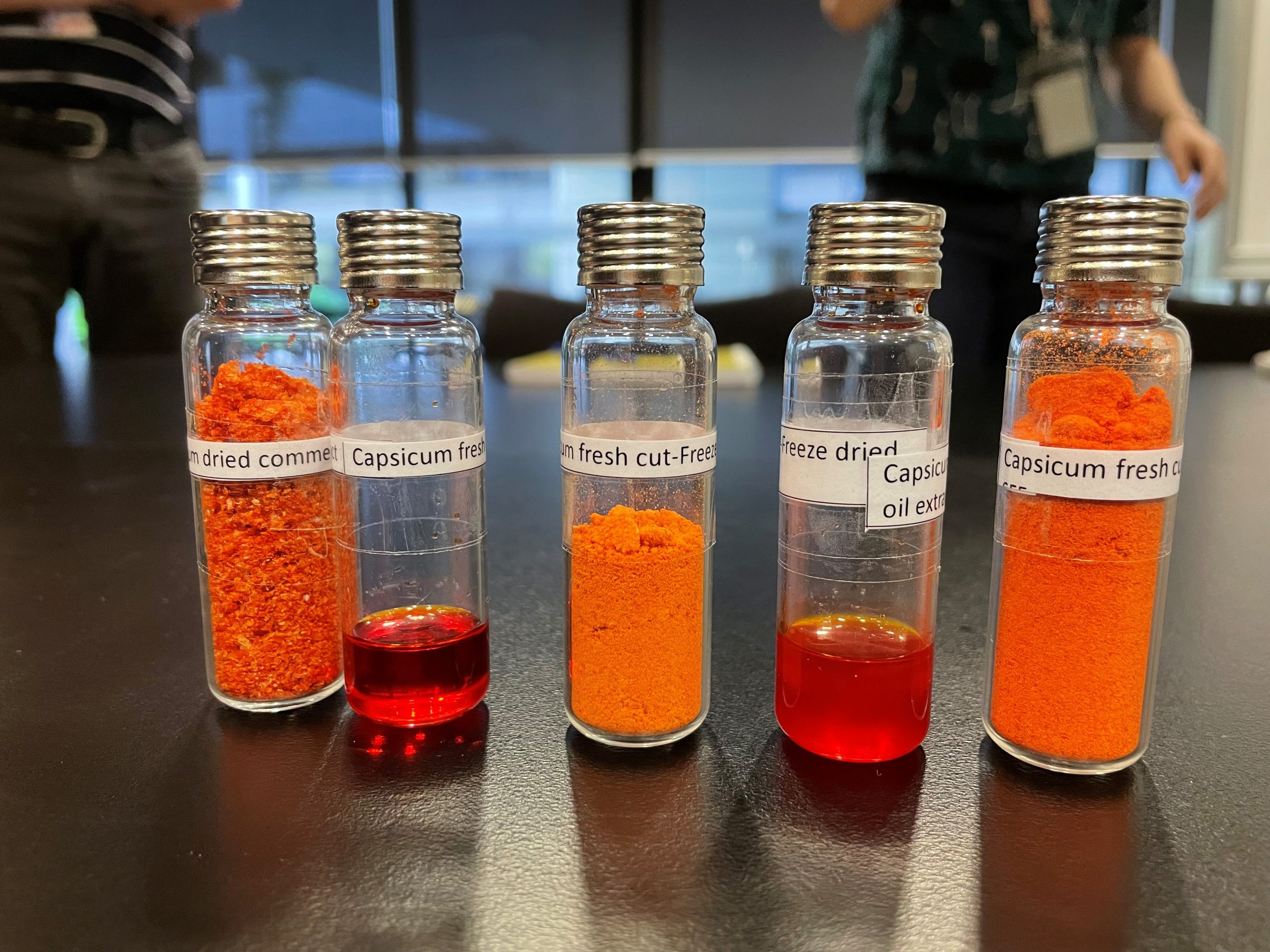
A selection of freeze, air and liquid extracted capsicum samples.
Researching new uses for waste capsicums
In 2021, Bowen Gumlu Growers Association participated in a collaborative project with the Fight Food Waste CRC and the Queensland Department of Agriculture and Fisheries (DAF) to investigate the potential for new products made from waste grade capsicum.
It is anticipated that in the North Queensland growing region this ‘waste grade’ product makes up as much as 40 per cent of total product, including approximately 15,000 tonnes of waste capsicum per annum.
These new products can be used in processed foods, nutraceuticals, and complementary health care. Utilising discarded streams from these crops not only improves industry profitability through saving on waste disposal costs, but also creating valuable side-streams and co-products for growers.
With the project in the final stages of research, we received the opportunity to tour the DAF food and beverage research facility in Brisbane. The facility was conducting the research and we saw some of the output product from the research trials.
The successful trials from this project have produced freeze and thermally dried powders with significant nutrient and bioactive content such as β-carotene, and a liquid extract able to be used in a range of consumer product applications.
As more work is done to explore the commercial potential of these products, further innovation could see less crop left to waste and more return on the product grown from our farms as well as new value-added or food and beverage manufacturing opportunities in the Northern Queensland region.
Through ongoing collaboration and innovation, it is hoped that the industry can make more efficient use of our resources and waste – resulting in savings for growers and the creation of a more sustainable future for our industry. We’ll be sure to share more information on these initiatives as they gather steam in the new year.
Find out more
Please contact VegNET – North and Far North Queensland Regional Development Officer David Shorten on 0419 429 808 or email rdo@bowengumlugrowers.com.au.
VegNET 3.0 is a strategic levy investment under the Hort Innovation Vegetable Fund.
This project has been funded by Hort Innovation using the vegetable research and development levy and contributions from the Australian Government.
Project Number: VG21000
Cover image: Bowen Gumlu Growers President Carl Walker (right) with representatives at the ZED Industries factory.