



Australian Onions: From pantry staple to flavour obsession Spring 2026
31 August 2026
No potato left behind: How Daly Farm is creating value from every crop
31 August 2026
Reading Time: 5 minutes
A new potato levy-funded program puts growers and industry participants in the driver’s seat.
What if you could help shape a training and professional development program, designed around the real needs of Australia’s potato industry, based on your own experiences in that very industry? What if you could then participate in that program, building your leadership skills while helping address the key challenges of the potato industry, identified by growers and industry stakeholders just like you?
The new Potato Workforce Training and Leadership Program (PT24002) delivered by AUSVEG and funded by Hort Innovation using the fresh and processing potato research and development levies is providing precisely those opportunities. Over the next five years, the program will provide training, leadership development and international study tour opportunities designed specifically for Australia’s potato industry, growers and the people who work with them. This project is being shaped by the very people it is designed to benefit.
Since launching earlier this year, growers and potato industry participants have already provided their views through an industry survey to help determine the program’s priorities and the specific initiatives and opportunities it should feature. This invaluable feedback is already shaping activities planned for the first year of the program, and there are still plenty of opportunities for you to have your say.
By seeking and incorporating the feedback, views and needs of growers and industry participants, then offering corresponding leadership training, professional development, study tour and networking opportunities, the program aims to strengthen the capability of people working across the potato sector, for the long-term benefit of growers and the industry.
Developing people and capability to support the industry
Australian potato growers continue to operate in an increasingly complex environment.
From labour shortages and rising input costs to rapid advances in technology and changing customer expectations, today’s potato businesses require much more than good agronomy to remain competitive. Running a successful enterprise increasingly means managing people, making strategic business decisions, adopting new technologies and planning for the future.
That’s why this project isn’t simply about offering training courses, it’s about fostering the confidence, leadership, skills and exposure to innovation that will help businesses stay viable, productive and competitive over the long term.
Over the next five years, program participants will have opportunities to take part in leadership and management programs, technical workshops, domestic and international study tours, networking events and other professional development activities designed specifically for the Australian potato industry.
Whether you’re an emerging grower, an experienced business owner, someone working in potato processing, or part of the wider supply chain, the program has been designed to create opportunities for learning at every stage of your career.
Growers have spoken
One of the first activities under the project was an industry-wide consultation to help ensure levy investments deliver the greatest value and address key industry needs.
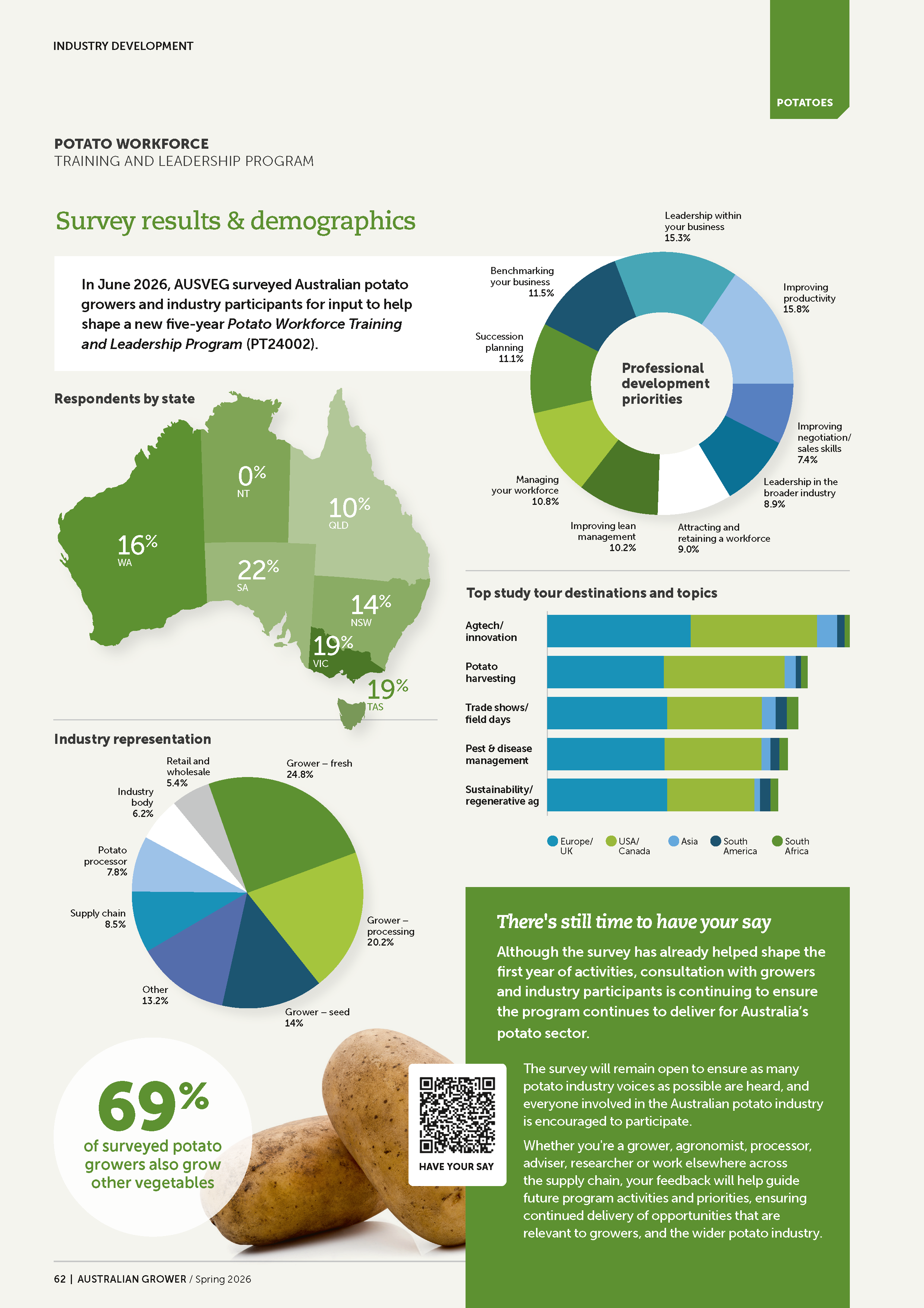
With responses received from growers and industry participants from across Australia, feedback to date has provided valuable insights into the training and leadership priorities that matter most to the industry.
Results so far show a strong appetite for professional development that goes well beyond technical production knowledge.
While improving on-farm productivity has featured prominently, respondents also highlighted the importance of strengthening leadership, business management, workforce management and succession planning, reinforcing that running a successful potato business today requires a diverse range of skills and capabilities.
Interest in international study tours has also been strong, with opportunities to learn about the latest innovations and practices in Europe emerging as a prevalent area of industry need. Respondents have highlighted the importance of exposure to international innovations in ag tech, potato harvesting, sustainability, pest and disease management, and of visiting major international trade shows and field days.
The breadth of potato industry representation among survey respondents to date has also been encouraging. Responses have so far been received from fresh, processing and seed potato growers, processors, supply chain businesses, retailers and industry organisations from across Australia’s major potato-growing regions. Interestingly, 69 percent of surveyed potato growers also grow other vegetables, highlighting the close connection between Australia’s vegetable industries.
What’s coming in Year One?
Thanks to the strong industry feedback already received, planning for the program’s first year is well underway.
Potato Leadership Study Tour
Interpom 2026
The flagship activity for the first year of the program will be the Potato Leadership Study Tour to Interpom, Europe’s leading trade fair dedicated exclusively to the potato industry.
Participants will attend Interpom from 29 November to 1 December 2026, before continuing on a European industry tour, with additional destinations and travel dates currently being finalised.
Held in Belgium, Interpom brings together more than 330 exhibitors and 24,000 industry professionals from over 60 countries, covering every stage of the potato value chain from cultivation and storage through to processing, machinery, technology and marketing. As Europe’s premier potato event, it provides a unique opportunity to see the latest innovations, explore emerging technologies and connect with growers and industry leaders from around the world.
Beyond the exhibition, participants will visit commercial farming operations, processing facilities and other leading potato businesses throughout Europe. The tour will provide valuable opportunities to observe different production systems, discuss common challenges with international growers and identify practical ideas that could be adapted to Australian conditions.
International study tours have consistently been among the most highly valued professional development opportunities delivered through Hort Innovation, levy-funded projects. They provide the chance to step outside the day-to-day demands of running a business, see fresh ideas in action and return home with practical knowledge that can be applied back on farm.
Productivity training in Melbourne
The second major initiative planned for year one of the program is a productivity training program to be held in Melbourne.
This training has been selected directly in response to potato industry consultation, with improving productivity ranking as the number one professional development priority identified by respondents.
The program will focus on practical strategies that businesses can implement to improve efficiency, streamline operations and strengthen overall business performance.
Further information, including dates, presenters and registration details, will be announced in the coming months.
This is only the beginning
One of the strengths of the Potato Workforce Training and Leadership Program is that it has been designed as a genuine long-term investment in the industry’s people.
Rather than delivering a fixed series of activities, the program will continue evolving over the next five years in response to industry priorities. As new challenges emerge and new opportunities arise, growers and industry participants will continue helping shape the direction of the project.
By participating in surveys, attending workshops, joining study tours and sharing experiences with others, growers and industry participants can help further shape this project, and help build a stronger, more connected and more productive Australian potato industry.
So, if you haven’t completed the survey yet, now’s the perfect time. Because the best ideas to shape the future of the potato industry don’t usually come from behind a desk – they come from the people out working in the field every day.