


Staying ahead of chemical losses
18 May 2026
VegNET WA: Supporting growers across WA
18 May 2026
Reading Time: 3 minutes
BY MAYA WALLENS
In April 2026, it was a privilege to host soil health educator Joel Williams from Integrated Soils at Forster Hill Farm in Nildottie. Joel’s work focuses on practical, systems-based approaches to soil health – linking plant nutrition, soil biology, and mineral management to improve farm resilience and productivity.
Joel’s ability to translate complex soil science into applied strategies attracted growers, researchers, advisors, and industry representatives to this workshop to explore the key constraints and opportunities of the region.
The Murray Bridge area of South Australia is characterised by highly leachable and sandy soils with inherently low organic matter and carbon levels. In combination with the effects of by salinity, sodicity, and climatic variability, the challenges around nutrient retention, soil structure, and biological function are drastically compounded. As a result, many farming systems in the region face declining soil resilience, inefficient input use, and limited capacity for water and nutrient holding.
Rebuilding soil function from the roots up
A central theme of Joel’s discussion was the importance of rebuilding soil function through biology-driven processes, particularly those associated with living root systems. Rather than relying solely on surface inputs, emphasis was placed on ‘feeding the soil via the plant’ and maximising the role of active root growth.
Living roots are one of the most powerful drivers of soil organic matter formation. Through rhizodeposition – the release of sugars, amino acids, and other organic compounds – plants actively feed soil microbes in the rhizosphere. This stimulates microbial activity, aggregation, and the formation of stable soil structure around roots.
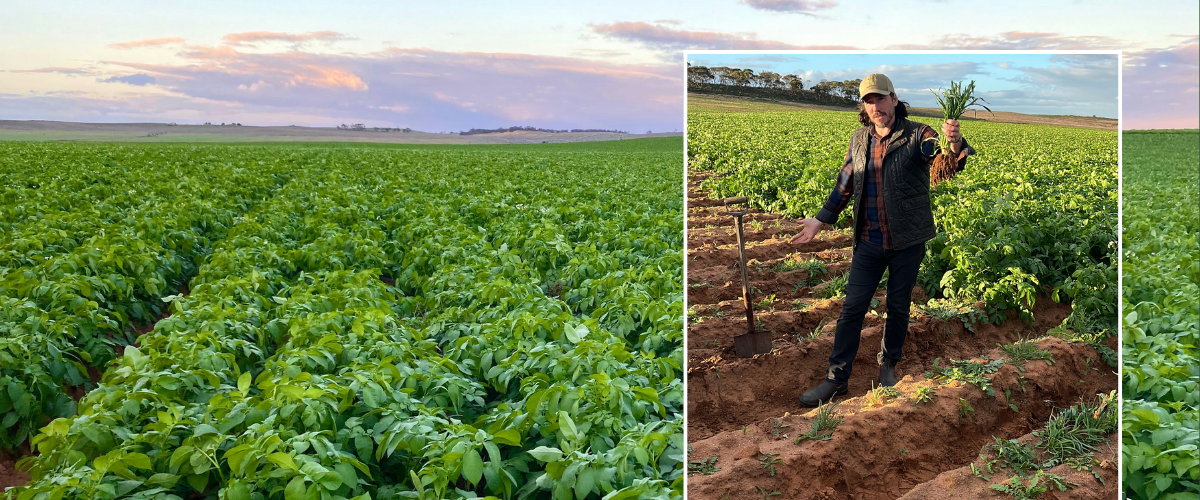
The ‘dreadlock’ appearance of roots often observed in healthy systems reflects this biological activity, where microbial glues and plant exudates bind soil particles together and adhere them to plant root systems.
Importantly, root-derived carbon is significantly more efficient at building stable soil organic matter compared to surface residue alone. While above-ground biomass adds to residue breakdown and nutrient cycling, root inputs directly interact with soil microbes in a protected environment, making them far more likely to contribute to longer-term carbon stabilisation. Greater root mass ultimately increases the amount of carbon delivered below ground, while deeper rooting improves access to water and nutrients across the full soil profile.
Building carbon retention in sandy soils
In low-clay, sandy systems such as those in the Murray Bridge region, one of the major limitations to carbon storage is the lack of stable mineral surfaces for organic matter to bind to. Without these surfaces, carbon inputs are more prone to rapid decomposition and loss.
Joel highlighted the importance of increasing soil reactive surface area through amendments such as clay additions, composts, and biochar. These materials provide sites for organic compounds to attach to, forming organo-mineral complexes that protect carbon from quickly breaking down.
Biochar, in particular, can contribute long-term structural stability due to its porous nature and high surface area, while clay additions can significantly improve cation exchange capacity and nutrient retention in sandy profiles. When combined with active root systems, these amendments help create a more stable framework for carbon storage and nutrient cycling.
Key takeaways from the workshop
The workshop, held across both shed-based discussion and in-field observation, provided a practical and engaging opportunity for knowledge sharing. Participants took away a range of applied insights, including strategies for reducing crop stress through the inclusion of amino acids in spray programs, and the importance of the form of nitrogen in influencing plant energy allocation and efficiency.
There was also strong interest in on-farm strategies to build soil organic matter through increased root biomass, both in density and depth, as well as the potential for compost production systems that reduce input costs while improving biological function.
Overall, the session reinforced a central message: improving soil health is not achieved through a single input or practice, but through aligning plant growth, microbial activity, and soil structure into a connected, functioning system. The strong engagement and discussion throughout the afternoon reflected a growing appetite for these integrated approaches across the region.
We extend a big thank you to the Haby Family for hosting us at their farm, to the contributions of AUSVEG SA and PotatoLink for making the event possible, and to Joel for sharing his time and knowledge with us all.