

Exploring innovation across Europe: Insights from the AUSVEG Europe Study Tour
18 May 2026
Smart nutrient management: smarter yields for a Victorian veg grower
18 May 2026
Reading Time: 4 minutes
Australia’s vegetable industry has long focused on productivity, quality and supply. But an equally critical challenge sits beyond the farm gate: demand.
Despite the essential role vegetables play in health and wellbeing, consumption remains critically low and is declining. Only 4.6 percent of Australian children meet the recommended daily vegetable intake.
If Australians ate just one additional serve of vegetables per day, the impact would be significant – delivering an estimated $4.68 billion in health, economic and social benefits, including $1.38 billion in reduced healthcare costs. For the industry, this represents one of the most powerful opportunities for sustained demand growth.
From supply to demand: A national shift
The Plus One Serve by 2030 program, led by AUSVEG and co-funded through Hort Innovation, is designed to increase vegetable consumption. For growers, this is not just a health initiative, it is a long-term market development strategy.
As Plus One Serve Managing Director, Justine Coates explains:
“Plus One Serve by 2030 is about shifting the dial on vegetable consumption nationally. For growers, that means creating real, sustained demand – not just awareness, but measurable increases in how often vegetables are chosen and eaten.”
The program is investing in evidence based R&D to identify what genuinely shifts behaviour – what gets more vegetables onto plates, more often.
Why schools matter for growers
The school environment is one of the most powerful settings for increasing vegetable intake. The Pick of the Crop Plus One research project (HN25001), delivered by Health and Wellbeing Queensland in partnership with AUSVEG and Hort Innovation, is the flagship school-based R&D initiative within the Plus One Serve by 2030 program.
Building on an initiative that has already reached more than 250 schools and over 54,000 students across Queensland, Pick of the Crop is designed to generate the robust evidence needed to scale effective school-based interventions nationally.
As Dr Robyn Littlewood, CEO of Health and Wellbeing Queensland, explains:
“Schools play a powerful role in shaping lifelong food habits. When we create environments where vegetables are accessible, appealing and part of everyday life, we’re setting children up with habits that last well beyond the school years.”
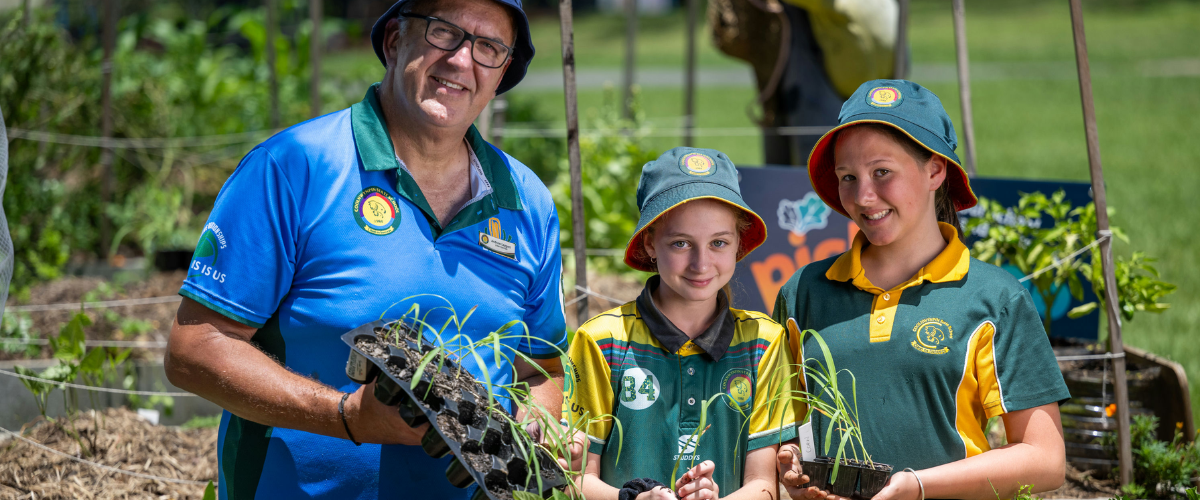
Through a whole-of-school approach, vegetables are embedded into learning, school environments and community engagement – often supported by direct connections with local growers.
Growers at the heart of the consumption story
A key insight from the program is that growers are not just part of the supply chain – they are part of the solution. Evaluation shows that engagement between schools and local growers is a critical driver of success.
As one participating grower noted:
“Programs like this are about connecting young people and families to where food is grown and to our farming industry. When kids understand that, they’re much more open to trying and enjoying vegetables.”
Grower groups like Bundaberg Fruit and Vegetable Growers and Bowen Gumlu Growers Association have partnered with schools to support farm visits, classroom engagement and local supply. This connection is already influencing behaviour. Schools report increased availability of locally produced vegetables in tuckshops, alongside ongoing use of gardens and food-based learning.
For growers, Pick of the Crop creates a new pathway to market – one that starts with exposure and preference, and builds toward long-term demand.
From proven program to national model
As the flagship school R&D program under Plus One Serve, Pick of the Crop represents a step-change for the industry.
While the original program has demonstrated strong outcomes across Queensland, the new Pick of the Crop research partnership is designed to test whether these results can be replicated, strengthened and scaled across a much broader and more diverse population.
A key focus of the project is expansion into new schools and regions, including metropolitan, regional and remote communities. Importantly, this includes deliberate engagement with low socio economic areas and Aboriginal and Torres Strait Islander communities, ensuring that the evidence generated reflects the diversity of the Australian population and can be applied nationally.
This expansion is not simply about reach – it is about generating robust, comparable data across different contexts.
The inclusion of a diverse and representative sample of schools means findings will be directly relevant to different regions, supply chains and communities across Australia.
It means the program is not just building awareness – it is building a repeatable, scalable model for increasing demand.
Insights from Pick of the Crop will inform:
- Rollout across other states and territories
- Integration of local grower partnerships
- Expansion of vegetables in school food environments
- Targeting of future industry investment and co-investment opportunities
Importantly, the project is designed for long-term sustainability. Pick of the Crop Plus One research project focuses on embedding changes into:
- School curriculum
- School food environment
- Community and grower partnerships
This ensures that once behaviours shift, they are more likely to stick – creating lasting demand beyond the life of the program.
As the program expands into new regions, grower engagement will be central to how the model works in every community, connecting schools with local production and building demand from the ground up.
Starting Healthy Habits Young
The long-term value lies in habit formation. When children grow, cook and taste vegetables, they are far more likely to incorporate them into their diets – behaviours that often carry into adulthood. As these habits extend into homes and communities, they begin to influence household purchasing decisions, creating flow-on effects for the entire industry.
Pick of the Crop Plus One research project features a significantly strengthened evaluation framework:
- Comparative evaluation to determine which school-led strategies deliver the greatest increases in vegetable consumption
- Control groups, allowing outcomes to be measured against non-participating schools
- Standardised measurement tools, capturing changes in student knowledge, attitudes and actual vegetable intake
- Implementation tracking, ensuring that what is delivered in each school is clearly documented and linked to outcomes
This level of rigour ensures the program moves beyond anecdotal success to deliver evidence that can inform industry investment, policy and national rollout.
This is not just about what works in one school – it’s about building the evidence to scale vegetable consumption nationally.