


Smart nutrient management: smarter yields for a Victorian veg grower
18 May 2026Protecting our patch: A new vegetable industry biosecurity plan that should matter to you
18 May 2026
Reading Time: 5 minutes
A research project led by Dr Ben Evert in collaboration with plant pathology researcher Dr Noel Knight, microbiologist Dr Neil Wilson and Metagen co-founder Shane Fitzgerald, has delivered a powerful new molecular diagnostic tool to sharpen the fight against onion canopy diseases, particularly Stemphylium leaf blight.
A qPCR test was developed at Metagen’s Gatton laboratory and will be commercially available for the upcoming onion season. The testing method will also be published, making it accessible to growers and researchers worldwide.
A growing threat to onion production
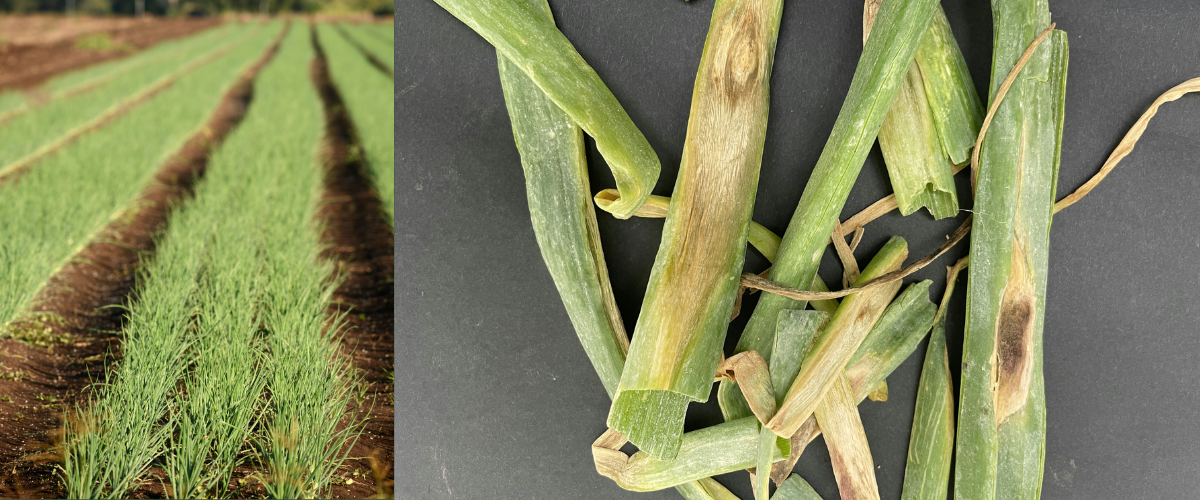
Stemphylium leaf blight of onions (SLB), caused by Stemphylium vesicarium, is a significant canopy disease affecting onions and other allium crops worldwide. It thrives in warm, humid conditions and is especially devastating in subtropical regions. It presents as necrotic leaves and leads to premature leaf senescence, reduced bulb size and significant yield losses.
In 2023 and 2024, growers in Queensland’s Lockyer Valley experienced severe crop losses.
“In the Lockyer Valley, particularly in the last two seasons, growers have been affected very badly,” Dr Evert explained. “Some didn’t harvest and some have said that they’re going to move away from growing onions because it’s too hard to manage.”
Concerns were raised by VegNET South East Queensland, which led to the initiation of the project titled Rapid test and fungicide resistant screening for Stemphylium leaf blight in onion (VN24003). Funded by Hort innovation, supported by AUSVEG and delivered by Queensland-based biotechnology company Metagen, the project set out to answer three critical questions:
- Is SLB the primary cause of crop losses in the Lockyer Valley?
- Is fungicide resistance contributing to control failures?
- Can a reliable diagnostic tool be developed?
“We thought there was a big Stemphylium leaf blight problem in the Lockyer Valley, but we didn’t know for certain until we did wide scale testing. And then other gaps [in knowledge] were not knowing the fungicide resistance status of this disease and also not having any rapid, scalable diagnostic tools.” – Dr Evert
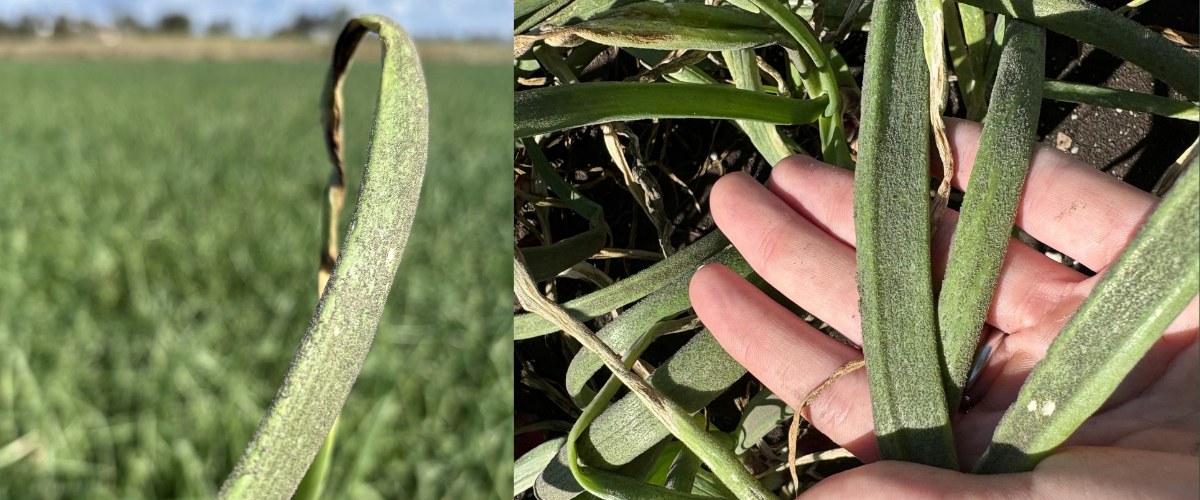
L-R. Downy mildew close up. Field symptoms of downy mildew in a Qualipac crop
Why diagnosis has been so difficult
Diagnosing onion canopy disease can be challenging. Several pathogens, including Downy mildew (Peronospora destructor) and Purple botch (Alternaria porri), can produce similar symptoms to SLB. Multiple infections can occur at once, and SLB can remain asymptomatic until environmental conditions trigger visible disease.
Previously, diagnosis has relied on visual assessment.
“Traditionally, diseases [have been] diagnosed just based on either looking at the symptoms, so what kind of marking shows up on a leaf, or looking for spores, like fungal spores or fungal structures that can be used to identify what the pathogen is,” Dr Evert said.
“The problem with just looking at the symptoms is lots of different pathogens can cause similar symptoms. There’s lots of things that can cause onion leaves to look like they have SLB. So, if you’re diagnosing it based on that, it’s easy to make a mistake. And that’s the same with spores. Lots of fungi can have very similar spores and fungal structures, so it takes a very carefully trained eye to be able to classify an organism based on spores and fungal structures.”
The research team turned to molecular diagnostics for greater precision.
“On the other hand, all organisms have unique DNA markers. Stemphylium vesicarium, which causes this disease in the Lockyer Valley, has DNA unique to all other fungi and all other Stemphylium species. So, what we can do is we can find a piece of Stemphylium vesicarium DNA that only that fungus has and then design a test that will only test for that particular DNA,” Dr Evert explained.
“The good thing about that is you can potentially calibrate the test to detect DNA when the fungus is present but before symptoms show up. This would allow growers to know the disease is there before it starts to cause damage and can help them pre-emptively implement management strategies.”
“Another possible application could be calibrating the DNA test to be used on seed. Since SLB can be a seed borne pathogen, growers might want to have seed tested before planting.”
A new generation of diagnostic tools
The project developed molecular diagnostic tests for SLB, Downy mildew and Purple blotch, which are now commercially available through the Metagen lab.
Field surveys across 17 onion crops in the Lockyer Valley combined disease assessments, lesion sampling and soil chemistry analysis. The results confirmed SLB as the dominant pathogen in the region. Downy mildew was also significant, while Purple blotch appeared only in limited cases.
Importantly, the research showed that SLB can survive over the off seasons on alternative plant hosts, allowing it to persist between onion seasons.
Growers can use the new tests to get a rapid disease diagnosis within 48 hours and check surrounding vegetation for disease. The test could potentially be further developed to allow growers to detect infection before symptoms appear and test seed lots for contamination.
If the test is used regularly each onion season, it will build a long-term data base on pathogen presence and disease prevalence over time.
“If growers are consistently sending in samples for testing every onion season, then we’re generating a new database of how often we’re detecting this disease. And then we can track it over time,” Dr Evert said.
“We can see if the incidence is going up or down, which gives us an idea of if management practices growers are using are helping or not, essentially.”
The molecular test will be commercially available next onion season through Metagen. Protocols will also be published for global use, and newly generated genome sequence and phylogenetic data have been uploaded to public databases for the wider research community.
In a production system where disease pressure is rising and chemical options are under strain, molecular diagnostics offer a proactive way forward.
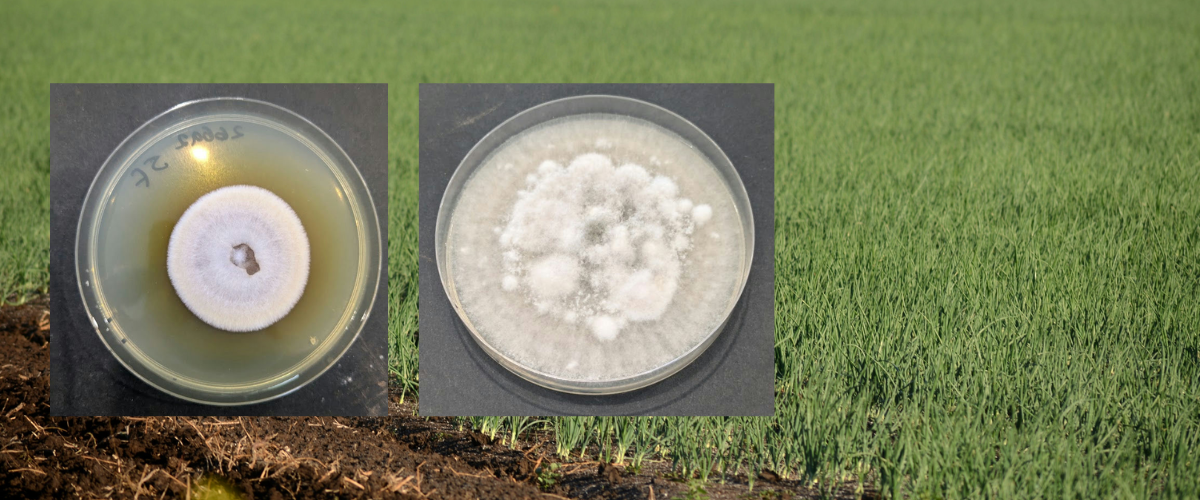
Onions growing in Gatton. Inset. Stemphylium vesicarium samples
Fungicide resistance
A critical piece of the puzzle
Globally, there is no single, fully effective control strategy for SLB, however integrated disease management, including fungicides or resistant varieties play a key role. There have been international reports of fungicide resistance emerging in SLB, however the status in Australia was unknown.
The project examined fungicide resistance in the SLB populations. Genetic analysis revealed evidence that recent strains of Stemphylium vesicarium have evolved resistance to Group 11 and Group 7 fungicides. This was confirmed by in vitro lab assays on azoxystrobin and penthiopyrad which demonstrated recent Stemphylium vesicarium isolates from the Lockyer Valley were significantly less sensitive compared to historical isolates. Surveys to determine how widespread fungicide resistance is in SLB are a crucial next step to determine the risk to disease management.
This finding underscores the need for diversified, integrated management approaches.
Outcomes for Lockyer Valley growers
Because no single solution is sufficient, the research explored broader disease drivers. The Metagen technical staff worked with growers to monitor and optimise soil health, soil chemistry and thrip damage. They identified possible links between disease severity, certain soil chemistry factors and thrip pressure, highlighting the complexity of canopy disease dynamics.
The project worked directly with approximately ten Lockyer Valley growers last season, providing disease diagnostics and detailed soil reports to help inform management systems and improve disease resistance.
“I think they’re pretty happy that there’s a new tool out there for them to use to diagnose diseases… the last couple of seasons have been pretty hard for a few onion growers,” Dr Evert said.
For onion levy payers and the wider industry, the project delivers accurate rapid disease detection, fungicide resistance insights, regional disease surveillance and a foundation for integrated disease management.
Find the Stemphylium leaf blight in onions: A Global Scan here.