


Jan to Dec 2025 Australian Vegetable and Onions Performance Overview
18 May 2026
Exploring innovation across Europe: Insights from the AUSVEG Europe Study Tour
18 May 2026
Reading Time: 3 minutes
VEGNET New South Wales
REGIONAL UPDATE
This initiative set out to establish a long-term soil health trial site that builds on the work from the Soil Wealth and Integrated Crop Protection (ICP) project to demonstrate the long-term benefits of a range of improved soil management practices.
Established in July 2024 at NSW Local Land Services’ (LLS) Demonstration Farm in Richmond Lowlands in the Hawkesbury Valley, the site became a hub for field events and practical learning.
Various improved soil management practices were undertaken and monitored over time, alongside the development of a range of extension resources designed to support grower adoption. Soil testing was conducted every six months throughout the trial to track changes in the soil biology and structure.
First steps
The first in a series of NSW Vegetable Innovation Field Days was held in December 2024 at the NSW LLS Demonstration Farm. It was a hot summer’s day, and it was fantastic to see more than 80 growers and industry come together to share insights and innovations. Umberto Calvo and Sophia Thach from Applied Horticultural Research (AHR), alongside the Soil Wealth ICP project team, led in-field discussions and demonstrations, showcasing the improvements made after only one cover crop cycle.
The second and third soil health field walks were held in June 2025. The Asian Vegetable Innovation Field Day was held exclusively for the Australian Chinese Growers’ Association of NSW. The following day, the Weeds, Bugs and Brassicas Field Day was held for industry and field vegetable growers, primarily from the Greater Sydney region.
The cool mornings and sunny days provided ideal conditions, bringing together more than 107 growers and industry representatives to share insights and innovations over the two days.
We plan to continue maintaining the soil health demonstration site and keep improving the soil in other areas of the Demonstration Farm. A control area using conventional farming techniques will also be retained for ongoing comparison.
Next steps
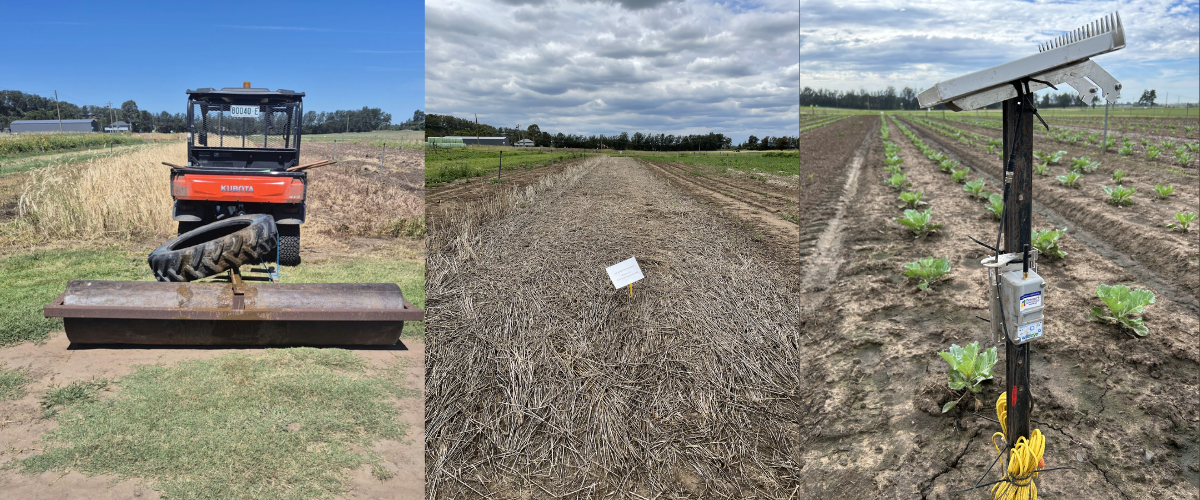
The desiccated rye corn cover crop was left to sit for two months from December 2025. In contrast, the conventionally treated area was left fallow and managed with herbicide to suppress weed growth. Crimping the desiccated rye corn proved effective, with no weeds penetrating through the dried rye corn. However, in the other section where the desiccated rye corn was mowed and mulched, some weed growth occurred. The use of the cover crop provided clear benefits, including increased soil carbon and organic matter, which encourage soil fauna.
The ground was then prepared for an autumn planting of cabbages. These crops will be assessed for plant health, vigour and yield (by weight) to determine if there are any differences between the two treatments. The final soil tests will be taken in April, with the results shared at a final farm walk in May.
Sizing up soil moisture monitoring tools
As part of VegNET and LLS’ National Heritage Trust Climate Smart ‘WaterWise’ project, we are demonstrating a range of soil moisture monitoring tools. These include the Chameleon soil water sensor and the GDot soil moisture sensor, which measure soil moisture tension.
We have also installed Wildeye and Sentek soil moisture probes, which measure volumetric soil water content. The aim is to support growers in improving their irrigation efficiency and gaining a better understanding of soil-water relations. These tools enable better decision making, enhanced water use efficiency and ultimately an increase in crop production.
National Ag Day celebrations and demonstrations
On Friday 21 November 2025 a National Ag Day Field Experience was held at the demonstration site. An unseasonal cool and showery day didn’t keep the attendees away as 60 people experienced the day at LLS Demonstration Farm including vegetable growers, high school agricultural students, teachers, the ‘Young Horties’ network, local industry representatives and researchers.
Umberto Calvo from AHR discussed the findings of the Soil Wealth ICP demonstration which showed the differences between low till and conventional cultivation. Rye corn cover crops were planted prior to the field day, with one of the experimental areas of the cover crop mowed, while the other was sprayed with a knockdown herbicide and crimped.
Results showed that the low till area had good porosity, crumbly structure, good root penetration and soil fauna present compared to the conventionally treated area, which had no soil structure, no stability and showed signs of compaction. Umberto has published a video showcasing the results of the demonstration 18 months into the commencement of this site.