


From model to field: How VegWatch surveillance works on the ground
31 August 2026
Biosecurity Incident: What if it happened to you?
31 August 2026
Reading Time: 6 minutes
WHAT IS AMR?
Antimicrobial resistance (AMR) occurs when bacteria, fungi, or other microorganisms stop responding to the treatments designed to control them, such as pesticides, fungicides, or sanitisers. This means those treatments no longer work effectively. Think of AMR as ‘bad bugs’ becoming too smart for the tools we usually rely on.
One example in vegetable production is fungicide resistance, such as cucurbit downy mildew developing resistance to Group 4 fungicides like metalaxyl. Resistant fungi can spread via seeds, manure, compost, irrigation water, harvest and post-harvest handling, or even via wind and dust. As a result, it can become harder to protect crops, increasing the risk of lower yields and potentially triggering new production rules or trade restrictions.
An additional aspect of AMR relevant to vegetable production involves microorganisms that can cause human infections. If these pathogens are detected on produce after harvest, costly recalls may follow. If these microorganisms develop resistance to the antibiotics and antifungals typically used to treat them, more expensive treatments are required, increasing healthcare costs on top of the financial burden of product recalls. Understanding the points in vegetable production systems where the development of AMR is most likely will allow systems and programs to be designed which will bolster sustainable production, enhance productivity, and protect local and export markets.
AMR is now recognised globally, including in Australia, as a food security and public health concern. In agriculture, it reduces the effectiveness of disease and microorganism control, affects productivity, and can significantly disrupt trade.
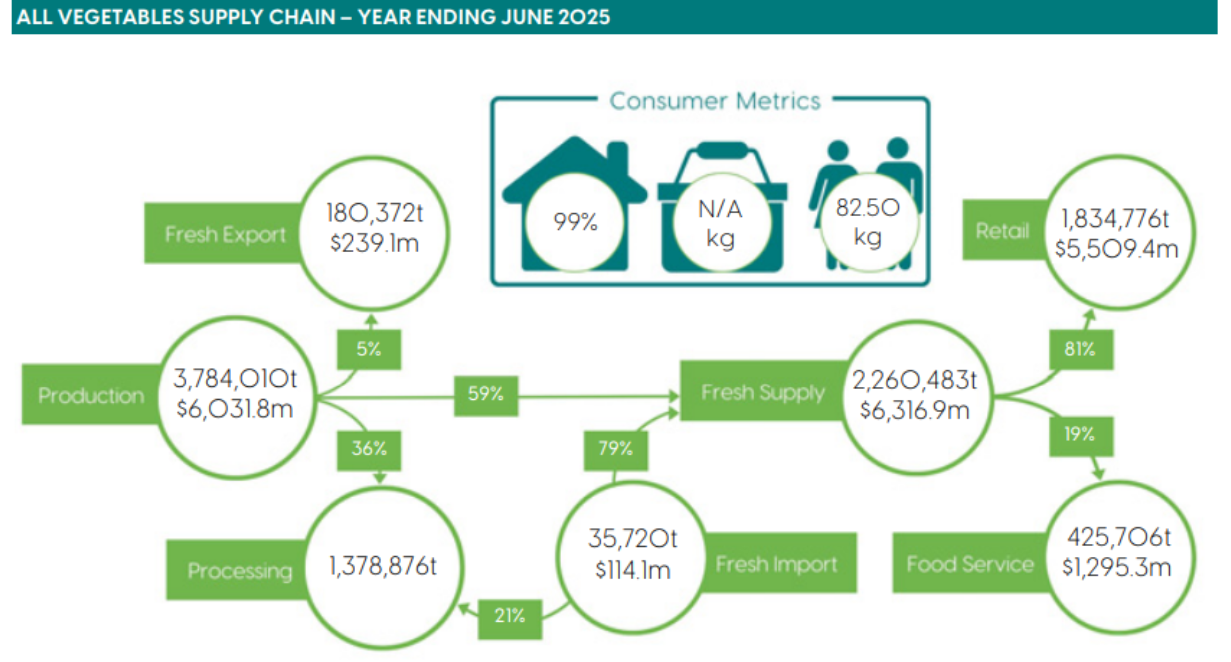
Source: 2024/25 Australian Horticulture Statistics Handbook
Unlocking the economic potential of addressing AMR
Australia’s vegetable industry is a $6 billion powerhouse, producing 3.8 million tonnes of vegetables in 2024–25. By strengthening approaches to AMR, the industry can enhance productivity, secure domestic supply, and expand export opportunities.
Gaining an understanding of where AMR can develop in the production cycle will help growers reduce the financial, agronomic, and reputational risks associated with AMR and build flexibility and reliability across the sector. The economic impacts of AMR can be felt at multiple levels: individual growers, local regions, the national economy, and international markets. At the grower level, AMR reduces the effectiveness of chemicals, such as fungicides and bactericides, leading to lower crop yields. Over time, growers can be forced to adopt newer, more costly treatments to manage resistant diseases. These increased input costs can be passed on to consumers, potentially driving them toward cheaper alternatives and reducing demand for premium Australian produce. Moreover, if these new chemical treatments are not approved or recognised in export markets, due to the absence of established maximum residue limits (MRLs), market access may be limited or lost.
Several fungal diseases affecting Australian vegetable crops are considered to be at a medium to high risk of developing AMR. These include:
- Grey moulds (Botrytis cinerea), which infect more than 200 plant species
- Cucurbit downy mildew (Pseudoperonospora cubensis)
- Powdery mildew (affecting cucurbits and carrots) (various fungi in the order Erysiphales, such as Podosphaera xanthii on cucurbits and Erysiphe heraclei on carrots)
- White rust (Albugo candida) on brassicas
- Ascochyta blight and purple spot (Didymella and Phoma spp.) on peas
- Downy mildew (Bremia lactucae) on lettuce
In 2024–25, the production of these crops was valued at approximately $2.2 billion, contributing an important 36 percent of the total value of Australia’s fresh vegetable production for that year.
The emergence of resistance in any of these diseases could result in significant economic losses, both for individual growers and the broader vegetable industry. It is therefore important to understand the risks associated with the development of AMR in the industry and potential points of introduction of AMR in the production cycle.
Strengthening market confidence through quality assurance
By identifying and proactively addressing AMR risks, Australia’s vegetable industry can reduce vulnerabilities and reinforce consumer trust. Strong assurance systems not only protect this $6 billion sector but also open pathways for premium branding, export growth, and long-term competitiveness. Detection of microorganisms affecting humans on vegetable products can lead to product recalls which in Australia average around $10 million each. This figure does not reflect the full economic impact of product recalls because it excludes numerous indirect costs, such as:
- Production costs of the recalled product
- Cost of replacement product
- Lost profits
- Downtime in production
- Quarantine testing (for the recalled crop and nearby crops)
- Logistics and disposal costs
- Cleaning of equipment and facilities
- Re-accreditation fees
- Staff retraining
- Management and staff time diverted
- Legal and public relations expenses
- Regulatory costs
- Potential compensation claims
These indirect costs often exceed the direct financial losses, particularly for growers and exporters, and can severely affect business continuity and market access. These substantial costs, as well as potentially significant additional healthcare costs, make it all the more important to understand and proactively address the risks of AMR in vegetable production systems.
Strong assurance systems not only protect this $6 billion sector but also open pathways for premium branding, export growth, and long-term competitiveness.
Building long-term market advantage
Taking the initiative in addressing AMR strengthens Australia’s reputation as a trusted supplier of safe, high-quality produce. By exceeding international standards on food safety and residue management, the industry can expand access to premium markets, maintain consumer confidence, and reinforce Australia’s standing as a world leader in sustainable food production. If AMR is detected in exported produce, it could result substantial long-term trade disruptions. AMR also carries environmental and social costs. As resistance develops, growers may need to adopt new chemical treatments, which can disrupt agricultural ecosystems, harm non-target organisms, and reduce biodiversity. Socially, food recalls due to AMR can lead to widespread food waste, especially if consumers avoid entire categories of produce. Moreover, when pathogens that can affect humans become resistant to antimicrobial agents, treatment options become more limited and costly. Hence, effectively managing AMR is critical not only for protecting industry viability but also for maintaining public health, environmental sustainability, and global market access.
A closer look at potential costs
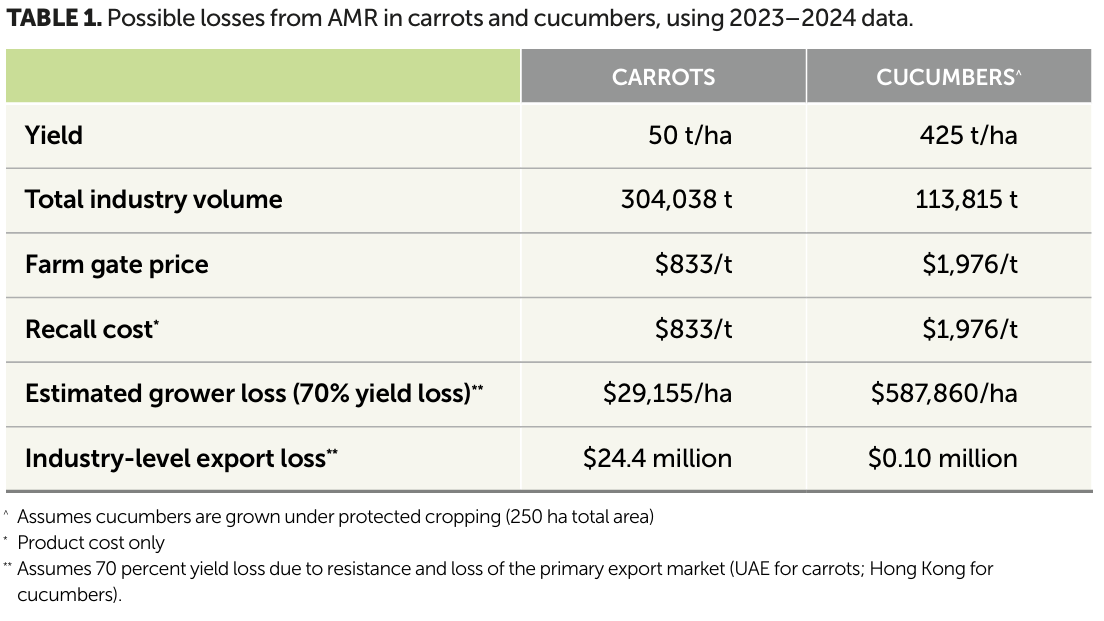
In order to build systems to protect and expand Australia’s $6 billion vegetable production industry it is important to understand what the development of AMR might cost. To estimate some of the possible costs of AMR to the Australian vegetable industry we can look at the potential impact on carrot production and the cucumber industry. Table 1, using industry production and farm level prices from the 2024–2025 Horticulture Statistics Handbook, and estimated average yields, shows that the financial impact at the grower level and at the export market level due to AMR could be substantial. We have already noted that the direct cost of a product recall could be in the order of $10 million. Assuming an outbreak of a resistant plant disease could result in a yield loss of around 70 percent, we can see that this could cost a carrot grower around $29,155/ha. Similarly for cucumbers grown under protected cropping conditions the cost of AMR to a grower could be in the order of $587,860/ha. Assuming that fungicide resistance results in the loss of the biggest export market for that commodity for a year then the cost to the carrot industry could be in the order of $24.4 million and for cucumbers, around $0.10 million (carrot exports for 2024–25 totalled 86,414t and cucumbers totalled 69t). These figures show that AMR outbreaks could be devastating, not only for individual growers, but also for the broader industry.
Tackling antimicrobial resistance in the Australian vegetable industry
AMR is a significant concern to the Australian vegetable industry. Understanding the threat will allow the design of systems and programs to reduce the risk. Resistance to key crop protection chemicals, including fungicides and bactericides, can undermine disease control, reduce yields, and increase production costs. Over time, it may also damage the reputation of growers, brands, and the broader industry, particularly in sensitive export markets.
The development of resistance is influenced by several factors: the chemical structure of the products used, the biology and mutation rate of the target pathogens, and agronomic, pre-harvest, and post-harvest practices on-farm. To effectively respond to this challenge, we must first understand where resistance is already occurring and how it is emerging within different production systems. A new collaborative project, jointly funded by Hort Innovation and the Cooperative Research Centre for Solving Antimicrobial Resistance in Agribusiness, Food and Environments (CRC SAAFE), is now underway. In partnership with AUSVEG, the NSW Department of Primary Industries and Regional Development (DPIRD), the University of South Australia/Adelaide University, the University of Queensland, and Curtin University, the project aims to map AMR risks across the vegetable supply chain. It will identify critical control points where targeted interventions can be most effective in underpinning grower incomes and reputations. These may include chemical stewardship programs, enhanced hygiene protocols, and more effective product rotations to prolong the efficacy of current treatments. The ultimate goal is to help growers address the financial, agronomic, and reputational risks associated with AMR, while building resilience and sustainability across the sector. Over the next year, the project team will consult with growers, agronomists, packers, and processors to gather insights and co-design practical, science-based recommendations.
Your input is essential. By working together, we can protect crop productivity, preserve market access, and secure the future of Australian vegetable production.
Mark Drew1,3
Barbara Drigo2,3
1 Gandhara Consultancy Pty Ltd (ACN 618 761 256), New Lambton, NSW, Australia.
2 Adelaide University, College of Science, School of Agriculture, Food and Wine, Adelaide, Australia.
3 Cooperative Research Centre for Solving Antimicrobial resistance in Agribusiness, Food, and Environments (CRC SAAFE), Adelaide, SA, Australia.